Wearable Data for Weight Loss: What to Track and Trust
Wearable Data for Weight Loss: What to Track and Trust

Wearable data helps with weight loss when you read it as a trend and pair it with real support. Steps, heart rate, sleep and activity minutes show you how your days actually go. They work best alongside food habits, clinician guidance and a routine you can keep. The numbers themselves are not a plan. Below, we explain which metrics matter, how accurate they are, and how to use them without getting overwhelmed.
Glpcareglpcare.orgTurn wearable data into useful guidanceGLPCare connects wearable metrics with dose logs, personalized nutrition coaching, and clinician support to help make your weight management data actionable.Explore GLPCareTL;DR
- Wearables can track steps, heart rate, sleep, activity minutes and estimated energy use. Together they give you a clearer picture of your habits.
- Research on health wearables shows reductions in body weight and BMI, and programs of at least 12 weeks did better.
- Accuracy varies by metric. Treat calories and sleep stages as estimates, and look at weekly averages instead of single days.
- Bring patterns, not single readings, to your clinician, especially if the data worries you.
- At GLPCare, we connect band data, dose logs and nutrition coaching, so the numbers lead to advice you can act on.
Table of Contents
- What wearable data can tell you about your weight
- What the research says about wearables and weight loss
- How accurate is the data?
- Read trends, not single days
- Make the habit stick
- When to talk to a clinician about your data
- How GLPCare puts your data to work
- A four-week plan to start using your data
- FAQ
- Sources
What wearable data can tell you about your weight
A wearable gives you a daily record of behavior that is hard to remember accurately. According to a 2022 academic review on self-monitoring technology, wearables can track steps, heart rate, sleep, activity minutes and energy expenditure. Changes in these measures can help you monitor activity and set future goals.
Here is how each metric helps in practice:
| Metric | What it shows | How to use it |
|---|---|---|
| Steps | Daily movement outside workouts | Build a baseline, then raise it gradually |
| Activity minutes | Time spent in moderate or vigorous effort | Track progress toward a weekly total |
| Heart rate | Effort during activity and resting trends | Watch the resting trend over weeks |
| Sleep | Duration and consistency | Look for a regular pattern across several nights |
| Estimated calories burned | Rough energy expenditure | Use as a trend, never as a precise budget |
None of these numbers is a verdict on you. Each one is a clue. A week of low sleep followed by a week of fewer steps and more snacking tells a story you could not see in a single day.
What the research says about wearables and weight loss
The evidence is encouraging and also mixed, which is useful to know. A 2021 network meta-analysis in the British Journal of Sports Medicine found that commercial health wearable interventions reduced body weight and BMI in adults with overweight or obesity and chronic comorbidities. Interventions lasting 12 weeks or longer were more effective for weight reduction.
A separate 2016 trial reported by Science News found that adding activity monitors did not produce greater weight loss than a standard behavioral program for some participants. The researchers suggested that people may lean too heavily on a device’s focus on movement and let other parts of weight loss slip.
That second finding is a design lesson. A tracker that only counts steps invites you to think of weight loss as a movement problem. Weight management also involves food, sleep, recovery, medication timing and consistency. The takeaway is that data works best when it sits inside a whole program.
Three practical conclusions follow:
- Give it time. Plan for at least 12 weeks before judging whether your tracking routine is helping.
- Track more than movement. Include sleep, food habits and, if you take one, your medication schedule.
- Have someone interpret it. A coach or clinician can tell you which trends matter and which are noise.
How accurate is the data?
Accuracy is the question most people skip, and it changes how you use the numbers. A 2024 review in The Conversation summarized the error ranges across metrics:
- Heart rate: error of about ±3%.
- Steps: generally underestimated by about 9%.
- Calories burned: errors from −21.27% to 14.76%, depending on the device and activity.
- Sleep time and efficiency: often overestimated by more than 10%.
The pattern is clear. Heart rate is the most dependable. Calorie and sleep estimates are the least exact. If you want to understand how heart rate error works, our guide to wearable heart rate accuracy explains what a ±3% mean bias means in daily life. For sleep, see why one night is never enough to trust and why looking at three nights or more gives a steadier read.
There is one more point worth knowing. A 2026 review in Obesities notes that standard activity algorithms are often trained on normal-weight groups. They may not fully reflect the gait and biomechanics of people with obesity, and proprietary algorithms may not be validated for this population. In plain terms, your absolute step count or calorie number might be off. Your own trend over time is still meaningful, because the same device makes the same kind of error each day.
Read trends, not single days
The fix for imperfect data is to change what you look at. One company guide on wearables and nutrition, published in 2026, suggests using calorie data as a trend indicator instead of an absolute number. It also notes that week-over-week averages are more reliable than any single day, and that you should adjust based on real outcomes such as weight trends, energy levels and performance.
Here is a simple weekly review you can do in about ten minutes:
- Pick three numbers. Average daily steps, average sleep across the week, and resting heart rate.
- Compare to last week. Look at the direction, not the exact figure.
- Add one real-world check. How is your energy? How do your clothes fit? What does your weekly weight average say?
- Change one thing. Add 500 steps a day, move bedtime earlier by 15 minutes, or plan one more balanced meal.
- Repeat for four weeks before deciding whether the change worked.
Small changes are easier to keep, and a routine matters more than perfect data. If you want a structured way to make a goal stick, this piece on turning a goal into a habit walks through research-backed steps that pair well with a weekly review.
Set movement targets that fit you
Activity targets should be personal and progressive. The Mayo Clinic notes that general aerobic guidance is 150 minutes of moderate activity a week, while people aiming to lose weight may need up to 300 minutes, and a wearable can help you monitor progress toward that. If you are starting from a low baseline, build up gradually. Our guide to personalized step targets for fat loss shows how to work toward 10,000 steps with brisk sessions instead of jumping there overnight.

Watch recovery as well as effort
Weight loss puts demands on your body, and recovery data shows how you are coping. Heart rate variability, or HRV, is one of those signals. We cover what it can mean for people who are losing weight in our article on HRV and weight loss. As with every metric here, the week-long pattern tells you more than any single morning.
Make the habit stick
The best data is the data you actually collect. A U.S. News report says about 30% of people eventually stop wearing their trackers, because of boredom, damage or not seeing the point. That is a routine problem, and routines can be built.
- Pair charging with something you already do, such as brushing your teeth or showering.
- Wear it at night if you want sleep data. Without it you will only see half of the picture.
- Pick a fixed review time, such as Sunday evening, so the data becomes a habit instead of a chore.
- Reduce the number of metrics you watch. Three is plenty.
A screen can also work against you. Constant glances at numbers can turn into checking for its own sake. That is one reason we think about the screenless approach, and you can read what it gives and what it asks of you in our look at screenless band benefits.
When to talk to a clinician about your data
Wearable data can create worry as easily as it creates insight. According to NPR’s 2026 reporting, you should discuss your data with a healthcare professional if it causes you anxiety, or if you notice patterns or alerts you do not understand. A clinician can read the numbers in the context of your symptoms and your life. The same reporting, citing American Academy of Neurology guidance, advises you to report patterns, not single data points. Dr. Sarah Benish, quoted by NPR, says people who feel overwhelmed should take in less data and talk it through with a provider.
Here is what that looks like at an appointment:
- Bring a four-week summary instead of a screenshot of one bad night.
- Name the specific pattern: “my resting heart rate has crept up over three weeks,” or “I sleep under six hours most weeknights.”
- Mention any new symptoms, medications or dose changes alongside the numbers.
- Ask what you should keep tracking and what you can ignore.
Good visits depend on good preparation. For ideas on how clinics keep people engaged between appointments, this evidence-based look at patient engagement is a helpful companion to your own routine.
If you take GLP-1 medication, tell your prescriber about any dramatic change in your heart rate, sleep or energy, rather than adjusting your dose on your own.
Our perspective on wearable data
We built GLPCare on a simple idea: a number only helps when someone helps you understand it. Most trackers hand you a dashboard and leave the interpretation to you. That is a lot to ask of a person who is also managing a medication, changing how they eat and fitting it all around a busy job.
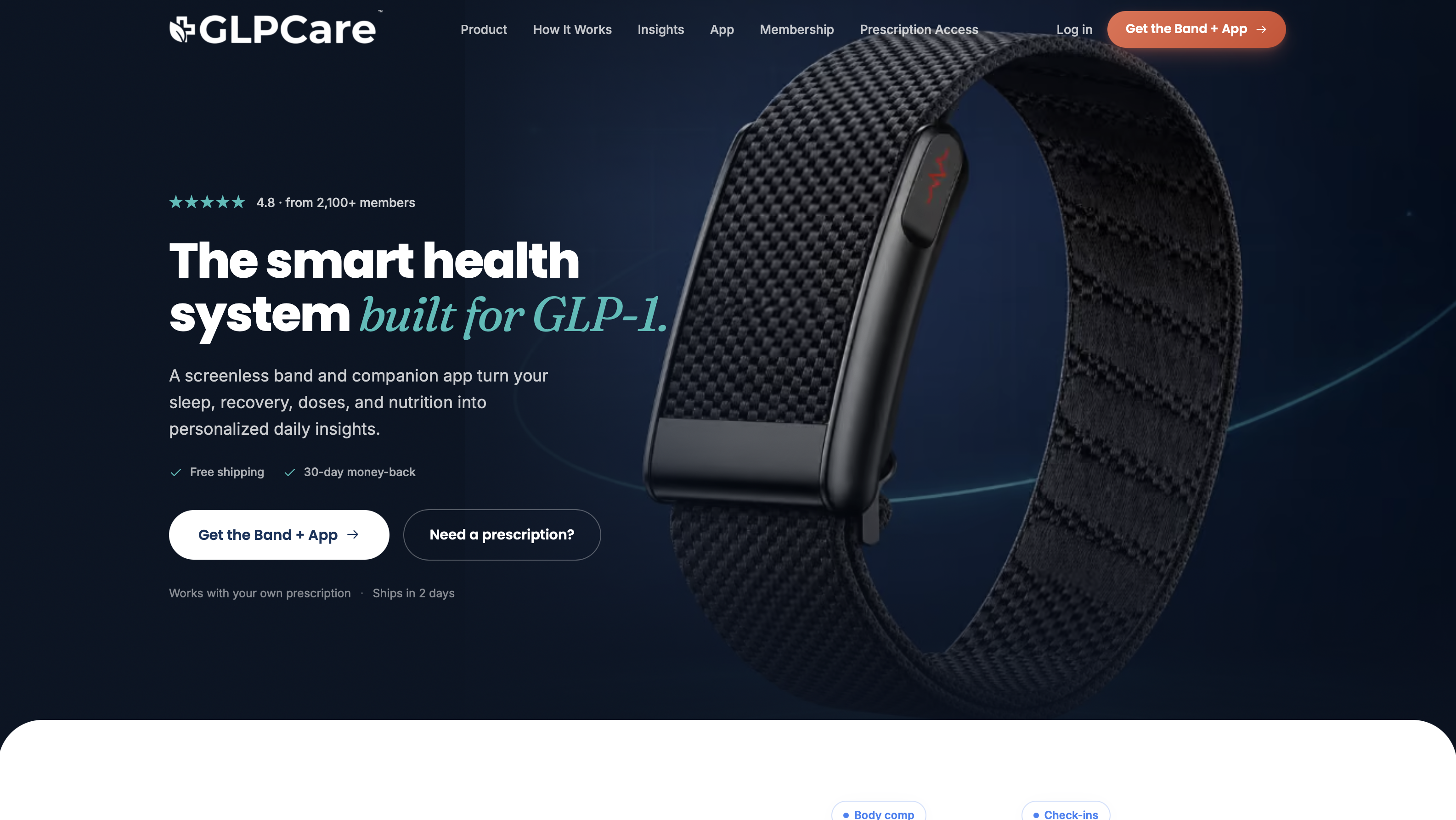
So our system connects the pieces. Our screenless band is designed to track sleep, heart rate and activity, and you log your food habits and doses in the app. Your clinician team can then see a fuller picture than a single visit could ever show. Our AI companion turns the trends into practical suggestions, and our nutrition coaching is designed to help you protect muscle while you lose weight.
We also believe in clinician oversight of GLP-1 medication. Data is most powerful when a licensed professional sits behind it. That is why every part of our program, from the band to the coaching, is built to feed one connected plan, instead of leaving you with five separate apps.
The goal is not more numbers. It is a clearer picture, a calmer routine and steady progress that you can keep.
Dominique
How GLPCare puts your data to work
We designed GLPCare as one connected system: prescription GLP-1 medication shipped to your home, personalized nutrition coaching, a wearable band with medical-grade sensors, an AI-driven app for dose tracking and custom insights, and ongoing clinician support. Plans are available whether or not you already have a GLP-1 prescription.
Here is what is published on our site today:
- GLPCare Membership: $199 per year, for the band and app experience.
- Semaglutide Care: from $209 per month, with compounded semaglutide prescribed online.
- Tirzepatide Care: from $299 per month, with compounded tirzepatide prescribed online.
Want to see the band before it ships? Join the launch list and we will keep you posted. You can also see how the app works in our overview of the GLPCare AI tracking app, or read our guide to GLP-1 wearable technology and our overview of telehealth weight loss programs. To start with the membership, visit GLPCare.
A four-week plan to start using your data
If you already wear a tracker, or plan to, this plan keeps things manageable.
Week 1: Baseline. Wear the device all day and night. Change nothing else. Note your average steps, sleep and resting heart rate at the end of the week.
Week 2: One change. Choose one behavior to shift, such as a 15-minute walk after dinner. Keep everything else the same so you can see the effect.
Week 3: Add recovery. Look at your sleep pattern over the full week. If it is irregular, fix your bedtime window before adding more exercise.
Week 4: Review and share. Compare weeks 1 and 4. Write down two patterns you noticed. If you are working with a clinician or coach, share those patterns and ask what to adjust.
Then repeat. Because interventions lasting at least 12 weeks were more effective in the research above, think of this as the first month of a longer effort, not a finish line.
FAQ
Can a wearable help me lose weight on its own?
Research shows health wearables can reduce body weight and BMI, especially in programs lasting 12 weeks or longer. Results are mixed when a tracker is used without other support, so pairing it with nutrition guidance and clinician input gives you the best footing. The device shows you what is happening, and your habits create the change.
Which wearable metric is most reliable?
Heart rate is the most dependable, with an error of about ±3% in the review cited above. Steps tend to be underestimated by about 9%, while calorie and sleep estimates carry wider margins. Use any metric as a trend over weeks, not as an exact daily figure.
How long should I track before I see a pattern?
Aim for at least four weeks to see your own patterns clearly, and twelve weeks or more to judge the effect on your weight. Week-over-week averages are more reliable than any single day, so avoid reacting to one unusual reading.
Should I show my wearable data to my doctor?
Yes, particularly if it makes you anxious or shows a pattern you do not understand. Bring a summary of several weeks, name the specific pattern, and mention any symptoms or medication changes. Clinicians can interpret the data in the context of your health.
Does the GLPCare band have a screen?
No. Our band is screenless by design, and it sends your data to the app, so you see insights there instead of checking numbers all day. Our article on screenless band benefits explains the trade-offs in more detail.
Sources
- Using self-monitoring technology for nutritional counseling (PMC, 2022)
- Health wearable devices for weight and BMI reduction (PMC, 2021)
- Activity trackers fall short in weight-loss trial (Science News, 2016)
- How accurate are wearable fitness trackers? (The Conversation, 2024)
- Applying AI Tools for Monitoring Nutrition and Physical Activity (Obesities, 2026)
- Wearables and Nutrition: How Fitness Trackers Improve Diet (2026)
- 10 Tips to Make the Most of Your Fitness Tracker (U.S. News)
- Mayo Clinic Q and A: Walking and weight loss (2015)
- Your doctor can help make sense of data from wearables (NPR, 2026)
- Habits vs Goals: Turn a Goal Into a Habit
- Patient Engagement Strategies: An Evidence-Based Playbook