5 to 10% Weight Loss Raises HRV: Monitoring for People Losing Weight
5 to 10% Weight Loss Raises HRV: Monitoring for People Losing Weight
Modest, sustained weight loss usually raises heart rate variability, while a caloric deficit that’s too aggressive tends to lower it, at least temporarily. That distinction is the whole game. If you’re using GLP-1 therapy, calorie tracking, or a training plan to lose fat, HRV gives you a real-time readout of whether your deficit is sustainable or quietly costing you recovery and muscle.
TL;DR:
- Losing 5 to 10 percent of body weight generally improves HRV, with gains extending into frequency-domain metrics beyond that threshold.
- Small sample sizes and measurement inconsistencies explain why research findings on HRV and weight loss appear variable, but the overall trend remains positive.
- Excess visceral fat promotes inflammation and insulin resistance, which suppress HRV, but reducing fat can restore autonomic balance and improve sleep quality.
- Weekly averages, rather than daily scores, provide a more reliable measure of HRV trends, with a 10 to 15 percent sustained drop signaling the need to adjust your plan.
- Combining moderate aerobic exercise with resistance training in a calorie deficit typically supports both fat loss and HRV improvements, especially when complemented by adequate sleep and hydration.
Glpcareglpcare.orgTrack Weight Management More CompletelyGLPCare combines GLP-1 therapy, nutrition coaching, wearable health insights, and continuous clinician support for personalized weight management.Explore GLPCare
Table of Contents
- What Does the Research Say About HRV and Weight Loss?
- Why Does Carrying Excess Fat Lower HRV in the First Place?
- When Should You Expect HRV to Change During Weight Loss?
- How Do You Monitor HRV Without Overreacting to Daily Swings?
- What Training and Eating Habits Support Both Fat Loss and HRV?
- How Do Wearables and Clinician Support Make HRV Monitoring Practical?
- What Actually Matters When You’re Watching Your Own HRV Data
- Where This Evidence Comes From
- Sources
- FAQ
What Does the Research Say About HRV and Weight Loss?
The strongest evidence comes from a systematic review showing that losing 5 to 10 percent of body weight produces measurable gains in time-domain HRV measures like SDNN and RMSSD. Lose more than 10 percent, and the benefits extend into frequency-domain metrics, including higher HF power and a lower LF/HF ratio, both markers of better balance between your sympathetic and parasympathetic nervous systems.
Randomized controlled trials back this up. A 10-week medical weight-loss program combining caloric restriction with aerobic exercise produced significant improvements in SDNN, RMSSD, and HFln, and the same trial found insulin levels predicted part of the HRV improvement, suggesting metabolic recovery drives some of the autonomic gain. A separate 12-week whole-body vibration training study found that reducing trunk fat specifically correlated with RMSSD increases and LF/HF decreases in obese participants.
Not every study agrees on magnitude. Sample sizes tend to run small, and researchers measure HRV under different conditions:
- Some use morning resting readings, others use overnight recordings during sleep.
- Protocols vary in how long participants rest before measurement.
- Body composition changes (fat versus muscle loss) aren’t always tracked alongside HRV.
Those inconsistencies explain why headlines about HRV can feel contradictory even when the underlying trend, that meaningful fat loss helps autonomic health, holds up across trials.
Why Does Carrying Excess Fat Lower HRV in the First Place?
Visceral fat isn’t passive tissue. It behaves almost like an endocrine organ, releasing inflammatory signals that keep your sympathetic nervous system in a low-grade state of alert. That chronic activation is a documented driver of reduced HRV in people with excess visceral adiposity, and it tends to reverse as visceral fat shrinks.
Three mechanisms explain most of the connection:
- Inflammation: Visceral fat produces cytokines that interfere with the vagus nerve’s ability to slow your heart rate between beats.
- Insulin resistance: Elevated insulin blunts parasympathetic tone, which is the “rest and digest” side of your nervous system that HRV largely reflects.
- Sleep quality: Excess weight raises the risk of sleep apnea, which fragments deep sleep and suppresses overnight HRV recovery.
As fat loss progresses, resting heart rate typically drops and sleep often improves, both of which feed back into higher HRV. If sleep apnea is part of the picture, weight loss can meaningfully ease that burden, which is worth reading about separately if snoring or nighttime waking has been part of your story.
When Should You Expect HRV to Change During Weight Loss?
HRV doesn’t move on a single timeline. Early wins show up fast; the deeper autonomic recovery takes longer to build.
| Timeframe | What typically changes | Why it matters |
|---|---|---|
| 2 to 4 weeks | Resting heart rate declines; RMSSD starts shifting | Early sign your body is adapting to a healthier load |
| At 5 to 10% weight loss | SDNN and RMSSD show measurable improvement | This is the threshold documented across weight-loss trials |
| 3 to 6 months | HF power rises, LF/HF ratio falls | Reflects deeper, sustained autonomic rebalancing |
A single morning’s HRV reading can bounce around because of sleep quality, alcohol, or stress the night before. That’s why weekly rolling averages, not daily numbers, are what actually track progress. Comparing this week’s average to last week’s smooths out the noise and reveals whether your trend line is truly moving up or down. If you want to translate a target weight-loss percentage into a concrete number, GLPCare’s weight loss percentage calculator does the math for you.
How Do You Monitor HRV Without Overreacting to Daily Swings?
Turning HRV into a usable tool means treating it as a feedback loop, not a daily report card. Here’s a monitoring protocol that works for most people running a structured deficit:
- Set a baseline. Measure HRV daily for one to two weeks while eating at maintenance, using the same time of day, posture, and device each time.
- Track weekly averages, not daily scores. A rough night or a stressful Tuesday will swing your number without meaning anything long-term.
- Watch for sustained trends. A stable reading or a slight dip is normal during a deficit. A sustained drop of roughly 10 to 15 percent from baseline, held across multiple weeks, is the threshold practitioners treat as a warning sign that the plan is too aggressive.
- Adjust before HRV crashes further. Ease the calorie deficit, add carbohydrate or protein back into your meals, dial down training intensity, or schedule a deliberate diet break.
- Protect sleep and hydration first. Both move HRV faster than almost any other lever you control.
Confounders muddy single readings constantly: caffeine, alcohol, travel, minor illness, and inconsistent measurement timing can all shift your number independent of fat loss. Rolling averages, tracked over weeks rather than single days, filter most of that out.
Pro Tip: Measure HRV at the same time each morning, before coffee and before checking your phone. Even a five-minute delay or a jolt of caffeine can shift your reading enough to look like a false trend.
What Training and Eating Habits Support Both Fat Loss and HRV?
The combination that shows up again and again in the research is moderate aerobic work paired with resistance training, run alongside a deficit that isn’t punishing. Zone 2 cardio targets visceral fat specifically, and lifting preserves the muscle mass a pure calorie-cutting approach tends to sacrifice. If you’re unsure what heart-rate zone actually corresponds to fat-loss training, clinician-guided heart rate zones explain how to set that up correctly.
A deficit in the range of 300 to 500 calories a day, combined with adequate protein intake, tends to produce steadier HRV trends than a steep cut. For a step-by-step approach, a structured calorie deficit plan lays out realistic numbers for losing roughly two pounds a week without wrecking recovery.
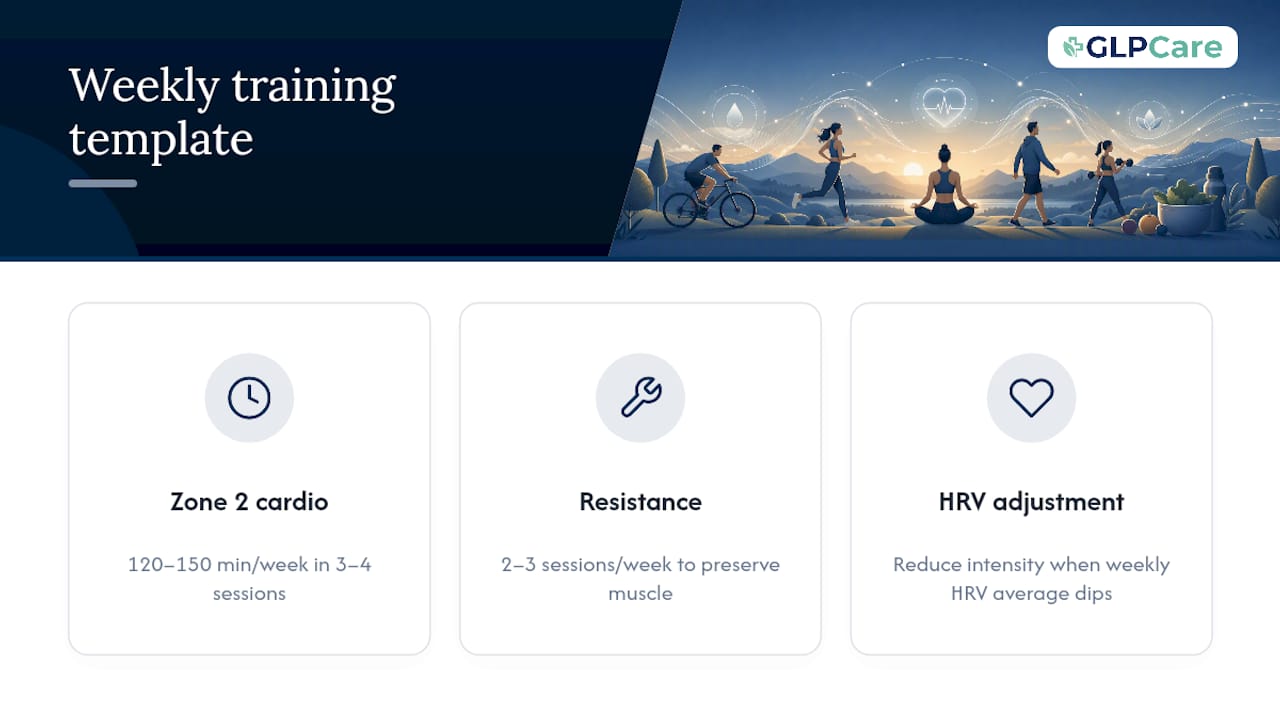
There’s also evidence that HRV can guide training intensity itself. One trial found that an HRV-guided training group completed fewer high-intensity days yet matched the fitness and body-composition results of a fixed, predetermined plan. A practical weekly template looks like 120 to 150 minutes of Zone 2 cardio split across three or four sessions, plus two to three resistance sessions, adjusted down on weeks where your HRV average dips.
How Do Wearables and Clinician Support Make HRV Monitoring Practical?
HRV readings mean more in context. Continuous tracking of sleep, resting heart rate, activity, and your own logs of diet and medication timing turns a single number into a pattern you can actually act on. That’s the gap a screenless wearable and connected app are built to close, pairing biometric data with the notes you enter yourself so trends are easier to interpret than a single morning reading in isolation.
If GLP-1 therapy is part of your plan, weight loss can also ease sleep apnea, and improved sleep apnea outcomes tend to show up as better overnight HRV as breathing stabilizes.
None of this replaces medical judgment. HRV is a feedback signal, not a diagnostic tool, and any changes to medication dosing or a significant, sustained HRV drop deserve a conversation with a licensed clinician before you adjust anything on your own.

What Actually Matters When You’re Watching Your Own HRV Data
Most people fixate on a single morning’s score, and that’s the wrong lens entirely. The evidence points somewhere more useful: establish a real baseline before you start cutting calories, judge your progress on weekly averages instead of daily noise, and treat a sustained drop as information rather than failure. A dip doesn’t mean stop. It usually means slow down, sleep more, and let recovery catch up to the deficit. None of this substitutes for a personalized plan from a licensed clinician who knows your history.
— Dominique
Where This Evidence Comes From
The claims in this piece draw on a mix of systematic review data, randomized controlled trials, and practitioner monitoring guidance:
- Effects of weight loss and weight loss maintenance on cardiac autonomic function in obesity: a randomized controlled trial
- Effects of Vibration Training on Weight Loss and Heart Rate Variability in the Obese Female College Students
- Review linking adiposity, inflammation and autonomic dysfunction
- HRV and Weight Loss — HRV Zone
- Sleep and Weight: Fix Wake Time First, Evidence Based Steps
If you want clinician-backed support putting this into practice, from GLP-1 prescribing to a connected wearable that tracks the metrics that matter, GLPCare’s membership program and Semaglutide and Tirzepatide care tiers are built around exactly this kind of continuous, integrated monitoring.
This article is general information, not a substitute for advice from a qualified doctor. Consult a qualified healthcare professional about your own circumstances before acting on anything here.
Sources
- Effects of weight loss and weight loss maintenance on cardiac autonomic function in obesity: a randomized controlled trial
- Effects of Vibration Training on Weight Loss and Heart Rate Variability in the Obese Female College Students
- Review linking adiposity, inflammation and autonomic dysfunction
- HRV and Weight Loss — HRV Zone
FAQ
Is an HRV of 10 bad?
An HRV of 10 milliseconds (typically RMSSD) is low for most adults, though normal ranges vary widely by age, fitness level, and measurement device. A consistently low reading, especially if it’s a sharp drop from your own baseline, is worth discussing with a clinician rather than comparing to a generic population average.
Does caffeine increase HRV?
Caffeine typically lowers HRV temporarily by stimulating the sympathetic nervous system, which is why practitioners recommend measuring HRV before your morning coffee. A single caffeinated reading can look like a false dip even when your underlying trend is improving.
Does HRV go up when you lose weight?
Yes, moderate weight loss in the range of 5 to 10 percent of body weight typically improves HRV, particularly SDNN and RMSSD. Losses beyond that threshold tend to bring additional improvements in frequency-domain measures like HF power and the LF/HF ratio.
How do I bring my HRV back up during a diet?
Ease your caloric deficit, prioritize seven or more hours of sleep, and add a diet break if your weekly average has dropped roughly 10 to 15 percent from baseline for more than a week or two. Hydration, reduced alcohol, and dialing back high-intensity training sessions also tend to restore HRV faster than any single change alone.