Calorie Deficit to Lose 2 lbs a Week: Your Complete Plan

Calorie Deficit to Lose 2 lbs a Week: Your Complete Plan

TL;DR:
- Losing two pounds per week requires a daily calorie deficit of about 1,000 calories. Maintaining proper nutrition, resistance training, and clinical supervision ensures safe and sustainable weight loss.
Losing 2 pounds per week requires a daily calorie deficit of approximately 1,000 calories. That figure comes directly from the foundational energy-balance equation: one pound of fat contains roughly 3,500 calories, so two pounds demands a 7,000-calorie weekly shortfall. The CDC and NIH both recommend 1–2 pounds per week as the safe, sustainable range for weight loss.
Your starting point is your Total Daily Energy Expenditure (TDEE), which accounts for your basal metabolic rate plus all activity. Subtract 1,000 calories from that number to find your daily intake target, but ensure your intake does not fall below 1,200 kcal/day for women or 1,500 kcal/day for men unless under medical supervision. If your TDEE is 2,400 calories, you’d aim for 1,400 calories per day, provided this intake stays above the minimum safety thresholds: 1,200 kcal/day for women and 1,500 kcal/day for men.
A few key benchmarks to orient yourself:
- 250 kcal/day deficit: ~0.5 lb/week, easiest to sustain long-term
- 500 kcal/day deficit: ~1 lb/week, the CDC and NIH default recommendation
- 750 kcal/day deficit: ~1.5 lbs/week, moderate pace with earlier plateau risk
- 1,000 kcal/day deficit: ~2 lbs/week, the upper limit of the safe non-supervised range
- 1,500+ kcal/day deficit: Not recommended without clinical supervision
One important distinction: early rapid weight loss often reflects water and glycogen depletion, not fat. If the scale drops several pounds in your first week, that’s usually due to water and glycogen loss, not just fat.
Table of Contents
- How a calorie deficit actually drives weight loss
- What are the safety guidelines for calorie restriction?
- How GLP-1 medications work alongside nutrition and biometric tracking
- How to personalize and sustain your deficit over time
- Glpcare gives you the integrated support to make this work
- FAQ
- Key Takeaways
How a calorie deficit actually drives weight loss
A calorie deficit puts your body in a state where it must draw on stored energy, primarily fat, to meet its daily needs. The math is clean; the biology is messier.

Real-world weight loss consistently runs below theoretical projections because your metabolism adapts. Body composition, starting weight, age, and hormonal status all influence how efficiently your body responds to a deficit. A 200-pound person with significant muscle mass burns more calories at rest than a 200-pound person with lower muscle mass, even at identical activity levels.
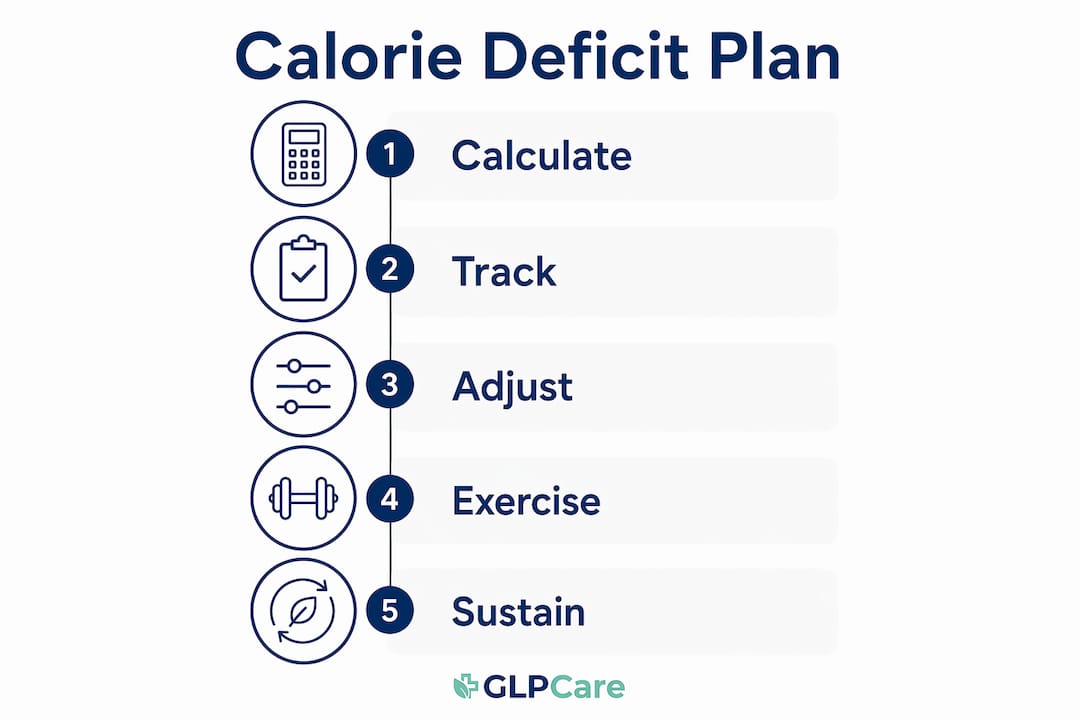
Nutrition quality matters as much as calorie quantity. Protein is the most critical macronutrient during a deficit. It preserves lean muscle, keeps hunger more manageable, and supports metabolic rate. Eating 800 calories of processed food and 800 calories of lean protein, vegetables, and whole grains produce very different outcomes on body composition, even though the deficit is identical on paper.
Dr. Mir Ali, a bariatric surgeon and medical director at MemorialCare Surgical Weight Loss Center, puts it plainly: weight loss doesn’t mean restriction to the point of malnutrition. Getting proper nutrition during the process is the key to maintaining energy and health throughout.
- Prioritize protein at every meal to protect muscle during deficit phases
- Track fiber intake; it directly affects satiety and hunger management
- Avoid ultra-processed foods that spike hunger without providing lasting fullness
- Use a calorie calculator for weight loss to set a realistic, personalized intake target
Pro Tip: Don’t just track calories in a vacuum. Log your energy levels, hunger ratings, and sleep quality alongside your food intake. Patterns in that data tell you far more about whether your deficit is working than the scale alone.
What are the safety guidelines for calorie restriction?
Health authorities recommend not dropping below 1,200 kcal/day for women or 1,500 kcal/day for men without medical supervision. These floors exist because going lower risks nutrient deficiencies, muscle catabolism, and a steeper drop in metabolic rate.
Excessive restriction is one of the most common mistakes people make when pursuing a 2-pound-per-week goal. The body responds to severe deficits by breaking down muscle for fuel, which reduces your resting metabolic rate and makes future weight loss harder.
Protein intake and resistance training are critical during any calorie deficit, and especially so when using GLP-1 therapy. Preserving lean muscle mass protects your metabolic rate and supports long-term fat loss. Clinical evidence confirms that combining adequate protein with resistance exercise significantly reduces muscle loss during calorie restriction.
Practical safety guidelines for managing your deficit:
- Avoid dropping calorie intake below recommended minimum thresholds without medical supervision
- Aim for a sufficient protein intake per day to support muscle preservation during calorie deficit phases
- Include resistance training at least 2–3 times per week
- Monitor for signs of fatigue, dizziness, or hair thinning, which can signal under-fueling
- Use a protein intake calculator to confirm you’re hitting your muscle-preservation targets
If you’re working with a GLP-1 medication like semaglutide or tirzepatide, clinical supervision isn’t optional. These medications suppress appetite significantly, which can make it easy to under-eat without realizing it. A structured program with clinician oversight keeps your deficit in the productive zone without crossing into territory that costs you muscle.
How GLP-1 medications work alongside nutrition and biometric tracking
GLP-1 medications like semaglutide and tirzepatide work by mimicking a naturally occurring hormone that regulates appetite and blood sugar. They slow gastric emptying, reduce hunger signals, and make it substantially easier to maintain a calorie deficit without constant willpower battles. For many people, that appetite regulation is the missing piece that makes a 1,000-calorie daily deficit actually achievable.
Tirzepatide goes a step further by also activating GIP receptors, which influences both fat storage and insulin sensitivity. Both medications are prescribed as part of a comprehensive weight management plan, not as standalone solutions.
Glpcare builds exactly this integration into a single system. Prescription GLP-1 medication (semaglutide or tirzepatide) ships directly to your home. A proprietary screenless fitness band with medical-grade sensors tracks sleep, heart rate, and activity levels in real time. You log dietary habits and dosages through an AI-driven app that translates your biometric data into personalized guidance. Clinicians monitor your progress and adjust your plan as your body adapts.
That continuous feedback loop is what separates this approach from a standard prescription. Biometric tracking catches metabolic slowdowns early, flags under-fueling before it costs you muscle, and gives your care team the data to make precise adjustments rather than educated guesses.
Pro Tip: If you’re on GLP-1 therapy and your appetite suppression is strong, set a protein floor rather than just a calorie ceiling. Hitting your protein target first protects muscle even on days when overall intake is low.
How to personalize and sustain your deficit over time
A 1,000-calorie daily deficit is the target for 2 pounds per week, but many people find a 500–750 calorie deficit more sustainable over months. The math produces slightly slower results, but compliance is dramatically better, and the weight tends to stay off.
Metabolic adaptation is the main reason weight loss stalls. As you lose weight, your body reduces energy expenditure by 10–30%, meaning the same deficit that produced results in month one produces less in month three. The standard response, cutting calories further, usually backfires. Better options include diet breaks (returning to maintenance calories for 1–2 weeks), increasing non-exercise activity, or adjusting your protein and resistance training.
Activity level changes your deficit math directly. A day with significant exercise burns more calories, which means you can eat more while maintaining the same deficit. Tracking this with a wearable device removes the guesswork.
Strategies that support long-term adherence:
- Schedule diet breaks every 8–12 weeks to reset metabolic rate and reduce hunger
- Increase non-exercise activity (walking, standing, daily movement) before cutting more calories
- Use hormonal and cycle-aware nutrition approaches if hormonal fluctuations affect your hunger and energy
- Adjust your calorie target downward as your body weight decreases, since your TDEE changes with weight
- Track weight as a weekly average, not a daily number, to filter out water fluctuation noise
Pro Tip: Resistance training 2–3 times per week during a deficit does double duty: it preserves muscle mass and partially offsets the metabolic slowdown from adaptive thermogenesis. If you can only add one habit alongside your calorie tracking, make it resistance training.
Glpcare gives you the integrated support to make this work
Hitting a consistent calorie deficit to lose 2 lbs a week is straightforward in theory and genuinely hard in practice. The gap between knowing the math and executing it daily is where most people struggle.

Glpcare closes that gap with a system built around the three things that actually determine outcomes: medication that makes the deficit achievable, nutrition coaching that keeps it safe, and biometric tracking that keeps it personalized. The GLP-1 prescriptions (semaglutide or tirzepatide) ship to your door. The screenless fitness band tracks your body’s real-time response. The AI app translates that data into guidance your care team can act on. Plans are available whether you already have a GLP-1 prescription or are starting from scratch.
Take the GLP-1 readiness quiz to find out if you qualify and get a personalized starting point for your plan.
FAQ
How many calories do I need to cut to lose 2 lbs a week?
You need a 1,000-calorie daily deficit, based on the 3,500 calories per pound of fat rule. Start by calculating your TDEE and subtract 1,000 from that number to find your daily intake target.
Is losing 2 lbs a week safe?
The CDC and NIH consider 1–2 pounds per week the safe, sustainable range for weight loss. At the 2-pound pace, clinical supervision is advisable to ensure the loss comes from fat rather than muscle.
What is the minimum calorie intake during a deficit?
Health authorities set the floor at 1,200 kcal/day for women and 1,500 kcal/day for men. Going below these thresholds without medical supervision raises the risk of nutrient deficiencies and muscle loss.
How does GLP-1 medication help with a calorie deficit?
GLP-1 medications like semaglutide and tirzepatide suppress appetite and slow gastric emptying, making it significantly easier to maintain a sustained calorie deficit without constant hunger.
What happens when weight loss stalls on a deficit?
Metabolic adaptation can reduce calorie burn by 10–30% over time. Rather than cutting calories further, practitioners recommend diet breaks, increasing non-exercise activity, or adjusting protein and resistance training to restart progress.
Key Takeaways
A sustained 1,000-calorie daily deficit is the evidence-based target for losing 2 pounds per week, but long-term success depends on protein intake, metabolic monitoring, and clinical support to prevent muscle loss and adaptation.
| Point | Details |
|---|---|
| Daily deficit for 2 lbs/week | A 1,000 kcal/day deficit, based on the 3,500 kcal per pound of fat rule, is the established target. |
| Safety minimums | Never drop below 1,200 kcal/day (women) or 1,500 kcal/day (men) without clinical supervision. |
| Metabolic adaptation | Calorie burn can decrease by 10–30% over time; diet breaks and resistance training help counter this. |
| Protein and muscle preservation | Adequate protein combined with resistance training is critical to prevent muscle loss during any deficit. |
| Glpcare’s integrated approach | Glpcare combines GLP-1 medication, personalized nutrition coaching, and real-time biometric tracking to keep your deficit safe, personalized, and sustainable. |