Personalized Step Targets for Fat Loss: Build to 10,000 with Brisk Sessions
Personalized Step Targets for Fat Loss: Build to 10,000 with Brisk Sessions
Aim for an average of 7,000 to 8,500 daily steps if you’re new to walking for fat loss, and progress toward 10,000 to 12,000 once your body adapts. That upper range shows the clearest body-composition benefits, but only when a portion of your walking happens at a brisk pace. Steps alone won’t move the scale. They work by supporting a calorie deficit and protecting the daily movement your body naturally does, which most diets quietly erode. Measure your current baseline before you set a new target.
TL;DR:
- Walking 10,000 steps at a brisk pace (above 103 steps per minute) significantly improves visceral fat, metabolic markers, and weight loss outcomes.
- Increasing daily steps from below 5,000 to around 8,000–9,000 over several weeks is sustainable and supports fat loss without excessive time commitment.
- Adding intensity through brisk sessions three times a week enhances fat loss more than accumulating steps at a slow pace alone.
- Aiming for 7,000 to 8,500 daily steps is realistic for maintenance, while 10,000 to 12,000 steps, with some brisk walking, maximizes fat-loss benefits.
- Clinical support, including medication management and personalized coaching, can be beneficial if step-based progress stalls or special health considerations exist.
GlpcareMake Weight Management More PersonalGLPCare combines GLP-1 therapy, nutrition coaching, wearable insights, and continuous clinician support for a more integrated approach.Explore GLPCare
Table of Contents
- What Does the Research Say About Step Count and Fat Loss?
- Why Walking Intensity Matters More Than Total Steps
- How Do You Set a Personalized Daily Step Goal?
- What Does an 8 to 12 Week Step Progression Look Like?
- When Do You Need Clinical Support Alongside a Step Goal?
- Why Chasing a Step Number Misses the Point
- A Clinician-Supervised Path When Steps Alone Aren’t Enough
- Sources
- FAQ
What Does the Research Say About Step Count and Fat Loss?
The clearest evidence on step count and fat loss doesn’t come from a single number. It comes from what happens when researchers add intensity to that number.
An 8-week randomized controlled trial gave one group of adults with obesity a simple 12,000-step daily goal. A second group got the same step target, plus three weekly sessions where they had to sustain a pace above 103 steps per minute. Only the intensity group saw significant drops in visceral fat area, hip circumference, and meaningful improvements in HDL cholesterol, glucose, and triglycerides, according to the randomized controlled trial published in PMC. The step-only group hit the same daily count and still came up short on body composition. Volume got them moving. Intensity is what changed their metabolic markers.
A separate secondary analysis of the Step-Up randomized trial backs this up from a different angle. Researchers found that daily step patterns predicted weight-loss outcomes, and that patterns with a substantial portion at moderate-to-vigorous intensity showed the strongest association with weight loss, according to the Step-Up trial analysis. That’s a useful detail: it’s not 10,000 steps at any pace. It’s 10,000 steps with a third of them pushing your heart rate up.
Diet-intervention research adds a dose-response angle to the picture. In cohorts following structured weight-loss diets, increases in daily step counts over months are associated with greater weight loss and reductions in waist circumference. That’s not a huge jump per increment, but it compounds. Someone who moves from 4,000 to 9,000 daily steps over several months is looking at five of those increments stacked together.
Large-scale wearable data tells a similar, if less rigorously controlled, story. Cohort analyses tracking hundreds of thousands of users have found a near-linear relationship between higher average daily steps and greater average weight loss over 12 months, with the steepest gains occurring as people climb from sedentary levels below 5,000 steps up toward the 11,000 to 12,000 range. Past that point, the returns start to flatten. This kind of industry data carries real limits. It’s observational, it’s proprietary, and people who naturally walk more may also eat better or sleep more consistently, which muddies cause and effect. Still, it lines up with what the controlled trials show.
Here’s the range most of the evidence converges on:
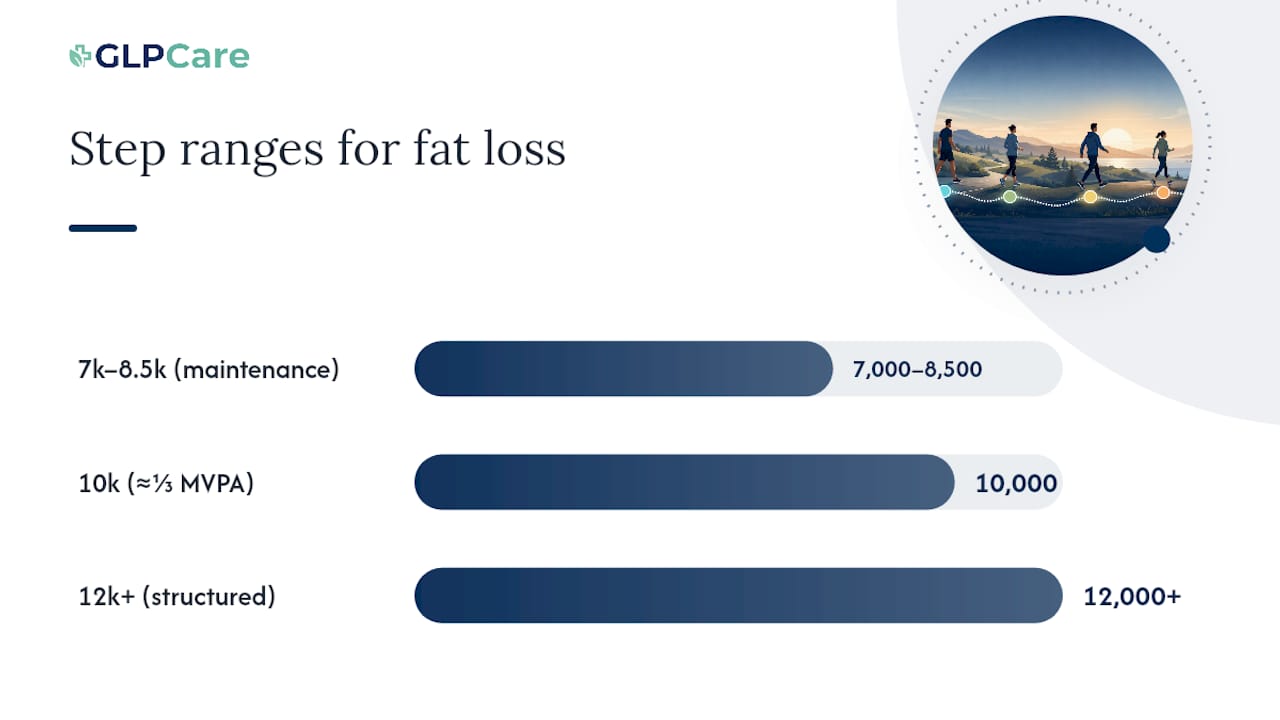
- 7,000 to 8,500 steps daily is linked to meaningful health benefits and is a realistic, sustainable maintenance benchmark for people coming off a weight-loss phase.
- 10,000 steps daily, especially with roughly a third done at moderate-to-vigorous intensity, shows the clearest link to active weight loss in trial data.
- 12,000+ steps daily, when combined with structured brisk sessions, produces the largest measured improvements in visceral fat and cardiometabolic markers.
None of this happens in a vacuum. A measurement review published in Sports Medicine points out that step counts are an imperfect proxy for energy expenditure and intensity, since device accuracy varies by placement, stride length, and terrain. And every one of these studies operated under some degree of calorie awareness. If you eat back every calorie you burn walking, and then some, the step count becomes irrelevant. Compensatory eating is the single most common reason people increase their activity and still don’t lose fat. Add in the body’s tendency to quietly reduce other forms of movement (fidgeting, standing, pacing while on the phone) once you start a structured exercise habit, and you can see why steps have to be paired with something else to actually create a deficit.
Why Walking Intensity Matters More Than Total Steps
Two people can both hit the same step count and get completely different results. The difference is pace.
Researchers generally define moderate-intensity walking using a step-rate threshold. Intervention research often cites a threshold around 103 to 110 steps per minute. That’s noticeably faster than a casual stroll. It’s the pace where a conversation gets a little harder to maintain and your breathing picks up. In the 12,000-step trial cited above, the group that layered in three weekly sessions at that pace saw measurable drops in visceral fat and better metabolic markers than the group hitting the same step count at whatever pace they chose.

The physiology behind this is fairly direct: walking faster recruits more muscle mass per minute, burns more calories per minute, and creates a bigger cardiovascular demand than the same distance covered slowly. That higher effort also seems to matter more for preserving lean muscle during a calorie deficit than sheer step volume does. Racking up steps at a wandering pace, the kind you get pacing around a kitchen, doesn’t create the same stimulus.
You don’t need a lab to gauge intensity. A few practical markers work:
- Steps per minute: aim for 100+ during dedicated walking sessions, not your whole day’s total.
- Talk test: you should be able to speak in short sentences, not sing along to a podcast.
- Borg RPE scale: target a perceived exertion of 12 to 14 out of 20, which feels “somewhat hard.”
- Short intervals: three 10 to 15 minute brisk sessions a day can hit the same intensity target as one long walk, without needing a block of free time.
Pro Tip: Set your phone or fitness tracker to buzz every 10 minutes during a walk and check your pace. If you can’t hold a brisk pace the whole session, break it into shorter, faster bursts instead of slogging through one long, slow one. Those heart-rate-based effort zones give you a more precise read than perceived exertion alone.
How Do You Set a Personalized Daily Step Goal?
Don’t pick a step number out of a listicle. Build it from your own baseline.
1. Measure your current average first. Wear your tracker or carry your phone for seven full days without changing your habits, then average the total. Most people underestimate their baseline by a wide margin, and starting from a fictional number sets up an unrealistic jump.
2. Increase gradually, not all at once. A safe, sustainable progression adds 500 to 1,500 steps per week, or roughly 10% to 20% of your current baseline, whichever feels more achievable. Someone starting at 4,000 steps should aim for 4,500 to 5,000 the following week, not 10,000.
3. Use a rough calorie estimate, with caveats. A commonly cited approximation puts walking-related energy expenditure around 40 calories burned per 1,000 steps for a person weighing about 70 kg (154 lbs), though this varies with body weight, terrain, and pace. Heavier individuals burn more per step; lighter individuals burn less. Treat this as a directional estimate, not a precise number to bank a deficit on.
4. Decide your target range based on your goal and your time. If you’re new to structured activity, 7,000 to 8,500 steps is a strong starting target that’s linked to meaningful health benefits without demanding hours of free time. If you’re aiming for a larger deficit or better body composition and have room to progress, work toward 10,000 to 12,000, prioritizing at least a few brisk sessions a week over adding more slow, low-effort steps.
5. If time is your constraint, prioritize intensity over volume. The trial data is consistent on this point: three focused, brisk sessions a week move the needle more than an extra 2,000 unhurried steps scattered through your day.
Registered dietitians who work in weight management are blunt about the ceiling here: step goals support fat loss but can’t cancel out a calorie surplus. If your eating pattern outpaces your activity, the step count is functioning as a health habit, not a weight-loss lever. A calorie deficit calculator paired with your step target gives you a much clearer read on whether you’re actually in a deficit than steps alone ever will.
What Does an 8 to 12 Week Step Progression Look Like?
A realistic plan depends entirely on where you’re starting. Here’s how it breaks down by starting point.
1. Sedentary starter (under 5,000 steps/day baseline). Weeks 1 to 4: build to 6,000 to 7,000 steps daily, adding roughly 500 steps per week. Weeks 5 to 8: hold at 7,000 to 8,000 and introduce one brisk 10-minute walk daily. Weeks 9 to 12: push toward 8,500 to 9,500, with two to three brisk sessions weekly.
2. Low-active starter (5,000 to 7,500 steps/day baseline). Weeks 1 to 4: increase to 8,000 to 9,000 steps, adding one brisk 15-minute session most days. Weeks 5 to 8: target 9,500 to 10,500, with three weekly sessions above 100 steps per minute. Weeks 9 to 12: settle into 10,000 to 12,000, adjusting based on energy and recovery.
3. Somewhat-active starter (7,500+ steps/day baseline). Weeks 1 to 4: shift focus from volume to intensity, converting a third of your daily steps into brisk-paced walking. Weeks 5 to 8: add short interval sessions (alternating 3 minutes brisk, 2 minutes easy) three times a week. Weeks 9 to 12: maintain 10,000 to 12,000+ with at least three structured intensity sessions.
A sample daily schedule that fits most routines: a 10-minute brisk walk before or after breakfast, standing or pacing during phone calls to build NEAT (non-exercise activity thermogenesis), a 15-minute walk at lunch, and a 10-minute interval walk in the evening. That adds up to roughly 8,000 to 9,000 steps without requiring a single dedicated “workout” block.
Track more than the scale. Waist circumference, progress photos, how your clothes fit, and your energy levels during the day all tell you more about fat loss than daily weight fluctuations do, which shift with water and food volume.
Pro Tip: Log your steps at the same time each day (most trackers default to a midnight reset) and look at your 7-day rolling average instead of daily numbers. One bad day won’t derail a real trend, but it will wreck your motivation if you’re staring at daily totals alone.
When Do You Need Clinical Support Alongside a Step Goal?
Steps do real work in a fat-loss plan: they defend the calorie deficit you’ve built through diet by keeping your non-exercise activity from quietly declining, which is one of the more common ways diets stall out. But steps have a ceiling, and clinical support extends past it.
Clinician-supervised programs add things a pedometer can’t: medication management for people using GLP-1 therapies like semaglutide or tirzepatide, nutrition coaching that adjusts as your weight changes, and oversight aimed at preserving lean muscle mass during a deficit rather than just tracking pounds lost. A wearable that captures sleep, heart rate, and activity data alongside a clinician’s input gives a fuller picture than steps in isolation ever could.
Seek a medical assessment before ramping up activity if any of the following apply:
- A history of cardiac issues or unexplained chest pain during exertion.
- Joint pain that worsens with walking, or a recent lower-body injury.
- Unexplained fatigue, dizziness, or shortness of breath at low step counts.
- You’re on medication that affects heart rate or blood pressure.
If joint limitations or a recent injury are part of your situation, a safe walking progression guide can help you rebuild volume without setbacks.
Why Chasing a Step Number Misses the Point
The obsession with round numbers like 10,000 steps has always struck me as backwards. That figure came from a 1960s Japanese pedometer marketing campaign, not a clinical trial, and the research since then has quietly moved past it. What the data actually rewards is consistency plus effort, not a specific digit on a screen.
The bigger risk I see is people chasing extreme step counts, 20,000 or 30,000 a day, treating volume as a substitute for a real calorie strategy. That’s a fast route to joint strain and burnout, not better fat loss. A modest, sustainable increase paired with honest calorie tracking beats a heroic step count paired with wishful eating, every time. Watch your data for quiet drops in daily movement once you start dieting seriously. That’s usually the first sign your body is compensating, and it’s far easier to catch with a week of tracking than to guess at after the scale stalls.
— Dominique
A Clinician-Supervised Path When Steps Alone Aren’t Enough
If you’ve built a solid step habit and a reasonable calorie deficit but still feel like you’re managing a complicated puzzle alone, Glpcare gives you the piece a fitness tracker can’t: a licensed clinician actually reviewing your data and adjusting your plan around it.

Some clinician-supervised programs offer GLP-1 medication options paired with a wearable band that tracks sleep, heart rate, and daily activity alongside personalized nutrition coaching. These programs provide clinicians access to integrated data to adjust dosing, coaching, and movement targets based on comprehensive information. This approach aims to preserve muscle during a deficit, addressing limitations of unsupervised step-and-diet plans. The GLPCare membership runs $199 per year, with Semaglutide Care starting from $209 per month and Tirzepatide Care starting from $299 per month, whether or not you already have a prescription. If clinical oversight and integrated tracking sound like the missing piece in your plan, start by comparing the medication options on the Glpcare comparison page.
FAQ
What Is the Best Step Count for Fat Loss?
Most evidence points to 7,000 to 8,500 daily steps for general health and maintenance, with progression toward 10,000 to 12,000 for greater fat-loss benefit, especially when a portion of that walking is done at a brisk pace above 100 steps per minute. A randomized controlled trial found the intensity component mattered more than the total count for improving body composition.
Will I Lose Belly Fat if I Walk 10,000 Steps a Day?
Walking 10,000 steps daily can reduce belly fat, but only when it’s paired with a calorie deficit and some portion of brisk-paced walking. A secondary analysis of the Step-Up trial found that step patterns including roughly 3,500 moderate-to-vigorous steps were linked to actual weight loss, not step count alone.
Is 30,000 Steps a Day Too Much?
For most people, 30,000 steps a day goes well beyond what the research supports as necessary and raises the risk of joint strain, fatigue, and burnout without adding proportional fat-loss benefit. The evidence shows returns flattening well before that range, making a focused 10,000 to 12,000 step target with brisk sessions a more sustainable and effective approach.
How Many Steps Should I Walk To Lose 20 Pounds?
There’s no fixed step count guaranteed to produce a specific weight loss, since results depend heavily on diet and individual metabolism. Building toward 10,000 to 12,000 daily steps, with brisk sessions included, alongside a consistent calorie deficit gives you the best evidence-backed foundation, and tools like a calorie deficit calculator can help you estimate a realistic timeline for your goal.
Can Glpcare Help Me Track Steps Alongside Weight Loss Medication?
Yes. Glpcare’s screenless wearable tracks daily activity, sleep, and heart rate alongside your GLP-1 dosing, giving your care team a fuller picture than step count alone. Plans include Semaglutide Care and Tirzepatide Care, both available with or without an existing prescription.