Zone 2 for Fat Loss: What Actually Works and Why
Zone 2 for Fat Loss: What Actually Works and Why
Zone 2 helps train your body to burn a higher share of fat during exercise and serves as a sustainable aerobic base you can sustain for years, not weeks. It is not a shortcut to weight loss. If you’re using zone 2 for fat loss as your primary strategy, the honest answer is that it works best as one piece of a larger plan that includes a calorie deficit and resistance training, not as a standalone fix.
Here’s what you can do starting today:
- Use the talk test. If you can speak in full sentences but couldn’t sing, you’re likely in Zone 2.
- Aim for 30 to 60 minute sessions, 2 to 4 times per week, at a pace you could technically hold for hours.
- Add two strength-training sessions weekly. Zone 2 alone won’t preserve the muscle you need to keep your metabolism running efficiently.
A practical heart-rate target for most people sits around a moderate intensity where fat oxidation peaks, though your real number depends on fitness level and age. We’ll walk through exactly how to find yours in the measurement section below. For now, know this: Zone 2 shifts your fuel mix toward fat, builds the aerobic engine that makes everything else easier, and pairs with the right nutrition and lifting plan to produce results you can actually keep.
Key Takeaways
Zone 2 increases the share of fat your body uses as fuel and builds a sustainable aerobic base, but fat loss ultimately depends on a calorie deficit paired with resistance training.
| Point | Details |
|---|---|
| Zone 2 shifts fuel use, not totals | It raises the percentage of fat burned per minute but not total calories compared with harder efforts. |
| Target 60 to 70% of max heart rate | Use this range alongside the talk test, since age-based formulas can be off by 10 to 20 beats per minute. |
| Pair with strength training | Two to three resistance sessions per week protect muscle that Zone 2 alone won’t preserve. |
| Consistency outperforms intensity | Accumulated weekly minutes and adherence predict outcomes better than any single workout’s intensity. |
| Glpcare supports tracking and recovery | Its wearable band and clinician-backed GLP-1 program help monitor heart rate and protect muscle during fat loss. |
Table of Contents
- Zone 2 Training and Weight Loss: What the Evidence Actually Shows
- How to Find Your Zone 2 Heart Rate
- Zone 2 Workout Plans by Fitness Level
- Zone 2 vs. HIIT: Which Actually Burns More Fat?
- Combining Zone 2 With Strength Training and Nutrition
- Zone 2 Safety Guidelines, Especially for GLP-1 Users
- The Bottom Line on Zone 2 and Fat Loss
- Why Adherence Beats Intensity Every Time
- Support Your Zone 2 Training With Clinician-Backed GLP-1 Care
- Sources
- FAQ
Zone 2 Training and Weight Loss: What the Evidence Actually Shows
Zone 2 works by changing what your body burns for fuel, not by burning more calories overall. That distinction gets lost constantly in fitness content, and it’s the single most misunderstood part of this whole conversation.
The physiological target here is called Fatmax, the intensity at which your body oxidizes the highest absolute amount of fat per minute. Research on Fatmax in populations with obesity has located this point at roughly 57% to 66% of peak heart rate, which lines up closely with the commonly cited 60% to 70% of maximum heart rate that most coaches use as a practical Zone 2 target, according to Colorado State University’s guidance on heart-rate training zones. Heart rate works as the proxy because measuring actual substrate oxidation requires a metabolic cart and a lab, something almost nobody has access to on a Tuesday morning run.
Here’s the trade-off nobody advertises: at Zone 2 intensity, fat contributes a larger percentage of your total energy expenditure. But total calories burned per minute are lower than they would be at a higher intensity. A 2023 meta-regression on fat oxidation and exercise intensity, summarized in a research review on Zone 2 cardio and weight loss, makes this trade-off explicit: you burn a higher percentage of fat at moderate intensity, but you burn more total calories, including fat calories, at higher intensities over the same time window. Zone 2 wins on sustainability and repeatability, not on calories per minute.
That sustainability angle matters more than it sounds. A peer-reviewed comparison of individual variability in submaximal exercise intensity boundaries found that Zone 2 training reliably stimulates mitochondrial efficiency and improves how well your body metabolizes fat over time, even as the exact heart-rate boundaries vary meaningfully from person to person. That variability is a big deal. Two people at the same age and heart rate can be in different metabolic zones, which is why relying purely on an age-based formula sells some people short and pushes others too hard.
What consensus research says about “best” exercise for fat loss:
- No single training mode consistently beats others for weight loss, according to exercise-medicine consensus reviews referenced in current research on exercise recommendations.
- Accumulated weekly activity minutes predict outcomes better than the specific intensity used to generate them.
- Adherence, meaning whether you actually keep doing it, outperforms any theoretical metabolic advantage on paper.
- Mitochondrial adaptations from consistent Zone 2 work support long-term metabolic health, but they don’t guarantee fat loss without an accompanying calorie deficit.
Mayo Clinic Press describes Zone 2 as accessible, low-to-moderate intensity cardio well suited to daily life, and notes its cardiovascular benefits extend beyond simple fat oxidation, according to their overview of Zone 2 cardio. The physiological case for Zone 2 isn’t that it torches more fat than a hard interval session. It’s that you can do it four or five days a week without wrecking your joints, your sleep, or your motivation, and that consistency compounds in ways a single brutal workout never will.
Mitochondrial improvements from months of steady Zone 2 work build the aerobic capacity that makes higher-intensity training more productive later, but on their own, those improvements don’t shrink body fat. That still requires eating less than you burn.
How to Find Your Zone 2 Heart Rate
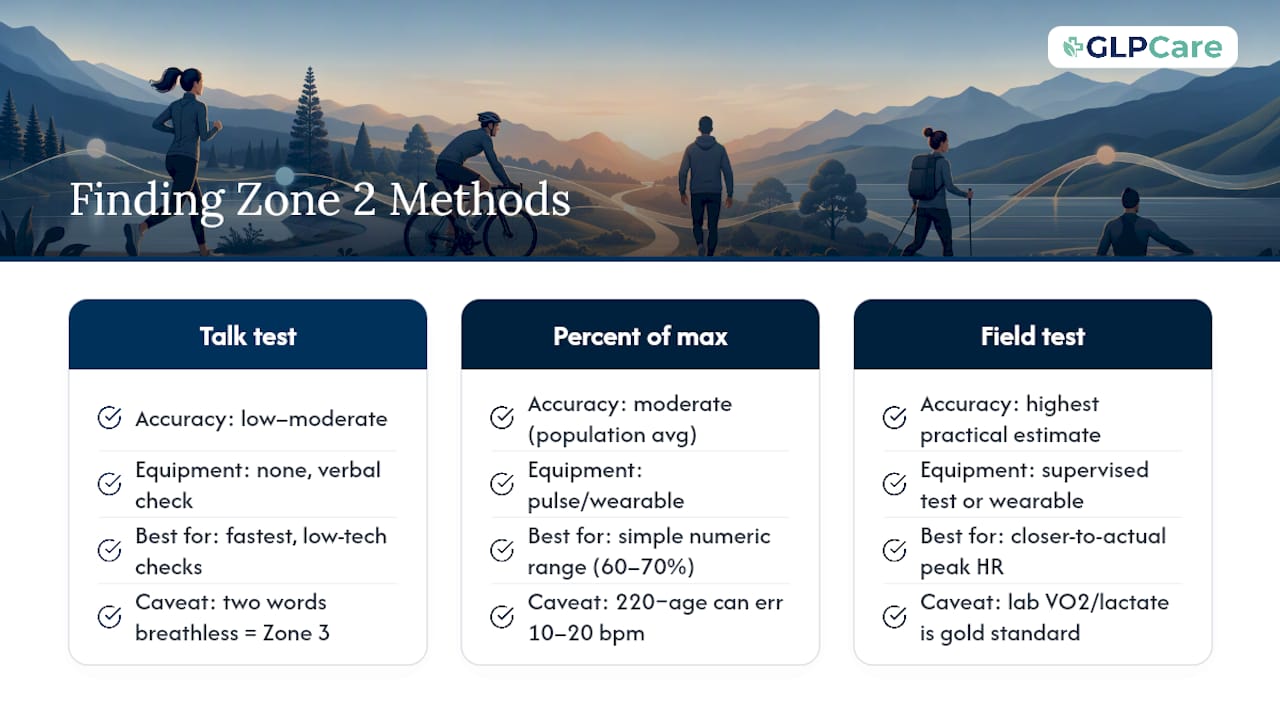
You don’t need a lab to find your Zone 2. You need one of three practical methods, and each has a different accuracy ceiling worth knowing before you commit to a number.
1. The talk test. This is the fastest, lowest-tech option available, and it works surprisingly well. If you can hold a conversation in full sentences without gasping, but you couldn’t comfortably sing along to a song, you’re likely in Zone 2. If you’re breathless after two words, you’ve drifted into Zone 3 territory.
2. Percentage of max heart rate. The standard estimate uses 60% to 70% of your maximum heart rate as the practical Zone 2 range, with Fatmax research pointing to a slightly tighter band of 57% to 66% of peak heart rate in some populations, per Colorado State University’s zone training breakdown. The catch: the classic 220 minus your age formula that generates your “max heart rate” is a population average, not a personal measurement. It can be off by 10 to 20 beats per minute in either direction for a given individual, which throws your entire zone calculation off if you lean on it alone.
3. A supervised field test. If you want a number closer to your actual peak heart rate, a progressive maximal effort test, done under supervision or with clinician input if you have any cardiovascular risk factors, gives you a real anchor point rather than an age-based guess. A cautious, controlled hill-sprint protocol can also approximate peak heart rate for healthy, trained individuals, according to the PMC review on submaximal intensity boundaries. Lab-based VO2 max or lactate threshold testing remains the gold standard, but it’s rarely necessary unless you’re training competitively or troubleshooting a stalled program.
Pro Tip: Don’t chase a single perfect number. Your Zone 2 range shifts with sleep, stress, heat, and training status, so treat your heart-rate target as a moving window, not a fixed line you have to hit exactly.
Once you’ve settled on a target range, a wearable becomes far more useful than checking your pulse manually mid-run. Look for continuous heart-rate logging, real-time zone alerts that buzz or beep when you drift out of range, and the ability to cross-check heart-rate data against perceived exertion, which CNET’s breakdown of Zone 2 monitoring tools recommends as a practical accuracy check. A wearable that logs trends over weeks, not just single sessions, will show you something a stopwatch never can: whether your Zone 2 pace is getting faster at the same heart rate, which is the clearest sign your aerobic base is actually improving.
Zone 2 Workout Plans by Fitness Level
The right Zone 2 template depends entirely on where you’re starting, and jumping straight to an advanced volume plan is one of the fastest ways to burn out before you see any benefit. Build up. Don’t leap in.
Beginner template
- Two to three Zone 2 sessions per week, 30 minutes each, using the talk test to confirm intensity.
- Two strength-training sessions per week, focusing on major muscle groups: squats, rows, presses, hinges.
- One full rest day between harder efforts, with light walking encouraged on off days.
Intermediate template
- Three to four Zone 2 sessions per week, extending to 40 to 60 minutes as your aerobic base improves.
- Two to three strength sessions per week, maintained even as cardio volume climbs.
- One optional short higher-intensity session, if recovery allows and you enjoy the variety.
Advanced or endurance-focused template
- The bulk of weekly cardio volume, roughly 80%, stays in Zone 2, even for people training for events or chasing bigger performance goals.
- Strength training holds steady at two to three sessions weekly, non-negotiable at this volume because the injury and burnout risk climbs with total training load.
- Sleep and recovery tracking become mandatory, not optional, since high weekly Zone 2 volume without adequate rest is one of the most common ways people plateau or regress.
Progression follows one simple rule: add duration before you add intensity. Stretching a 30-minute session to 40 minutes is a safer, more sustainable way to build your aerobic base than trying to push your heart rate higher within the same time window. Speed and intensity gains tend to follow naturally once the duration base is solid, not the other way around.
Watch for fatigue signals that tell you to back off:
- Your Zone 2 pace feels harder than usual at the same heart rate.
- Resting heart rate creeps up morning after morning.
- Sleep quality drops even though nothing else in your routine changed.
- Motivation craters and sessions that used to feel easy start feeling like a grind.
Any one of these on its own might be nothing. Two or three together, sustained over a week, usually mean it’s time for an easier week before you push volume further.
Zone 2 vs. HIIT: Which Actually Burns More Fat?
HIIT burns more total calories per minute than Zone 2, full stop. That’s not up for debate. What is debatable is whether that makes HIIT the better fat-loss tool, and the honest answer is: it depends on what you can actually sustain week after week.
High-intensity interval sessions torch calories fast but come with a steep recovery cost. You can’t do four hard interval sessions a week indefinitely without accumulating fatigue, disrupting sleep, or eventually getting hurt. Zone 2, by contrast, is repeatable almost daily because it doesn’t dig the same physiological hole. That repeatability is exactly why accumulated weekly minutes, not the intensity of any single session, tend to predict weight outcomes more reliably across exercise-medicine consensus research. Five 45-minute Zone 2 sessions can add up to more total calories burned across a week than two exhausting HIIT sessions squeezed in around recovery days.
The fuel mix differs too. Zone 2 pulls a higher percentage of its energy from fat, while HIIT leans harder on carbohydrate stores, especially during the work intervals. Neither is inherently “better” for fat loss. What burns off your waistline over months is the calorie deficit your total activity and eating pattern create, not which fuel your muscles happened to prioritize during any individual workout.
A practical mixing strategy works well for most people:
- Build your base with Zone 2 as the majority of weekly cardio volume.
- Add one, occasionally two, higher-intensity sessions for variety, cardiovascular stimulus, and time efficiency when your schedule is tight.
- Treat HIIT as seasoning, not the main course. It adds fitness benefits Zone 2 alone won’t produce as quickly, but it can’t replace the volume Zone 2 provides.
There are days when Zone 2 is the smarter choice regardless of your program, particularly on low-energy days, during a stressful week, or if you’re managing side effects from a GLP-1 medication that make harder efforts feel disproportionately draining. Pushing through a HIIT session on a day your body is clearly asking for less isn’t discipline. It’s a good way to derail the next three days of training entirely.
Combining Zone 2 With Strength Training and Nutrition
Fat loss without a strength-training plan tends to cost you muscle along with the fat, and that trade is a bad one. Muscle tissue drives your resting metabolic rate, and losing it makes long-term weight maintenance measurably harder. Zone 2 does very little to protect lean mass on its own; resistance training is the piece of the puzzle that does that job.

Two to three strength sessions per week, hitting the major muscle groups with progressive resistance, should sit alongside your Zone 2 cardio, not compete with it for scheduling priority. If you’re also managing a calorie deficit to lose fat, that deficit needs to be moderate enough that your body has the raw material to maintain muscle while training. An aggressive deficit combined with high training volume and inadequate protein is close to a guaranteed way to lose both fat and muscle at once.
Protein intake matters enormously here. A useful rule of thumb for people in a fat-loss phase who are also strength training is to aim meaningfully higher than the general population’s baseline protein recommendation, and a protein intake calculator can help you land on a personalized target rather than guessing. For anyone specifically working to prevent muscle loss during a weight-loss phase, protein and resistance training are the two levers that matter most, with Zone 2 supporting the cardiovascular and metabolic side of the equation.
Fueling around long Zone 2 sessions differs from what you’d need for short ones. Sessions under 45 minutes rarely require anything beyond normal meals timed reasonably around your workout. Longer sessions, particularly past the 60 to 75 minute mark, benefit from a small carbohydrate snack beforehand if you’re also running a calorie deficit, since low energy availability going into a long session can leave you drained for the rest of the day.
A sample weekly structure that balances everything:
- Monday: Zone 2, 40 minutes
- Tuesday: Strength training, full body
- Wednesday: Zone 2, 40 minutes
- Thursday: Strength training, full body
- Friday: Zone 2, 30 to 45 minutes
- Saturday: Optional longer Zone 2 session or active rest
- Sunday: Full rest
Zone 2 Safety Guidelines, Especially for GLP-1 Users
Zone 2 is one of the gentler forms of structured exercise, but “gentle” doesn’t mean risk-free, and a few warning signs deserve your immediate attention regardless of fitness level.
Stop a session and seek medical evaluation if you experience:
- Chest pain, pressure, or tightness during exercise.
- Fainting, near-fainting, or sudden dizziness.
- Shortness of breath that feels disproportionate to the effort you’re putting in.
- Irregular or racing heartbeat that doesn’t settle once you slow down.
Anyone with known cardiovascular risk factors, or anyone starting exercise for the first time in years, benefits from clinician clearance before ramping up training volume. This isn’t a formality. It’s the difference between building a program safely and finding out about a problem the hard way.
For people using GLP-1 medications like semaglutide or tirzepatide, Zone 2 fits particularly well into a weekly routine because it’s forgiving on the low-energy days that sometimes accompany dose adjustments or appetite suppression. Zone 2 is often better tolerated than high-intensity work during periods of nausea, fatigue, or reduced food intake, according to guidance on Zone 2 cardio for people using GLP-1 medications. Prioritizing protein intake and consistent resistance training becomes even more important on GLP-1 therapy, since appetite suppression can make it harder to eat enough to support muscle, a concern covered in detail in guidance on preventing muscle loss while on GLP-1 medications.
Pro Tip: If you’re on a GLP-1 medication and a scheduled HIIT session feels impossible on a given day, swap it for Zone 2 instead of skipping entirely. You’ll keep the habit alive without forcing your body through an effort it isn’t ready for.
Wearable heart-rate and recovery tracking can flag overtraining or accumulating fatigue days before you’d notice it subjectively, particularly useful during medication titration when your body’s signals can be harder to read accurately.
The Bottom Line on Zone 2 and Fat Loss
Zone 2 is a genuinely valuable, sustainable training tool, and it earns its place in a fat-loss program. It is not, by itself, sufficient. Pair it with a calorie deficit you can actually maintain and resistance training that protects the muscle you’re working hard to keep, and Zone 2 becomes the aerobic foundation that makes everything else in your program work better.
Three things to do this week:
- Pick a Zone 2 activity you actually enjoy—walking, cycling, rowing, swimming—and schedule two to four sessions.
- Add two resistance-training sessions to protect lean mass while you’re in a deficit.
- Track your sessions, whether with a simple log or a wearable, so you can see your Zone 2 pace improve at the same heart rate over time.
If you have any cardiovascular risk factors or you’re new to structured exercise, get clinical clearance before increasing volume or intensity. It’s a small step that removes a real risk.
Why Adherence Beats Intensity Every Time
The biggest mistake I see people make with Zone 2 isn’t choosing the wrong heart rate. It’s treating it like a technique to perfect rather than a habit to protect. Clients who pair Zone 2 with a genuinely simple strength plan, nothing fancy, just consistent lifting twice a week, tend to stick with both far longer than people chasing an optimized, complicated program that collapses the first time life gets busy.
The research keeps pointing to the same conclusion: total weekly minutes and adherence matter more than which exact zone produced them. That’s not a compromise. It’s the actual lever that moves the needle, and it’s less exciting than a headline about the “best fat-burning zone,” but it’s the one that holds up when the motivation fades and the routine has to carry you instead.
Support Your Zone 2 Training With Clinician-Backed GLP-1 Care
Tracking your Zone 2 heart rate accurately, day after day, is hard to do consistently with a chest strap you forget to charge or a phone app you forget to open. Glpcare built its integrated system around exactly this problem: a wearable band with medical-grade sensors that logs your heart rate continuously, so your Zone 2 sessions are measured in real time instead of estimated after the fact.

If you’re also considering GLP-1 therapy alongside your training plan, Glpcare pairs the wearable with prescription medication support, personalized nutrition coaching, and ongoing clinician oversight, the same combination this article recommends for protecting muscle while you lose fat. The protein intake calculator helps you hit the protein targets that matter most when you’re combining a calorie deficit with resistance training, and continuous activity tracking through the band flags low-recovery days before they turn into a missed week of training entirely.
If you’re wondering whether GLP-1 therapy fits your situation, start with the GLP-1 Readiness Quiz to see where you stand and what a clinician-supervised program could look like for you.
Sources
- How to target heart-rate training zones effectively (Colorado State University)
- Zone 2 Intensity: A Critical Comparison of Individual Variability in Different Submaximal Exercise Intensity Boundaries (PMC)
- ACSM-related exercise medicine publication (PubMed entry)
- Zone 2 cardio: What is it and why is it trending online? (Mayo Clinic Press)
This article is general information, not a substitute for advice from a qualified doctor. Consult a qualified healthcare professional about your own circumstances before acting on anything here.
FAQ
Is 30 minutes in Zone 2 enough?
Thirty minutes is a solid starting point, especially for beginners, and it meets the lower end of most weekly aerobic guidelines when done several times a week. Longer sessions of 40 to 60 minutes add more benefit as your fitness improves, but 30 minutes consistently beats a longer session done rarely.
What are the signs you’re in Zone 2?
You should be able to hold a full conversation without gasping for air, breathing noticeably harder than at rest but not struggling.
What heart-rate zone is best for losing fat?
No single zone is definitively “best” for fat loss, since total weekly activity and calorie balance matter more than any one intensity. Zone 2 maximizes the percentage of fat used as fuel and supports higher weekly volume, while higher-intensity work burns more total calories per minute, and most effective programs use both.
Is Zone 2 good for weight loss?
Zone 2 supports weight loss by building a sustainable aerobic base you can train consistently, but it works best paired with a calorie deficit and resistance training rather than as a standalone strategy. Tools like a calorie deficit calculator and consistent strength work make Zone 2’s contribution to fat loss far more reliable.