3 Nights, Not One: Sleep Tracking Accuracy and When to Trust It
3 Nights, Not One: Sleep Tracking Accuracy and When to Trust It
Consumer sleep trackers are genuinely reliable at one thing: telling whether you’re asleep or awake, with sensitivity above 95% in controlled studies. Sleep-stage accuracy is a different story. Precision there ranges widely by device and person, so a single night’s “deep sleep” number deserves skepticism. The smarter approach is to track trends across weeks, not obsess over one night’s score, and to bring real symptoms (not app scores) to a clinician when something feels off.
TL;DR:
- Consumer sleep trackers reliably distinguish between sleep and wake, but their accuracy for specific sleep stages varies widely from 50% to 86%, depending on the device.
- Validation studies show that these devices tend to underestimate total sleep time by about 15 minutes on average and misclassify sleep stages, especially in people with sleep disorders or fragmented sleep.
- Factors like device fit, skin contact, Bluetooth disruptions, and proprietary algorithms significantly influence individual accuracy, making sleep stage estimates less reliable for home use.
- Tracking trends over multiple nights and using confidence indicators improve interpretation, as single-night data can be misleading due to noise and measurement biases.
- Wearable data should inform discussions with healthcare professionals about sleep patterns, not replace clinical diagnosis, especially during disrupted sleep or suspected sleep disorders.
GlpcareTrack Sleep Within Whole-Body CareGLPCare combines wearable sleep and activity insights with nutrition coaching, GLP-1 therapy, and continuous clinician support.Explore GLPCare
Table of Contents
- What Sleep Tracking Accuracy Actually Measures
- What the Validation Studies Actually Found
- Why Your Device Might Be More (or Less) Accurate Than the Study Average
- How to Interpret Your Own Sleep Tracking Data
- How Many Nights of Data Do You Actually Need?
- What Consumer Sleep Data Can’t Tell You
- A Publisher’s Perspective on Clinically Integrated Tracking
- Sources
- FAQ
What Sleep Tracking Accuracy Actually Measures
Sleep tracking accuracy isn’t one number. It’s really two separate questions: can the device tell you’re asleep versus awake, and can it tell you which stage of sleep you’re in. Those are answered very differently by the research, and conflating them is where most of the confusion around wearable sleep data comes from.
Every consumer tracker builds its estimate from a small set of raw signals, then runs those signals through an algorithm that guesses at something it cannot directly observe: your brain activity.
- Accelerometer (actigraphy): Detects movement and stillness. This is the oldest and most basic input, and it’s still the backbone of most sleep-versus-wake detection.
- Optical heart rate (PPG): Shines light into the skin and measures blood flow changes to estimate heart rate and heart rate variability (HRV). PPG is sensitive to motion artifacts and needs stable skin contact to work well.
- HRV patterns: Falling heart rate variability and dropping heart rate typically signal deeper sleep stages, so many algorithms use HRV shifts as a proxy for stage transitions.
- Bed mats and nearables: Devices like under-mattress sensors skip the wrist entirely, picking up movement, respiration, and sometimes sound through the mattress or nightstand.
- Audio and ambient sensors: Some phone-based apps use microphone data to detect snoring, movement, or disturbances, layering that onto motion data.
Algorithms process those signals in one of a few ways. The simplest is motion-only actigraphy, which flags long stillness as sleep and movement as wake. Most modern trackers now add HR and HRV to that baseline, since heart rate alone helps separate light sleep from deeper stages. The most advanced approach, multimodal fusion, blends motion, heart signals, and sometimes temperature or respiration, then smooths the output and attaches a confidence estimate to each night.
That confidence estimate matters more than most people realize. A tracker that flags a night as low confidence, whether because of a loose strap or a Bluetooth dropout, is telling you not to trust that particular data point. World Sleep Society guidance recommends manufacturers disclose these data-quality indicators precisely because optical sensors are vulnerable to motion artifacts that quietly corrupt a night’s reading.
Here’s the limit that no software update will fix: polysomnography (PSG), the lab-based sleep study that records brain waves through EEG, remains the clinical gold standard because it directly measures the electrical activity that defines sleep stages. Wrist-worn and mat-based trackers infer sleep stages indirectly, from movement and cardiovascular signals, rather than measuring the brain waves themselves. As Johns Hopkins Medicine puts it, wearables are useful for tracking bedtime, wake time, and broad duration trends, but the sleep-stage graph on your app is a statistical estimate, not a diagnosis.
What the Validation Studies Actually Found
Here’s the number that should anchor how you read your own sleep app: consumer wearables detect sleep versus wake with sensitivity of 95% or higher, but sleep-stage sensitivity in the same study ranged from roughly 50% to 86% depending on the device and the stage being measured, according to validation research on three commercial wearables. That’s a wide gap. It means your tracker is almost never wrong about whether you were asleep, but it’s meaningfully uncertain about what kind of sleep you were in during any given stretch of the night.
The core finding, in plain terms: Wearables reliably separate sleep from wake. They’re far less reliable at separating light sleep from deep sleep from REM, and how far off they run depends heavily on the specific device and the specific stage.
The bias patterns were just as telling. Fitbit overestimated light sleep by about 18 minutes per night while underestimating deep sleep by roughly 15 minutes. Apple Watch swung harder, overestimating light sleep by 45 minutes and underestimating deep sleep by 43 minutes. Oura ran comparatively tighter, though it still overestimated sleep latency (how long it takes to fall asleep) by about 5 minutes.
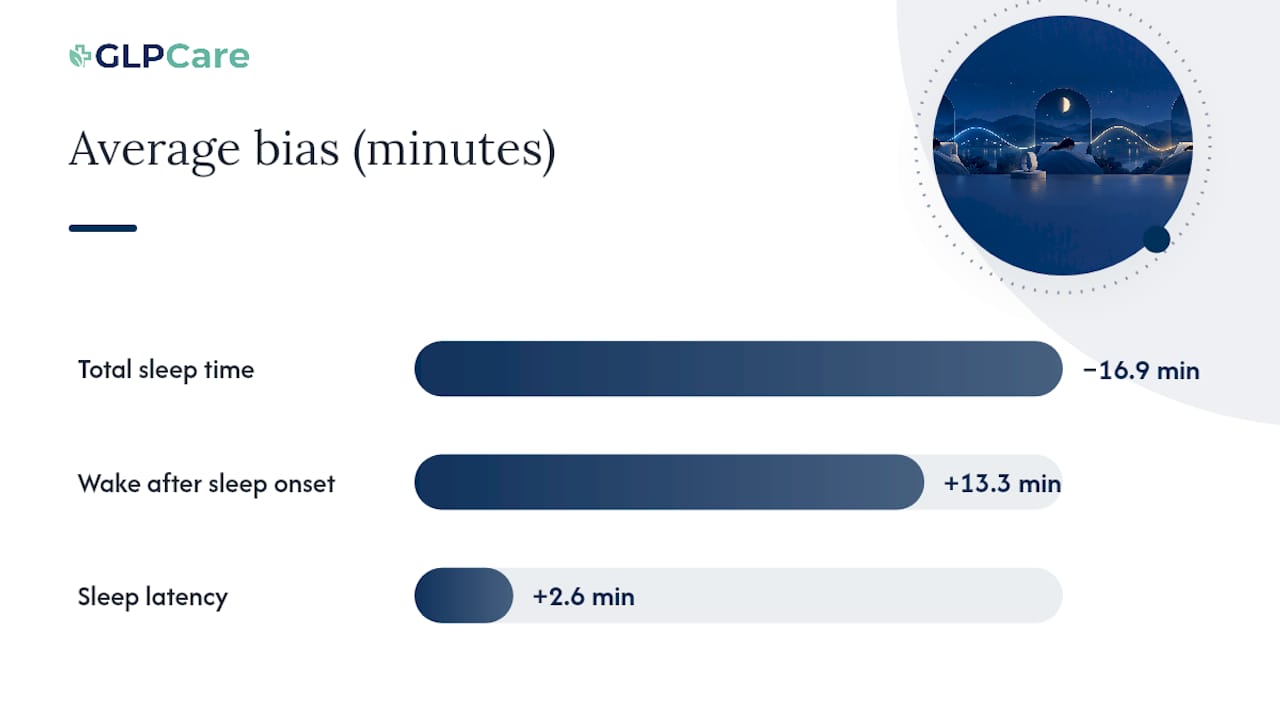
Zoom out to the pooled data and the picture holds. A 2025 meta-analysis covering 24 studies and 798 participants found consumer wrist trackers, compared against polysomnography, showed these average differences:
- Total sleep time: underestimated by 16.854 minutes on average.
- Sleep efficiency: underestimated by 4.691 percentage points.
- Sleep latency: overestimated by 2.574 minutes.
- Wake after sleep onset (WASO): overestimated by 13.255 minutes.
None of those numbers are catastrophic on their own. Fifteen or twenty minutes of error on total sleep time won’t change how you plan your day. But averages hide a wider spread underneath them, and that’s where a multicenter validation study of 11 consumer sleep technologies gets more useful. That’s not a tight cluster. It’s evidence that “sleep tracker accuracy” varies enormously by which device you’re holding, and the same study found performance also shifted with a person’s BMI, sleep efficiency, and apnea-hypopnea index, meaning healthy-volunteer results don’t automatically generalize to someone with a diagnosed sleep disorder.
There’s also a subtler pattern worth knowing about: proportional bias. Comparative research across five device types found trackers tend to overestimate short wake periods and underestimate longer ones. In practice, that means a device might flag you as briefly awake when you were actually still asleep for a few minutes, while missing a real half-hour of nighttime wakefulness altogether. It’s one reason a single night’s wake-up count can look clean on the graph while still missing what actually happened.
The caveats matter as much as the numbers. Most of these studies test healthy volunteers in either sleep labs or short home-recording windows, not people with clinically disrupted sleep living their normal lives over months. Small sample sizes (35 to 75 participants in the studies above) mean the confidence intervals around these averages are wider than a single headline figure suggests. Treat every number here as a reasonable estimate of typical performance, not a guarantee for your specific device on your specific night.
Why Your Device Might Be More (or Less) Accurate Than the Study Average
Validation studies report averages, but your own accuracy depends on factors specific to you and how you wear the thing. Age is one of the strongest. Research on age-related tracker performance found some devices underestimated total sleep time in older adults by substantial amounts in certain comparisons, alongside a higher rate of stage misclassification overall. If you’re older, or tracking sleep for a parent, expect wider gaps between what the app says and what a lab would find.
Body composition and existing sleep conditions matter too. The multicenter validation study found accuracy shifted with BMI, sleep efficiency, and apnea-hypopnea index, meaning someone with sleep apnea or generally fragmented sleep is likely to see less reliable stage estimates than the healthy volunteers most validation research recruits.
Then there’s the mundane stuff that quietly wrecks a night of data:
- Fit and positioning: A loose strap or a ring worn on the wrong finger changes how well PPG sensors read your pulse.
- Charging gaps: A device that dies at 3 a.m. gives you a partial night that some apps still score as complete.
- Bluetooth interruptions: Sync failures can create phantom gaps or duplicate data in your sleep timeline.
- Bed-sharing and ambient noise: Nearables and audio-based apps struggle to separate your movement and breathing from a partner’s or a pet’s.
- Firmware updates: Algorithm changes between software versions can shift how the same physiological signal gets scored, without you noticing anything changed.
There’s also a labeling problem that trips up a lot of comparison-minded users. Because different manufacturers build their own proprietary algorithms, one platform’s “deep sleep” doesn’t necessarily correspond to the same physiological pattern as another’s deep sleep label. Switching from one brand to another and seeing your deep sleep percentage jump 10 points overnight usually reflects a different scoring model, not a real change in your sleep.
Pro Tip: If you switch tracker brands, give yourself two to three weeks of parallel data (or at least a mental reset) before comparing new numbers to your old baseline. You’re not comparing your sleep to itself. You’re comparing two different measurement systems.
Trackers are least trustworthy exactly when you’d want them most: during fragmented sleep, shift work, travel across time zones, or any period of clinically disrupted sleep. That’s when movement and heart-rate patterns look the least like the tidy 90-minute cycles the algorithms were trained to recognize, and it’s when stage estimates drift furthest from reality.
How to Interpret Your Own Sleep Tracking Data
Getting real value out of a sleep tracker isn’t about buying a fancier device. It’s about reading the data the way it was designed to be read: as trends, not verdicts. Here’s a practical sequence to run through.
- Wear it the same way, every night. Consistency in strap tightness, wrist position, or mat placement removes a huge source of night-to-night noise before you even look at the results.
- Check the confidence or quality indicator before trusting the number. Most apps flag low-confidence nights somewhere in the data view. A night with a dropped connection or a low battery is not a night worth reacting to.
- Keep a short manual sleep diary alongside the app. Jot down rough bedtime, wake time, and anything unusual (a late workout, alcohol, stress) so you can sanity-check outlier nights against real life.
- Aggregate multiple nights before drawing conclusions. One night tells you almost nothing reliable about your stage distribution. A week or a month tells you a lot.
- Look for consistent directional trends, not single-night swings. If your average sleep efficiency climbs steadily over three weeks after a schedule change, that’s a real signal. If one night shows a dip, that’s just noise.
When you calculate your own summaries, use simple weekly or monthly averages rather than fixating on any single night, and note the median alongside the mean if a couple of unusually bad nights are dragging the average down. The best personal validation method isn’t matching your tracker to a lab result. It’s checking whether the device consistently reflects real within-person changes, like a new medication, a schedule shift, or a stretch of high stress, across several weeks.
Pro Tip: Export your data before a clinician visit rather than describing it from memory. A simple CSV or screenshot of weekly averages gives your doctor something concrete to work from, and it’s far more useful than trying to recall “I think I’ve been sleeping worse lately.”
If sleep quality is tangled up with a broader health goal, like managing weight or reducing GLP-1 related side effects, pairing consistent sleep habits with your care routine tends to produce more stable trend lines than chasing a single night’s score ever will.
How Many Nights of Data Do You Actually Need?
One night of sleep tracking tells you almost nothing you can act on. A large home-based study of 1,041 working adults across 107,144 nights found you need multiple nights of data—generally a few nights—to achieve good reliability for weekly and monthly total sleep time estimates, with more nights required for very good reliability over longer periods.
Rule of thumb: Judge a week of sleep on at least 3 nights of data. Judge a month on at least 5, and ideally closer to 10.
That single figure explains why so many people feel misled by their sleep app. Checking a Tuesday-night score and treating it as representative of “how I sleep” is statistically closer to guessing than measuring.
A few practical adjustments make your sampling more honest:
- Capture both weekday and weekend nights. Weekend sleep often runs later and looser, and averaging only weekdays (or only weekends) skews your baseline.
- Shift workers need a different baseline entirely. Comparing a night-shift sleep block to a “normal” 10 p.m. to 6 a.m. window isn’t a fair comparison, even for the same person.
- Exclude obvious outlier nights when they have a clear explanation. A night of travel, illness, or a late flight is real data, but it shouldn’t anchor your sense of your typical pattern.
- Report medians when one or two rough nights are dragging your average down. The median resists the pull of outliers better than a simple mean.
What Consumer Sleep Data Can’t Tell You
Consumer sleep trackers have a legitimate place in a clinical conversation, just not the place most people assume. They’re genuinely useful for spotting patterns worth raising with a doctor, like a consistent drop in sleep duration, a rising resting heart rate trend, or increasingly fragmented nights over several weeks. What they cannot do is diagnose anything.
A tracker can flag a pattern. It cannot establish a diagnosis of sleep apnea, insomnia, or any other sleep disorder, and Johns Hopkins Medicine is direct about that boundary. Polysomnography remains the clinical reference standard because it captures the brain-wave activity that actually defines a stage or confirms a disorder. Clinicians who’ve spoken publicly about wearable data echo the same caution: device scores shouldn’t be treated as definitive, and trends across time carry far more diagnostic weight than any single night’s result, reporting from AP News on wearable sleep accuracy notes.
Certain symptoms should prompt a clinical evaluation regardless of what your app says:
- Loud snoring paired with witnessed pauses in breathing, a classic sign of sleep apnea that no wrist sensor can rule out.
- Persistent daytime sleepiness despite tracker-reported sleep duration that looks adequate.
- Difficulty falling or staying asleep most nights for several weeks, regardless of what your sleep score shows.
- Morning headaches or a dry mouth on waking, which can point toward breathing-related sleep issues.
- Sudden, unexplained shifts in your tracker’s heart rate or HRV trends over multiple weeks, worth mentioning even if you’re unsure what they mean.
If you’re heading into an appointment, bring more than a screenshot of last night’s score. A simple export of your weekly or monthly averages, alongside a brief symptom log (when you feel tired, when you wake up, anything unusual), gives a clinician something to actually work with instead of a single data point they’ll rightly discount.
A Publisher’s Perspective on Clinically Integrated Tracking
Most of the anxiety around sleep tracking accuracy comes from treating a consumer device like a diagnostic tool when it was never built to be one. The research backs a more useful mental model: trackers are trend detectors with meaningful noise built in, and the noise gets worse exactly when your health picture is more complicated.
That’s the gap Glpcare’s model is built around. Our program pairs a wearable band, tracking sleep, heart rate, and activity, with licensed clinician oversight and an AI companion that helps translate the raw numbers into something actionable. The point isn’t that our band eliminates the sensor limitations described throughout this article. Optical sensors are still optical sensors, and motion artifacts don’t disappear because a clinician is involved. What changes is the interpretation layer sitting on top of the data.
A single confusing night of stage data means very little in isolation. It means considerably more when a clinician can look at it alongside your GLP-1 dosage history, your reported energy levels, and weeks of trend data all in one place. That context is exactly what reduces the risk of over-reacting to a bad night or under-reacting to a genuine pattern. It’s also why we built the band around continuous biometric tracking rather than a single nightly score: a clinically integrated wearable is designed to feed a care relationship, not replace one.
If sleep, weight, and metabolic health feel connected in your own experience, they probably are. GLPCare Membership starts at $199 per year and connects you with clinician-supervised care built around that kind of continuous, contextualized data, rather than a single isolated sleep score you’re left to interpret alone.
— Dominique
Sources
The validation studies and meta-analyses cited throughout this piece each come with their own sample sizes, settings, and limitations worth checking before you generalize their findings. The three-device validation study, the 24-study meta-analysis, and the 11-device multicenter trial all tested relatively small, largely healthy adult samples in short windows, so treat their averages as directional rather than universal. For a plain-language clinical overview, Johns Hopkins Medicine’s explainer is a solid starting point.
This article is general information, not a substitute for advice from a qualified doctor. Consult a qualified healthcare professional about your own circumstances before acting on anything here.
- Accuracy of Three Commercial Wearable Devices for Sleep Tracking in Healthy Adults
- Do Sleep Trackers Really Work? | Johns Hopkins Medicine
FAQ
Is 40 Minutes of Deep Sleep Per Night Enough?
Deep sleep needs to vary by person and age, and there’s no single universal minute count that applies to everyone. What matters more than hitting a specific number is whether your deep sleep trend stays roughly stable over weeks. Given that trackers can misestimate deep sleep by 15 to 43 minutes depending on the device, treat any single night’s deep sleep figure as a rough estimate, not a target to hit exactly.
What Is a Normal Sleep Score by Age?
There’s no single validated “normal” sleep score by age published in the research, largely because each brand calculates its score differently and stage-sensitivity varies with age. What the research does show is that older adults tend to see larger tracker errors and more stage misclassification, so comparing your score to a generic age-based benchmark is less useful than watching your own trend over time.
Is Oura or Eight Sleep More Accurate?
Independent validation research hasn’t directly compared Oura and Eight Sleep head to head. Oura has been studied against polysomnography, showing stage sensitivity between 76.0% and 79.5%, among the tighter ranges tested. Accuracy always depends on fit, the specific stage being measured, and the individual wearing it, so device choice matters less than consistent wear and reading trends over single nights.
How Does My Watch Know I’m in Deep Sleep?
Your watch doesn’t directly detect deep sleep the way a lab EEG does. It infers it from a drop in movement combined with a slowing heart rate and shifting HRV patterns, then runs those signals through an algorithm trained to guess at sleep stages. Because this is an indirect estimate, sensitivity for deep sleep detection varies widely by brand, and the label “deep sleep” reflects a statistical guess rather than a direct measurement of your brain waves.