Make Sleep a Weight Loss Pillar: Prioritize Regularity and Efficiency
Make Sleep a Weight Loss Pillar: Prioritize Regularity and Efficiency
Yes, consistent, good-quality sleep genuinely supports weight-loss success. It improves appetite regulation, curbs evening snacking, and helps preserve fat loss during calorie restriction. A 2026 systematic review tied behavioral sleep interventions to measurable weight reductions, and a separate trial found losing a modest amount of sleep each night added measurable weight gain. The relationship runs both ways, so improving one tends to improve the other. Later sections walk through exactly which sleep habits to change first.
TL;DR:
- Shortening sleep by around 78 minutes per night can lead to nearly 0.45 kg of weight gain over six weeks, primarily due to hormonal and activity changes.
- Prioritizing consistent sleep duration between 7 and 9 hours, regular bedtimes, and good sleep efficiency can significantly enhance weight-loss outcomes.
- Sleep-related hormonal shifts, such as decreased leptin and increased ghrelin, start almost immediately after poor sleep and increase cravings for high-fat, high-carb foods.
- Individuals with sleep disorders like obstructive sleep apnea face additional challenges, as fragmented sleep worsens metabolic function regardless of sleep duration.
- Combining behavioral sleep improvements with structured weight management systems that track biometric data, including sleep, offers measurable benefits and personalized guidance.
GlpcareMake Sleep Part Of Your Weight PlanGLPCare combines sleep tracking, personalized nutrition coaching, GLP-1 therapy, and clinician support for individual weight management.Explore GLPCare
Table of Contents
- How Sleep Affects Weight Loss at the Hormonal Level
- What Does the Research Say About Sleep and Weight Change?
- Which Sleep Habits Matter Most for Weight Loss?
- Practical Sleep Changes That Support Weight Loss
- How Should You Use Sleep Tracking to Spot Metabolic Warning Signs?
- When Should You Talk to a Doctor About Sleep and Weight?
- Making Sleep a Measurable Part of Your Weight Plan
- Medically Supervised Weight Management That Tracks Your Sleep Too
- Sources
- FAQ
How Sleep Affects Weight Loss at the Hormonal Level
Sleep loss doesn’t just leave you tired. It rewires the hormones that tell your brain when to eat and when to stop. Two hormones do most of the work here: leptin, which signals fullness, and ghrelin, which signals hunger. Cut sleep short and leptin drops while ghrelin climbs, a combination that pushes cravings toward high-fat and high-carbohydrate foods rather than the balanced meals a weight-loss plan calls for.
That hormonal shift shows up almost immediately, often after a single short night, and it compounds with each additional night of poor sleep.
The metabolic effects go deeper than appetite alone. Sleep restriction reduces insulin sensitivity, meaning your cells struggle to pull glucose from the blood as efficiently. Cortisol, the stress hormone, tends to rise with sleep deprivation too, and elevated cortisol favors fat storage over fat burning. Together, these shifts change substrate oxidation, the process your body uses to decide whether it’s burning fat or carbohydrate for fuel. A tired body leans toward carbohydrate burning and fat storage, working directly against a calorie deficit.
Behavior compounds the biology. When you’re under slept, decision-making weakens, portion control slips, and the eating window tends to stretch later into the night. A narrative review of sleep and weight-loss maintenance found that restricted sleep reduces fat loss during calorie-restricted diets, even when calorie intake stays controlled on paper. Part of the reason: less sleep means less energy for movement.
A single night of short sleep can trigger measurable behavior change the next day:
- Increased ghrelin and decreased leptin, driving stronger hunger signals within hours
- Reduced insulin sensitivity, shifting fuel use toward carbohydrate and away from fat
- Elevated cortisol, which favors fat storage during periods of stress
- Weaker impulse control around food, especially in the evening
- Roughly 17 more minutes of sedentary time per day when sleep is chronically restricted, according to a Stanford Lifestyle Medicine summary
That last point deserves attention. Seventeen minutes sounds trivial until it compounds across weeks. Less movement means fewer calories burned daily, and that gap adds up quietly, long before the scale reflects the change in sleep.
What Does the Research Say About Sleep and Weight Change?
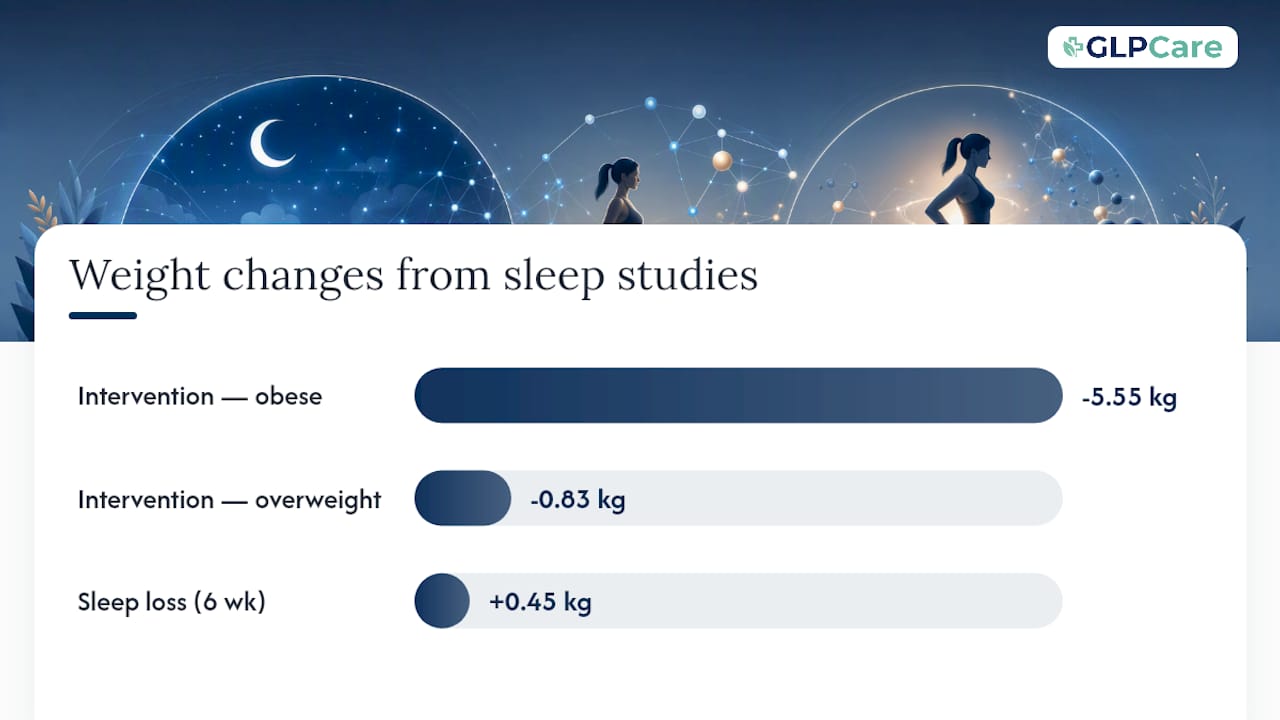
The evidence for sleep as a weight-loss lever isn’t anecdotal anymore. A 2026 systematic review examined behavioral sleep interventions, meaning structured programs like cognitive behavioral therapy for insomnia (CBT-I) and sleep hygiene coaching, across multiple study cohorts. The results were substantial: average BMI reductions of 0.64 kg/m², with weight reductions averaging 5.55 kg in obese cohorts and 0.83 kg in overweight cohorts.
Those numbers matter because they come from interventions that changed sleep specifically, not diet or exercise. The weight change followed the sleep change, which is the kind of evidence that supports a causal link rather than a coincidental one.
Shorter-term trials tell a consistent story from the opposite direction: what happens when sleep gets worse. A six-week trial found that losing around 78 minutes of sleep per night, not an extreme restriction, was associated with nearly a pound (0.45 kg) of weight gain and about 17 extra minutes of daily sedentary behavior. That’s a modest, realistic sleep loss most adults experience during a stressful work week, not a lab-induced extreme.
A separate analysis using a composite sleep-health score, factoring in regularity, satisfaction, alertness, timing, efficiency, and duration together, found that better sleep health predicted greater subsequent weight and fat loss during a 12-month behavioral weight-loss program. The association weakened somewhat after accounting for sleep apnea severity, but it did not disappear, suggesting sleep quality and sleep-disordered breathing act as related but separate factors.
Key research findings worth remembering:
- Behavioral sleep interventions produced BMI reductions averaging 0.64 kg/m² in a 2026 systematic review
- Losing 78 minutes of sleep nightly correlated with roughly 0.45 kg of weight gain over six weeks
- Better composite sleep health scores predicted greater fat loss over a 12-month intervention
- Restricted sleep reduced fat loss during calorie restriction in controlled comparisons, even when calorie intake matched
None of this evidence is perfect. Many of the underlying trials run for weeks rather than years, rely on self-reported sleep logs instead of polysomnography or actigraphy, and study specific populations like adults already enrolled in weight-loss programs. That limits how confidently the findings generalize to, say, a healthy-weight adult trying to maintain rather than lose. Still, the direction of the evidence is remarkably consistent across trial designs, cohort studies, and mechanistic research, which is a stronger signal than any single study could offer alone.
Which Sleep Habits Matter Most for Weight Loss?
“Sleep more” is vague advice that rarely changes behavior. The research points to four specific, trackable dimensions instead: duration, regularity, timing, and efficiency. Each one moves the needle differently, and prioritizing them in order tends to produce faster, more durable results than chasing hours alone.
- Duration: Most adults do best between 7 and 9 hours nightly. Falling consistently below 6 hours is where the hormonal and behavioral effects described earlier tend to intensify.
- Regularity: Going to bed and waking at consistent times, even on weekends, appears to matter as much as total hours in several intervention cohorts. A study using a composite sleep-health measure found regularity was one of several dimensions independently tied to fat-loss outcomes.
- Timing: Sleep that aligns with your natural circadian rhythm, rather than shifted late into the night, supports better glucose regulation the next day.
- Efficiency: The percentage of time in bed actually spent asleep matters more than most people realize. Frequent awakenings fragment restorative sleep stages even when total hours look adequate on paper.
Multidimensional sleep health, addressing several of these factors together rather than fixating on one, tends to outperform single-metric interventions in weight-related outcomes. Someone who sleeps 8 hours but at wildly different times each night may see less benefit than someone sleeping a steadier 7.
Special circumstances change this calculus. Shift workers face a structurally harder path to regularity and often need staggered light exposure and meal timing strategies rather than a fixed bedtime. Adults with diagnosed obstructive sleep apnea (OSA) face a different risk profile entirely, since fragmented breathing during sleep undermines efficiency regardless of how many hours they log. That population usually needs treatment before sleep-based weight strategies can work as intended.
Practical Sleep Changes That Support Weight Loss
Improving sleep for weight management works best as a staged process, not an overnight overhaul. Some changes pay off within days; others take a few weeks of consistency before appetite and energy shift noticeably.
Tonight:
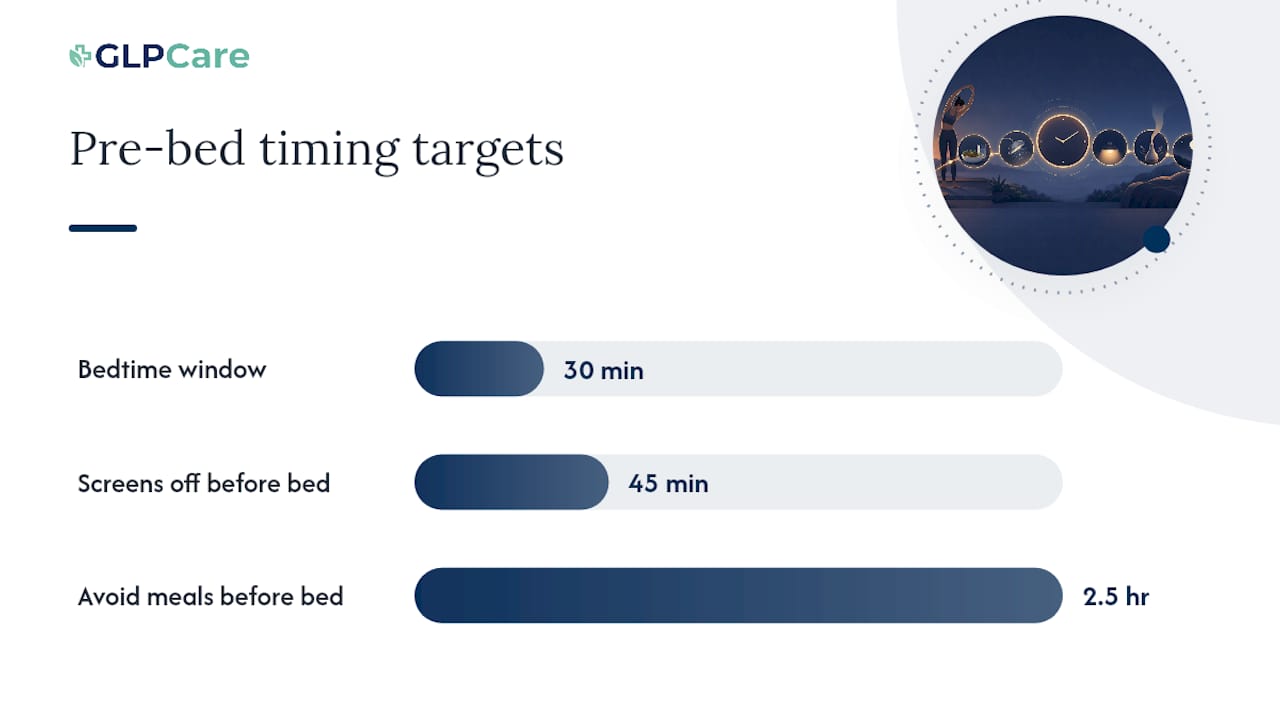
- Set a fixed bedtime and wake time, and hold to it within a 30-minute window even on weekends
- Put screens away 30 to 60 minutes before bed to reduce blue-light interference with melatonin release
- Cut caffeine after early afternoon and avoid large, heavy meals within 2 to 3 hours of bedtime
Over the next 2 to 4 weeks:
- Add sleep gradually rather than all at once. A realistic goal is 30 to 60 extra minutes per night, built up over several weeks
- Borrow elements from CBT-I, the gold-standard behavioral treatment for insomnia, even without a formal diagnosis: fixed wake times, getting out of bed if you can’t sleep after 20 minutes, and reserving the bed for sleep only
- If exercise disrupts your sleep, shift intense sessions earlier in the day; morning light exposure also helps anchor your circadian rhythm
Ongoing:
- Track sleep logs alongside food logs to spot behavioral triggers, like whether late meals correlate with worse sleep efficiency
- Watch trends in a wearable, not single nights, and pair sleep data with waist measurements and weight over 2 to 4 week windows rather than day to day
- Use a protein intake calculator or weight-loss goal calculator to set measurable, realistic targets you can check against your sleep improvements
Pro Tip: Don’t chase a perfect sleep score every night. Look at your seven-day average instead. One rough night rarely matters; a pattern of shortened, fragmented sleep across a week is the signal actually worth acting on.
If you’re also managing a structured nutrition plan, sleep habits and eating habits reinforce each other more than most people expect. A holistic approach to weight management treats sleep as a core input rather than an afterthought, which tends to produce steadier results than treating diet and exercise as the only two levers.
How Should You Use Sleep Tracking to Spot Metabolic Warning Signs?
A wearable device turns sleep from a vague feeling into data you can actually act on. Five metrics matter most for weight-management purposes: total sleep time, sleep regularity, sleep efficiency (how fragmented the night was), resting heart rate, and nightly recovery trends.
Resting heart rate deserves particular attention. A gradual upward drift in resting heart rate, even before the scale moves, can signal metabolic stress building beneath the surface. Practitioners increasingly use this kind of trend data as an early flag, well before weight changes become obvious.
The mistake most people make is reacting to a single bad night. One night of poor sleep, whether from travel, stress, or a late dinner, tells you almost nothing useful on its own. What matters is the multi-night pattern: has your sleep efficiency been sliding for two weeks? Has resting heart rate crept upward alongside shorter sleep? Those trends, cross-referenced with a food log, are far more useful for spotting what’s actually driving a plateau than any single data point.
When reviewing your sleep and biometric trends, prioritize:
- Seven-night rolling averages over single-night readings
- Sleep efficiency and fragmentation, not just total hours logged
- Resting heart rate direction over the past two to three weeks
- Cross-referencing sleep dips with food and activity logs to isolate triggers
Consumer wearables aren’t clinical-grade instruments. They don’t replace polysomnography for diagnosing sleep disorders, and single-night accuracy varies by device and by how the sensor sits against your skin. Understanding what wearable heart-rate accuracy really means helps you read trend data with appropriate confidence instead of over-interpreting one anomalous reading.
When Should You Talk to a Doctor About Sleep and Weight?
Some sleep problems need medical evaluation before any behavioral fix will work. Loud snoring, witnessed pauses in breathing during sleep, and persistent daytime sleepiness despite adequate time in bed are the three biggest red flags for obstructive sleep apnea, and they’re worth raising with a clinician regardless of your weight-loss goals.
- Watch for the classic OSA signs: snoring, gasping or choking during sleep, morning headaches, and daytime fatigue that doesn’t improve with more time in bed.
- Understand the two-way relationship: OSA makes weight loss harder by fragmenting restorative sleep, while excess weight, particularly around the neck and airway, worsens OSA severity. Treating one often helps the other, which is why GLP-1 therapy and sleep apnea are increasingly discussed together in clinical settings.
- Bring it up directly with your primary care provider: ask about a sleep study or home sleep apnea test, and mention any weight-management medications or plans you’re using so treatment can be coordinated rather than managed in isolation.
Clinicians increasingly treat sleep and weight as intertwined rather than sequential problems, adjusting dietary or medication plans once a sleep disorder is identified and addressed.
Making Sleep a Measurable Part of Your Weight Plan
The biggest mistake in most weight-loss advice is treating sleep as passive recovery, something that happens to you rather than something you actively manage. The evidence doesn’t support that framing. Sleep behaves like a third pillar alongside diet and exercise, with its own measurable levers: regularity, efficiency, and timing, not just hours logged.
What strikes me most in this research is how modest the sleep loss needs to be before it shows up on the scale. Seventy-eight minutes isn’t an extreme case; it’s a rough week most adults have lived through repeatedly. That’s precisely why small, consistent sleep changes tend to outperform occasional heroic efforts.
Tools that connect sleep data to daily coaching, rather than isolating it as a separate wellness metric, make this easier to act on. That’s part of why integrated tracking, the kind built into precision GLP-1 care, matters: sleep data means little without context from food intake, activity, and clinician guidance tying it together. Treat sleep with the same seriousness you’d give a food log, and discuss it openly with whoever is guiding your weight-management plan.
— Dominique
Medically Supervised Weight Management That Tracks Your Sleep Too
A clinician-led GLP-1 care program combined with a wearable band that tracks sleep, heart rate, and activity in one connected system can help users understand correlations between sleep and weight loss plateaus.

If you’re already working with a GLP-1 medication or considering one, Glpcare’s Semaglutide Care and Tirzepatide Care plans start at $209 and $299 per month respectively, and both include clinician oversight, personalized nutrition coaching, and access to the GLP Care wearable band that feeds real biometric data, including sleep, back into your program. For adults without a current prescription who still want the full connected system, the GLPCare Membership runs $199 per year. This approach is built for people who want their sleep, dosage, and daily habits managed as one picture rather than three disconnected apps.
Not sure where you stand? Take the GLP-1 readiness quiz to see which plan fits your situation, and if you’re weighing whether supplements belong in your routine alongside better sleep, this evidence-based overview of weight-management supplement options is worth a look before you buy anything.
This article is general information, not a substitute for advice from a qualified doctor. Consult a qualified healthcare professional about your own circumstances before acting on anything here.
Sources
- The effect of behavioral sleep interventions on measures of obesity, dietary intake and related outcomes (Obesity Reviews, 2026)
- How sleep deprivation affects your metabolic health (Stanford Lifestyle Medicine summary)
- Sleep Deprivation: Effects on Weight Loss and Weight Loss Maintenance (narrative review, PMC)
- The association between sleep health and weight change during a 12-month behavioral weight loss intervention (PubMed)
FAQ
Can improving sleep alone help you lose weight?
Better sleep supports weight loss mainly by improving appetite hormones, insulin sensitivity, and daily activity levels rather than burning calories directly. A 2026 systematic review found behavioral sleep interventions alone produced average weight reductions of 5.55 kg in obese cohorts. It works best alongside, not instead of, diet and activity changes.
How much sleep loss actually affects weight?
A relatively small amount. A six-week trial found that losing about 78 minutes of sleep per night was tied to roughly 0.45 kg of weight gain and increased daily sedentary time. That’s a common, realistic sleep deficit, not an extreme one.
Does sleep quality matter more than sleep duration?
Both matter, but quality dimensions like regularity and efficiency independently predict weight outcomes beyond total hours alone. Composite sleep-health research found these multiple dimensions together predicted greater weight and fat loss over a 12-month program.
Can sleep apnea affect weight-loss efforts even if I’m not obese?
Yes. Obstructive sleep apnea fragments restorative sleep regardless of body weight, and it can interfere with the hormonal and metabolic benefits that improved sleep normally provides. If you snore heavily, gasp during sleep, or feel persistently tired despite adequate time in bed, it’s worth discussing OSA screening with a clinician.
What does Glpcare cost, and does it include sleep tracking?
Glpcare’s Semaglutide Care plan starts at $209 per month and Tirzepatide Care starts at $299 per month, both including the wearable band that tracks sleep alongside heart rate and activity. The standalone GLPCare Membership costs $199 per year for those without a current prescription.