Calorie Burn Accuracy in Wearables: What the Research Shows
Calorie Burn Accuracy in Wearables: What the Research Shows

Wearables are not accurate at estimating calories burned. Across independent studies, the typical error runs from roughly 15% to 25% in the best recent testing, and it can climb far higher depending on the device, the activity and your body. The good news: heart rate, sleep and long-term trends are measured far better, and those are the numbers that help you manage your weight. Here is how big the gap is, why it happens, and how to use your data without being misled by it.
GlpcareLook Beyond Calorie Burn EstimatesGLPCare combines wearable insights on heart rate, sleep and activity with personalized nutrition coaching and clinician support for weight management.Explore GLPCareTL;DR
- A 2026 Florida International University study found typical calorie errors of about 15% to 25% across four popular watches.
- Older research found larger gaps: a Stanford study of seven trackers found average errors from 27% to 93% for energy expenditure.
- Errors grow with higher body fat, and activity type matters. Treat the calorie number as a ceiling, not a measurement.
- Heart rate, heart-rate zones and personal trends over time are more dependable than a single day’s calorie total.
- Do not cut food intake aggressively based on a watch estimate. If you take GLP-1 medication, talk to your clinician before changing how much you eat.
Table of Contents
- How accurate are wearables at estimating calories burned?
- How big can the gap get?
- Why calorie estimates vary by device, activity and person
- Which activities are tracked better?
- What to trust instead: heart rate, zones and trends
- How to use a calorie-burn estimate without being misled
- Perspective: why we focus on trends, not a calorie total
- Using wearable data alongside GLP-1 care
- Get a connected plan, not just a number
- FAQ
- Sources
How accurate are wearables at estimating calories burned?
The short answer is: close enough to show direction, not close enough to do math with.
The most recent test comes from Florida International University. Researchers compared four popular watches (Apple Watch Series 8, Fitbit Sense 2, Samsung Galaxy Watch 5 and Garmin Forerunner 955) against a COSMED K5 metabolic analyzer in 58 adults. Typical errors were about 15% to 25%. Apple was the most accurate, while Garmin and Samsung overestimated the most.
That is a good result compared with earlier work. The table below puts the major studies side by side.
| Study | Year | What was tested | What it found |
|---|---|---|---|
| FIU, PLOS One | 2026 | 4 watches vs. metabolic analyzer, 58 adults | Typical errors of about 15% to 25% |
| Stanford Medicine | 2017 | 7 fitness trackers | Best device off by 27% on average, worst by 93% |
| Fuller et al., systematic review | 2020 | Commercial wearables across many studies | No brand within ±3% error more than 13% of the time |
| Chevance et al., meta-analysis | 2022 | Recent Fitbit devices | Average underestimate of 2.77 kcal per minute |
| O’Driscoll et al., BJSM | 2018 | 60 studies, 104 effect sizes | Accuracy varies widely by device and activity type |
Two patterns stand out. First, no brand is reliably accurate. Second, the direction of the error differs. The 2020 review reported that Garmin devices underestimated 69% of the time and Withings devices 74%, while Apple devices overestimated 58% of the time and Polar devices 69%. So you cannot fix the number by simply adding or subtracting a fixed amount.
How big can the gap get?
For many people the error is a nuisance. For some it is large enough to change a plan.
The FIU team reported that for participants with higher body fat, errors reached about 50% to 100% or more: 100 actual calories could show up as 150 or 200. For someone with 35% or more body fat who exercises four hours a week, the watch could be 1,200 to 2,400 calories off per week.
That matters because most calorie-based plans rely on the gap between what you eat and what you burn. Jason Kostrna, lead author of the FIU study, put it plainly: you could be hundreds of calories off each week and land in a surplus when you believe you are in a deficit.
The same study saw some extreme outliers. Fitbit produced implausible readings, including seven that exceeded 450% of the value the metabolic system measured, which the researchers treated as device errors.
An earlier overview by Cailbhe Doherty found that energy expenditure discrepancies ranged from −21.27% to 14.76% depending on the device and the activity. The same piece noted that wearables generally underestimate step counts by about 9%.
In other words, the range of reported error is wide, and that range itself is the finding.

Why calorie estimates vary by device, activity and person
A wearable does not measure calories. It measures movement and pulse, then runs those inputs through an algorithm.
Anna Shcherbina, co-lead author of the Stanford study, explained it this way: heart rate is measured directly, while energy expenditure must be measured indirectly through proxy calculations. She also noted that it is very hard to train an algorithm that is accurate across a wide variety of people, because energy use depends on fitness level, height, weight and more.
Three factors do most of the damage.
Your body
Two people with the same pulse can burn different amounts of energy. Body composition, fitness level and metabolism all shift the true number, and the algorithm only knows what you typed into your profile. The FIU data on higher body fat shows how much this can matter.
The activity
The British Journal of Sports Medicine meta-analysis found that current algorithms may not account for activity type or body posture. Movement-only sensing is limited for non-weight-bearing activities and tends to underestimate energy use during cycling. The same review found that adding heart-rate or heat sensing to movement sensing reduced error in most activity types.
A 2019 study in JMIR mHealth also found that a wrist device had its highest error rates during household chores, a low-to-moderate activity with a lot of arm movement. Larger wrist circumference and higher intensity both predicted bigger errors.
The device and its software
Each brand uses its own sensors and its own model, and the models change with software updates. A number that was off in one direction on last year’s firmware may drift on this year’s. That is one reason a consistent number is not necessarily an accurate one, a point Kostrna made in discussing the 2026 results.
Which activities are tracked better?
No activity is perfectly tracked, but the pattern is consistent enough to plan around.
- Steady walking and running: Typically the best case, because the wrist motion and heart rate follow a predictable rhythm.
- Cycling and other low-arm-movement exercise: Movement-only sensing tends to underestimate, according to the BJSM review.
- Strength training and mixed workouts: Heart rate responds to effort differently than in steady cardio, so energy estimates built on pulse can drift.
- Daily life and chores: Arm movement can inflate or confuse the estimate, as the JMIR study found for household tasks.
If you do a mix of all four, expect errors to vary day to day. That is normal and no reason to stop wearing your device. It is a reason to rely on other signals.
What to trust instead: heart rate, zones and trends
This is where data overload starts to ease. A modern wearable can show dozens of numbers, and most people do not need most of them.
The FIU researchers recommended leaning on measurements wearables handle better, including heart rate and time spent in different heart-rate zones. They also suggested that tracking your own trends over time is more useful than fixating on one day’s calorie total.
A simple filter keeps your dashboard manageable:
- Pick three to five metrics. Resting heart rate, sleep duration, daily activity or steps, heart-rate zones during workouts, and your own weight trend cover most needs.
- Look weekly, not hourly. A week of data smooths out the noise that makes any single day misleading.
- Compare to yourself. Your own baseline is more meaningful than a population average or a friend’s numbers.
- Pair numbers with how you feel. Energy, hunger, sleep quality and recovery add context no sensor can.
- Ignore the calorie total as a target. Use it, if at all, as a rough sense of a hard day versus an easy day.
If you want to go deeper on the metrics that hold up well, our guides on wearable heart rate accuracy, heart-rate zones for fat loss, heart rate recovery and HRV during weight loss explain what each number means and what to do with it.
How to use a calorie-burn estimate without being misled
You do not have to ignore the number. You have to put it in its place.
Kostrna’s advice is to treat the calorie figure as an estimate rather than an exact measurement, and to look at patterns over time alongside heart rate, exercise intensity, changes in body weight and your own experience. The FIU researchers also suggest treating the number as a ceiling and rounding down.
Here is what that looks like in practice.
A worked example. Your watch says you burned 500 calories in a workout. Treating that as a ceiling, you might assume 350 to 400 and not use it as permission to eat extra. If the true figure is closer to the watch, you simply come out slightly ahead. If it is far lower, as it can be for people with higher body fat, you have protected yourself from an accidental surplus.
Check against your scale trend. If your weight trend over three or four weeks does not match what your calorie math predicts, believe the trend. It reflects your actual energy balance, which the watch only guesses at.
Do not under-fuel. The same researchers caution against cutting food too aggressively, because your body still needs fuel to recover and train consistently. A large gap between a calorie target and real intake can backfire, particularly if you are trying to hold on to muscle.

If you are exercising more to support weight loss, build up gradually and listen to your body. For practical guidance on moving with fewer setbacks, these safe exercise habits can help you keep a routine going.
Perspective: why we focus on trends, not a calorie total
We built our program around the idea that one number should never run your plan. The research is clear that calorie-burn estimates from wrist devices carry real error, and that the error can be larger for the people who most want to lose weight. So we do not ask you to chase a daily calorie-burn figure.
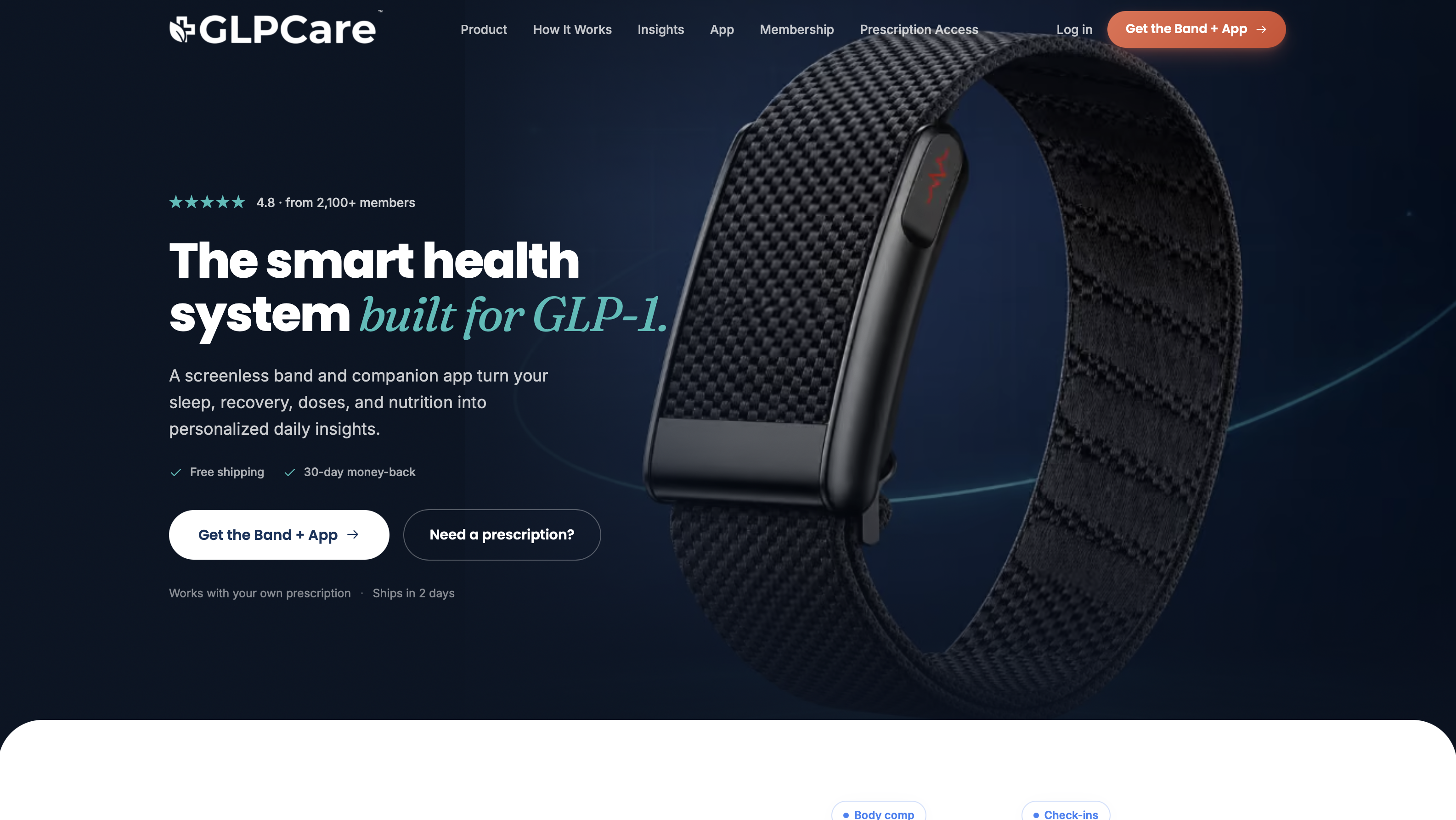
Instead, our screenless band tracks sleep, heart rate and activity levels, and you add your food habits and medication doses in the app. Our AI companion turns that into personalized insights, so you see your patterns over weeks rather than a single day’s score. With a licensed clinician overseeing your medication, those patterns become a conversation about what to adjust, not a guess.
Our system is designed to help you minimize muscle loss while you lose weight. That is why we pair GLP-1 therapy with nutrition coaching and movement guidance: protein, recovery and steady activity matter more than a number on a screen. If a metric does not help you make a better decision this week, you do not need to look at it.
Dominique
Using wearable data alongside GLP-1 care
If you are taking, or considering, a GLP-1 medication such as semaglutide or tirzepatide, accurate food and activity picture matters even more. Appetite often drops on these medications, which makes it easier to under-eat. That is where the “do not cut intake aggressively” advice becomes a safety point. Any change to your eating, activity or dosing belongs in a conversation with your prescribing clinician, not with your watch.
Wearable data is useful here in a different way. Sleep, resting heart rate and activity trends give your clinician a clearer picture between visits. They can show whether you are recovering well, whether your movement has dropped, and whether a plan needs adjusting.
A few places to start on the practical side:
- Movement: Our guide on 150 minutes of cardio on GLP-1 covers how to build activity while preserving muscle.
- Daily activity: NEAT for weight loss explains how everyday movement adds up under clinician oversight.
- Steps: Personalized step targets show how to build toward 10,000 steps with brisk sessions.
- The device itself: Learn the benefits of a screenless band and read our GLP-1 wearable technology guide.
You can also try the free weight loss and GLP-1 tools to set up simple targets before you start.
Get a connected plan, not just a number
If you want clinician-guided GLP-1 care with a band and app that track what matters, GLPCare brings it into one program. Plans are available whether or not you already have a GLP-1 prescription.
The GLPCare Membership is $199 per year. Medication plans start from $209 per month for Semaglutide Care and from $299 per month for Tirzepatide Care, with prescription medication shipped to your home and clinician oversight of your treatment. You can read more about compounded semaglutide and compounded tirzepatide before you decide. Our program also comes with a guaranteed results or money-back promise, and you can see its terms on our site.
FAQ
Which smartwatch is the most accurate for calories burned?
In the 2026 FIU comparison of four popular watches, Apple was the most accurate, while Garmin and Samsung overestimated the most. Even the best performer still showed typical errors in the range of 15% to 25% across the group, so no device should be treated as exact. Use any of them for trends rather than totals.
Why is my watch’s calorie number so different from what I expected?
The watch estimates energy use from movement and heart rate, not by measuring it directly. Your body composition, fitness level and the type of activity all change the true figure, and the algorithm cannot see them. Research also shows errors tend to be larger for people with higher body fat.
Should I eat back the calories my wearable says I burned?
It is safer not to, or to eat back only a portion. The FIU researchers recommend treating the number as a ceiling and rounding down. They also caution against cutting food too much, so aim for steady, adequate fueling and check your weight trend over several weeks.
How do I avoid data overload from my wearable?
Choose a handful of metrics, such as resting heart rate, sleep, heart-rate zones, activity and weight trend, and review them weekly. Researchers suggest leaning on the measurements wearables handle better and watching your own trends over time rather than a single day’s total.
Is a wearable still worth using if calorie numbers are off?
Yes. Heart rate, sleep and activity patterns are valuable for understanding recovery and consistency, and they give your care team useful context. The calorie figure is just one of many outputs, and it is the one to hold most loosely.
Sources
- FIU News: Your smartwatch is lying to you about how many calories you burned
- The Conversation: The higher your body fat percentage, the less accurate your smartwatch is
- EurekAlert: FIU smartwatch calorie study news release
- Stanford Medicine News: Fitness trackers accurately measure heart rate but not calories burned
- PMC: Reliability and Validity of Commercially Available Wearable Devices (Fuller et al.)
- PMC: Accuracy and Precision of Energy Expenditure, Heart Rate, and Steps (Chevance et al.)
- PubMed: How well do activity monitors estimate energy expenditure? (BJSM)
- JMIR mHealth and uHealth: Accuracy of the Multisensory Wristwatch Polar Vantage
- The Conversation: How accurate are wearable fitness trackers? Less than you might think