Clinician-Backed Creatine on GLP-1: 3–5 g, Timing & Safety
Clinician-Backed Creatine on GLP-1: 3–5 g, Timing & Safety
Yes, most healthy adults can safely combine creatine monohydrate with a GLP-1 medication. Creatine won’t stop muscle loss on its own, though. It works by improving how hard you can push during resistance training, and that training is what actually protects lean tissue while you lose weight. If you have kidney disease, are pregnant, or have unexplained lab abnormalities, talk to your prescriber before adding it.
TL;DR:
- Creatine enhances resistance training capacity by speeding up energy production, but its muscle-preserving effects rely heavily on consistent exercise.
- Up to 40 percent of weight loss on GLP-1 therapy can be lean mass, but no direct trial proves creatine prevents this specifically during such treatments.
- Proper creatine dosing involves avoiding loading phases, taking 3 to 5 grams daily, and scheduling around medication timing and hydration needs.
- Creatine raises serum creatinine levels temporarily, so clinicians must interpret kidney tests carefully, especially in those with kidney issues or pregnancy.
- Protein intake and weightlifting are the most effective strategies for muscle preservation, with creatine serving as a useful, well-tolerated supplement when combined with these practices.
Table of Contents
- How Creatine Supports Muscle Performance on a GLP-1
- Does GLP-1 Therapy Really Cause This Much Muscle Loss?
- How Should You Actually Take Creatine on a GLP-1?
- Why Protein and Resistance Training Matter More Than Any Supplement
- What Labs and Symptoms Should You Watch For?
- How a Clinician-Led Program Fits Creatine Into the Picture
- A Measured Take on Creatine and Muscle Preservation
- Get Clinician-Backed Support for Muscle Preservation on GLP-1
- Sources
- FAQ
How Creatine Supports Muscle Performance on a GLP-1
Creatine works inside the muscle cell, not in the bloodstream where GLP-1 medications act. It speeds up ATP resynthesis, the energy cycle your muscles rely on for short bursts of effort like a heavy set of squats or the last few reps of a push-up set. That faster energy turnover lets you train at slightly higher intensity or volume than you could otherwise manage, which is exactly the stimulus muscle needs to hang onto itself during a calorie deficit.
Creatine also pulls water into muscle cells, which is why people often see a small, quick bump on the scale after starting it. That is not fat gain. It’s intracellular fluid, and it typically levels off within a couple of weeks.
None of this happens automatically, though. A PMC review of creatine and exercise found the compound reliably boosts strength and lean-mass gains only when paired with resistance training. Without a training stimulus, creatine’s independent effect is minimal.
For someone managing appetite suppression and reduced food intake on a GLP-1, that distinction changes how you should think about supplementation:
- Creatine amplifies the workouts you do. It does not replace them.
- Hydration matters more here, since GLP-1 drugs already blunt thirst signals and creatine increases the muscle’s water demand.
- Skipping resistance training and taking creatine anyway will do very little for muscle preservation.
Does GLP-1 Therapy Really Cause This Much Muscle Loss?
The concern about lean mass isn’t hypothetical. Clinical substudies using DXA scans show that lean body mass can account for roughly 20 to 40 percent of total weight lost during GLP-1 therapy. That range is wide because “lean mass” on a DXA scan includes water, connective tissue, and organ mass, not purely contractile muscle. Still, even a conservative reading of these data means a meaningful share of the weight coming off is not fat.
By the Numbers: Up to 40 percent of weight lost on GLP-1 therapy in some analyses is lean mass, according to DXA substudy data reported by UC Davis Health.
Here’s where the research gets more cautious. A 2026 editorial in the Journal of Nutritional Physiology frames creatine as a promising adjunct for preventing muscle atrophy in patients on incretin-based therapies like semaglutide and tirzepatide, but the authors are explicit that direct trial evidence in this specific population is still needed. The International Society of Sports Nutrition’s position stand backs creatine’s general safety and performance benefits, but that stand was built on decades of athletic and older-adult research, not GLP-1 users specifically.
What that means in practice:
- No large randomized controlled trial has proven creatine prevents muscle loss specifically during GLP-1 treatment.
- Label reviews of Wegovy, Ozempic, Zepbound, and Mounjaro show no listed pharmacokinetic interaction with creatine, though “not listed” reflects an absence of formal study rather than a tested and cleared interaction.
- The evidence that exists supports creatine as a reasonable, well-tolerated adjunct, not a proven fix.
How Should You Actually Take Creatine on a GLP-1?
Dosing creatine correctly matters more when you’re also managing nausea, reduced appetite, and a sensitive gut from a GLP-1 medication. Here’s a practical sequence:
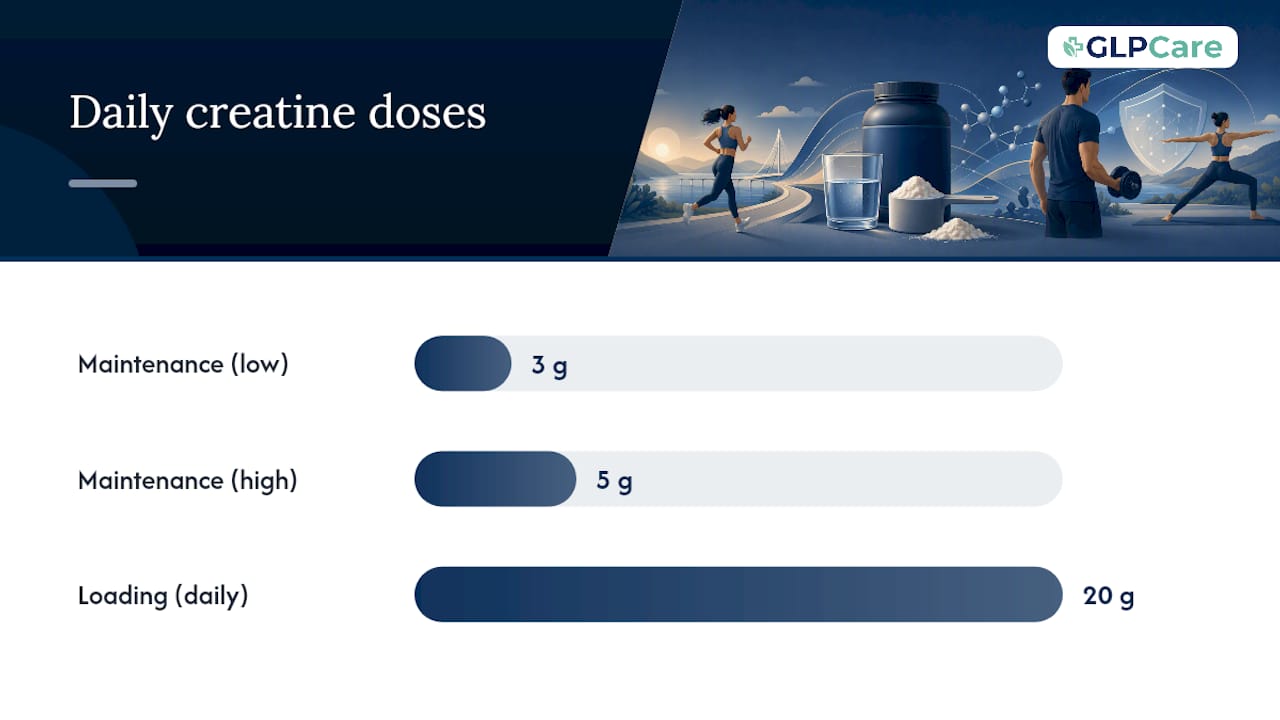
- Skip the loading phase. A traditional loading protocol (20 grams a day for a week) speeds up muscle saturation but raises GI upset risk, which is the last thing you need during dose titration. A steady maintenance dose reaches full saturation in about three to four weeks with far less stomach stress.
- Take 3 to 5 grams daily. That’s the maintenance range backed by sports nutrition research, and it’s enough for the strength and training benefits most people are after.
- Choose plain, micronized creatine monohydrate. It’s the best-studied form. If pill fatigue or low appetite make swallowing another capsule unappealing, a gummy or a small scoop mixed into a protein shake works just as well.
- Time it around oral semaglutide, if that’s your medication. Oral semaglutide requires an empty stomach, minimal water, and a 30-minute wait before any food, drink, or other oral supplement. Take creatine well outside that window. Injectable GLP-1s like Wegovy, Ozempic, Zepbound, and Mounjaro carry no such timing restriction, so creatine can go with any meal.
- Build a hydration schedule, not a thirst response. GLP-1 medications dull thirst cues, and creatine draws extra water into muscle tissue. Sip water at set intervals through the day instead of waiting to feel thirsty.
Pro Tip: If you’re mid-dose-escalation on your GLP-1 and dealing with nausea or loose stools, hold off on starting creatine until symptoms settle. Adding a new supplement during the roughest weeks of titration makes it hard to tell which product is causing what.
Pause creatine entirely during active vomiting or diarrhea, and resume once you’re keeping fluids and food down normally.
Why Protein and Resistance Training Matter More Than Any Supplement
Creatine is a helper. Protein intake and resistance training are the actual load-bearing strategies for keeping muscle while you lose weight on a GLP-1, and neither should take a back seat to a supplement routine.
Aim for roughly 1.2 to 2.0 grams of protein per kilogram of body weight per day, leaning toward the higher end if you’re older or training hard. On a lower-appetite day, that might mean prioritizing a protein shake or Greek yogurt over trying to force down a full meal. A protein-first meal plan built around your GLP-1 schedule makes hitting that number far less of a guessing game.
On the training side:
- Lift weights multiple times per week, focusing on compound movements: squats, rows, presses, deadlifts or their machine equivalents.
- Prioritize progressive overload over workout length. A focused 20-minute session on a low-energy day beats skipping the gym entirely.
- Track strength numbers and how your clothes fit, not just the scale. A stalled or slowly climbing bench press while the scale drops is a good sign you’re preserving muscle rather than just losing weight.
What Labs and Symptoms Should You Watch For?
Creatine supplementation raises serum creatinine, a lab marker doctors use to estimate kidney function, even when actual kidney filtration (GFR) stays completely normal. That’s a lab artifact, not kidney damage, but your clinician needs to know you’re taking creatine so they don’t misread a routine kidney panel as a red flag. If there’s genuine concern, a cystatin C test or direct GFR measurement can clarify the picture.
Creatine can elevate creatinine readings on standard labs without reducing actual kidney filtration, according to nephrology guidance on interpreting kidney function tests.
Stop and call your clinician if you experience:
- Persistent vomiting or diarrhea that won’t resolve
- Inability to keep fluids down for more than a day
- Known kidney disease or a new abnormal kidney lab result
- Pregnancy, which warrants a full supplement review with your provider
How a Clinician-Led Program Fits Creatine Into the Picture
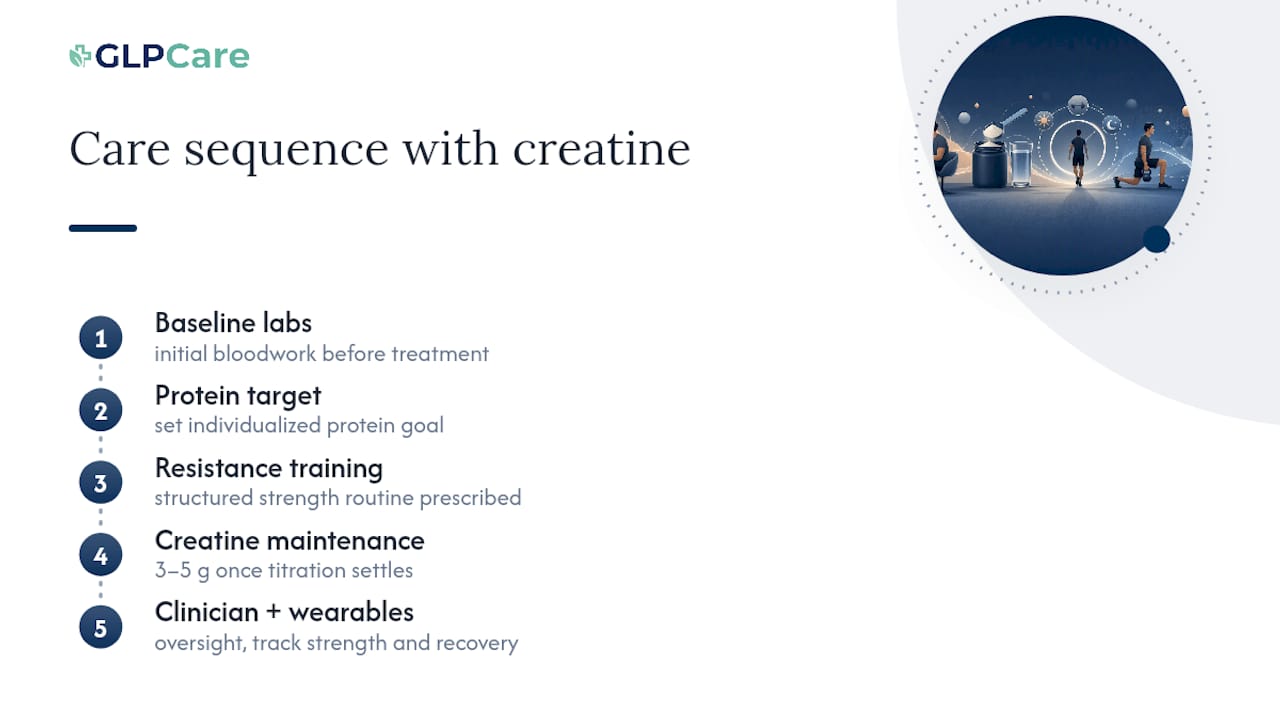
A well-run GLP-1 program treats creatine as one piece of a larger plan, not a stand-alone fix. Structured care typically follows a sequence: baseline labs, a protein target, a resistance training routine, then creatine at maintenance dose once titration symptoms settle. GLPCare’s clinical model pairs clinician oversight with wearable tracking of activity and sleep, so strength trends and recovery patterns are visible alongside any lab changes, not guessed at after the fact.
A Measured Take on Creatine and Muscle Preservation
The honest answer here is less exciting than the hype suggests. Creatine is not going to save your muscle mass if you’re not lifting weights and eating enough protein. It is a solid, low-risk addition for people who are already doing that work and want a small performance edge. Expect a little extra water weight in the first couple of weeks, don’t panic about it, and watch your strength numbers instead of the scale. If you have kidney history, are pregnant, or develop new GI symptoms, loop in your prescriber before you start.
— Dominique
Get Clinician-Backed Support for Muscle Preservation on GLP-1
Figuring out creatine timing, protein targets, and training on your own while managing a GLP-1 prescription is a lot to track without help. Some structured GLP-1 weight management programs build support into the care plan: clinician oversight, nutrition coaching focused on hitting protein targets, and a wearable band that tracks activity and recovery so patients and their care team can see whether strength and function are holding steady, not just the number on the scale.

If you’re weighing whether a structured, monitored approach makes sense for you, the GLP-1 Readiness Quiz takes a few minutes and gives you a clear next step. Curious what your protein target actually looks like in grams per meal? The Protein Intake Calculator turns the 1.2 to 2.0 g/kg range into a number you can actually plan around. Start there, and see what a clinician-guided program could look like for you.
Sources
- Creatine supplementation for preventing muscle atrophy in patients taking incretin-based pharmacotherapies: a perspective (Journal of Nutritional Physiology, 2026)
- UC Davis Health — GLP-1 systemic impact coverage
- PMC review on creatine and exercise (PMC3970209)
- My Kidney Specialist — How to read kidney function tests
This article is general information, not a substitute for advice from a qualified doctor. Consult a qualified healthcare professional about your own circumstances before acting on anything here.
FAQ
Can I Take Creatine on Ozempic or Wegovy?
Yes, for most healthy adults. No current prescribing information for Ozempic, Wegovy, Zepbound, or Mounjaro lists a pharmacokinetic interaction with creatine, though direct interaction studies haven’t been done.
Why Did I Gain 10 Pounds After Starting Creatine?
That’s almost always water retention inside muscle cells, not fat or muscle gain, and it typically settles within a few weeks. A jump that large this fast is worth mentioning to your clinician, especially if it doesn’t level off.
Why Do Some Doctors Advise Caution With Creatine?
Some providers hesitate because creatine raises serum creatinine on standard labs, which can look like reduced kidney function even when actual filtration is normal. Telling your clinician you’re supplementing lets them interpret your labs correctly.
What Supplements Should I Avoid on a GLP-1?
There’s no universal banned list, but supplements that irritate the stomach or worsen dehydration deserve extra caution given how GLP-1 medications already slow digestion and blunt thirst. When in doubt about a specific product, review it with your prescriber rather than guessing.
Does Creatine Actually Prevent Muscle Loss on GLP-1s?
Creatine supports muscle preservation indirectly by improving resistance-training performance. It’s not a standalone fix. Protein intake and consistent strength training remain the two factors with the strongest evidence behind them.