Zepbound vs Wegovy: Which GLP-1 Is Right for You?
Zepbound vs Wegovy: Which GLP-1 Is Right for You?
TL;DR:
- Clinical trials show tirzepatide leads to greater weight loss than semaglutide, but individual factors and medical indications influence the best choice. Wegovy is FDA-approved for cardiovascular risk reduction and certain liver conditions, while Zepbound offers stronger average weight reduction with its dual mechanism. Structured, monitored care programs like Glpcare improve persistence and help manage side effects during treatment.
Tirzepatide (Zepbound) produces greater average weight loss than semaglutide (Wegovy) in head-to-head clinical data, but the right choice for you depends on your comorbidities, insurance coverage, and how your body tolerates each drug. In the SURMOUNT-5 trial, participants on tirzepatide lost a notably higher average percentage of body weight than those on semaglutide over a comparable timeframe. That gap is clinically meaningful. Still, Wegovy holds specific FDA-approved indications for cardiovascular risk reduction and certain liver conditions that tirzepatide currently does not, which matters for patients with established heart disease or metabolic-associated steatohepatitis.
| Dimension | Zepbound (tirzepatide) | Wegovy (semaglutide) |
|---|---|---|
| Average weight loss (trial) | ~20.2% body weight (SURMOUNT-5) | ~13.7% body weight (SURMOUNT-5) |
| Mechanism | Dual GIP + GLP-1 agonist | GLP-1 agonist only |
| FDA indications | Chronic weight management; obstructive sleep apnea | Chronic weight management; CV risk reduction; MASH (noncirrhotic) |
| Common side effects | Nausea, diarrhea, vomiting, constipation | Nausea, diarrhea, vomiting, constipation |
| Dosing | Weekly injection; 2.5 mg start, up to 15 mg | Weekly injection; 0.25 mg start, up to 2.4 mg |
| Payer/access note | Manufacturer savings card available; prior auth common | Manufacturer savings card available; prior auth common |
Quick picks:
- Prioritizing maximum average weight loss: Zepbound’s dual-agonist mechanism consistently delivers larger mean reductions in registration and head-to-head trials.
- Established cardiovascular disease or MASH: Wegovy carries specific FDA labeling for CV risk reduction and noncirrhotic MASH that tirzepatide currently does not.
- Adolescent eligibility: Wegovy is approved for patients 12 and older; Zepbound’s label covers adults only.
- Wanting supervised, tech-enabled care: GLPCare integrated GLP-1 care pairs either medication with clinician follow-up, a wearable, and AI-driven nutrition coaching for continuous monitoring.
TL;DR: Talk to your clinician about which indication fits your health profile. If you want guided care with built-in monitoring, take Glpcare’s GLP-1 Readiness Quiz to check your eligibility before your next appointment.
Table of Contents
- Zepbound vs Wegovy: Side-by-side profiles
- What does the clinical evidence actually show?
- What are the side effects and safety warnings?
- How are these medications dosed and titrated?
- How do you choose between Zepbound and Wegovy?
- Switching between Wegovy and Zepbound: what to know
- What does Zepbound or Wegovy actually cost?
- Key Takeaways
- Why supervised GLP-1 care changes the outcome
- Glpcare’s integrated GLP-1 program: a clear next step
- Useful sources
- FAQ
Zepbound vs Wegovy: Side-by-side profiles
Zepbound (tirzepatide)
- FDA-approved indications: — Chronic weight management in adults with BMI ≥30, or ≥27 with at least one weight-related condition; obstructive sleep apnea in adults with obesity
Wegovy (semaglutide)
- FDA-approved indications: — Chronic weight management in adults (BMI ≥30, or ≥27 with comorbidity) and adolescents 12+; reduction of serious cardiovascular events in adults with established CVD and obesity or overweight; noncirrhotic metabolic-associated steatohepatitis (MASH) with liver fibrosis
GLPCare integrated GLP-1 care
GLPCare is not a competing molecule — it is a supervised care program that can support you on either tirzepatide or semaglutide. The program combines clinician-prescribed GLP-1 medication (shipped to your home), a proprietary wearable fitness band with medical-grade sensors, an AI-driven app for dose tracking and personalized nutrition coaching, and ongoing clinician follow-up. The wearable monitors sleep, heart rate, and activity in real time, feeding data back to your care team so adjustments happen between appointments, not only at them. For patients who want more than a prescription, this connected model is designed to improve persistence and minimize muscle loss during active weight loss.
What does the clinical evidence actually show?
The most direct answer to “which is better” comes from SURMOUNT-5, a head-to-head randomized controlled trial published in the New England Journal of Medicine that compared tirzepatide and semaglutide directly in adults with obesity. Participants on tirzepatide lost approximately 20.2% of body weight versus roughly 13.7% for semaglutide over the trial period. That difference held across multiple secondary endpoints.
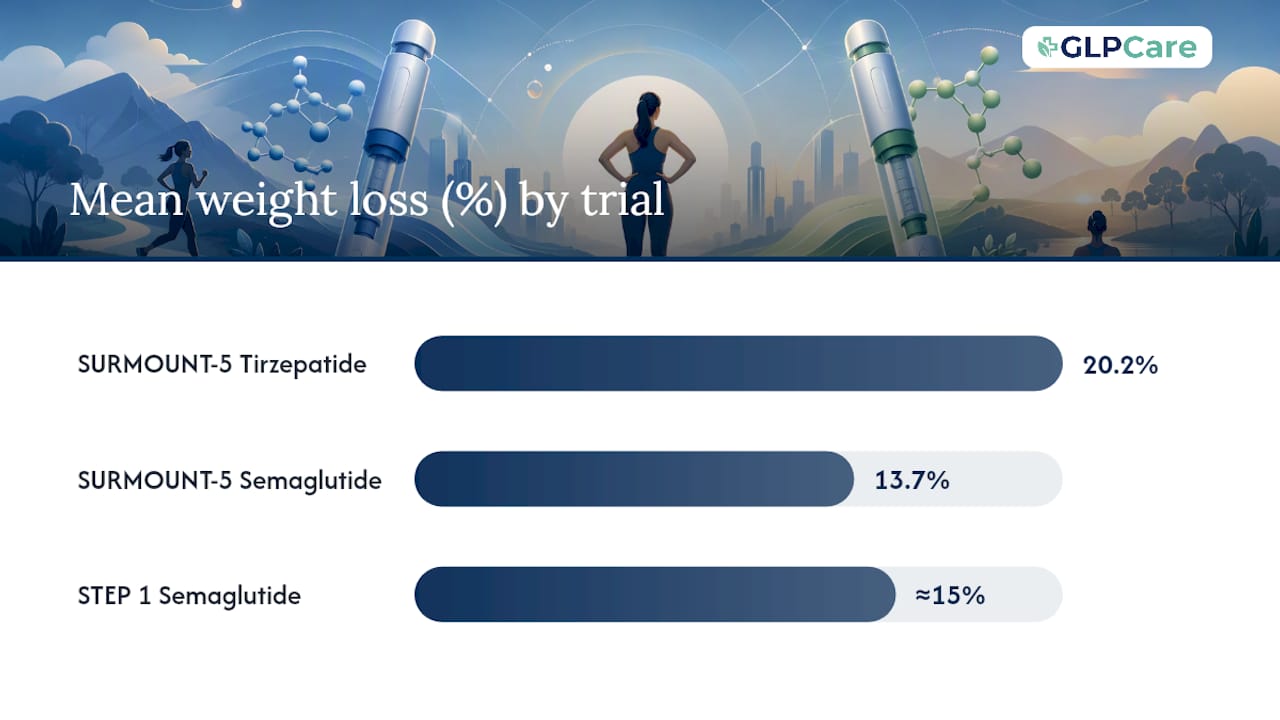
Before SURMOUNT-5, the comparison relied on cross-trial inference. The SURMOUNT program (tirzepatide) and the STEP program (semaglutide) each ran separate registration trials against placebo, not against each other. SURMOUNT-1 reported mean weight loss of approximately 20–22% at the highest tirzepatide dose over 72 weeks. The STEP 1 trial reported approximately 15% mean weight loss with semaglutide 2.4 mg over 68 weeks. Cross-trial comparisons carry limitations — different populations, run-in periods, and endpoints — which is precisely why SURMOUNT-5’s direct comparison carries more weight.
| Trial | Drug | Comparator | Mean weight loss | Duration |
|---|---|---|---|---|
| SURMOUNT-5 | Tirzepatide (up to 15 mg) | Semaglutide (up to 2.4 mg) | ~20.2% vs ~13.7% | 72 weeks |
| SURMOUNT-1 | Tirzepatide (5/10/15 mg) | Placebo | ~15% (dose-dependent) | 72 weeks |
| STEP 1 | Semaglutide 2.4 mg | Placebo | ~15% | 68 weeks |
| SELECT (CV) | Semaglutide 2.4 mg | Placebo | Reduced major CV events | — |
Key finding: Peer-reviewed analyses consistently show tirzepatide’s dual-agonist mechanism produces larger mean weight-loss percentages than GLP-1–only agents, though individual responses vary and cardiovascular outcomes data currently favor semaglutide for labeled indications.
A few things worth keeping in mind when reading trial averages: these are mean results across large populations. Some patients on semaglutide lose more than the tirzepatide average; others on tirzepatide lose less than the semaglutide average. Genetics, baseline metabolic health, dietary adherence, and how well GI side effects are managed all influence where you land. Trial averages tell you what to expect statistically, not what you personally will achieve.
The SELECT trial is the other landmark number that matters here. Semaglutide 2.4 mg reduced the risk of major adverse cardiovascular events in adults with established CVD and overweight or obesity, which led directly to Wegovy’s FDA labeling for CV risk reduction. Tirzepatide does not yet carry that label, though cardiovascular outcome trials are ongoing.
What are the side effects and safety warnings?
Both drugs share a nearly identical GI side-effect profile because both slow gastric emptying and act on appetite centers in the brain. Nausea, diarrhea, vomiting, and constipation are the most common complaints, and they tend to peak during dose escalation then ease as your body adjusts. Published comparative reviews confirm the overlap is substantial, with some trial-reported differences in frequency for specific events.
Common side effects (both drugs):
- Nausea (most frequent, especially in weeks 1–8)
- Diarrhea and constipation (often alternating)
- Vomiting
- Injection-site reactions (redness, bruising, itching)
- Fatigue, particularly during titration
- Headache
Serious risks and boxed warnings (both drugs):
Both tirzepatide and semaglutide carry an FDA boxed warning for thyroid C-cell tumors based on animal studies. Neither drug is recommended for patients with a personal or family history of medullary thyroid carcinoma (MTC) or Multiple Endocrine Neoplasia syndrome type 2 (MEN2). This is a class-level warning, not specific to one drug.
Additional serious risks to discuss with your clinician:
- Pancreatitis: Discontinue if acute pancreatitis is suspected; do not restart.
- Gallbladder disease: Cholelithiasis and cholecystitis have been reported; monitor for right-upper-quadrant symptoms.
- Hypoglycemia: Risk increases significantly when combined with insulin or sulfonylureas in patients with type 2 diabetes.
- Acute kidney injury: Usually secondary to dehydration from GI side effects; stay well hydrated.
- Suicidal ideation: Both labels include a monitoring note; report mood changes promptly.
Population-specific cautions:
- Pregnancy: Both drugs should be discontinued at least two months before a planned pregnancy. Neither is recommended during pregnancy.
- Adolescents: Wegovy is approved for patients 12 and older; Zepbound’s current label covers adults only.
- Renal or hepatic impairment: No dose adjustment is required for mild-to-moderate impairment, but close monitoring is warranted.
Pro Tip: Start with small, low-fat meals and avoid lying down for two hours after eating during the first four to eight weeks of titration. Simple antiemetic strategies, like ginger tea or an over-the-counter antiemetic taken 30 minutes before your injection, can meaningfully reduce nausea and improve your chances of staying on the medication long enough to see results.
For a deeper look at tirzepatide-specific tolerability patterns, Glpcare’s guide on tirzepatide side effects covers what to expect week by week.
How are these medications dosed and titrated?
Both drugs are weekly subcutaneous injections, but their titration schedules differ in starting dose, step intervals, and available maintenance strengths.
Semaglutide (Wegovy) titration
- Weeks 1–4: 0.25 mg once weekly
- Weeks 5–8: 0.5 mg once weekly
- Weeks 9–12: 1 mg once weekly
- Weeks 13–16: 1.7 mg once weekly
- Week 17+: 2.4 mg once weekly (maintenance dose)
Semaglutide’s titration is slightly faster in terms of reaching maintenance, though the dose steps are smaller in absolute terms. For detailed timing on when semaglutide’s effects typically become noticeable, Glpcare’s article on when Wegovy starts working breaks down the dose-response timeline.
What to expect during titration:
- GI side effects are most intense in the first four to eight weeks and usually improve as your body adapts.
- Meaningful weight loss often begins within the first four weeks, with the steepest decline typically occurring between weeks 8 and 20 as doses increase.
- Fatigue and reduced appetite are normal early signals that the medication is working.
Patient checklist for weeks 1–12:
- Log nausea, vomiting, and GI symptoms daily for the first four weeks.
- Note injection-site reactions after each dose.
- Record your weight weekly at the same time of day.
- Contact your clinician if you experience severe abdominal pain, persistent vomiting, or signs of dehydration.
- Confirm your next dose escalation date at every check-in.
How do you choose between Zepbound and Wegovy?
The Endocrine Society’s guidelines recommend pharmacotherapy for adults with a BMI ≥30, or ≥27 with at least one weight-related comorbidity, when lifestyle intervention alone has not produced sufficient results. Within that eligible population, the choice between tirzepatide and semaglutide comes down to four axes: efficacy target, comorbidity benefit, tolerability, and insurance coverage.
Decision framework:
- Efficacy is the top priority: Tirzepatide’s dual-agonist mechanism consistently produces larger average weight loss. If your primary goal is maximum percent body-weight reduction and you have no contraindications, tirzepatide is the stronger evidence-based choice.
- Established cardiovascular disease: Wegovy has FDA labeling for reducing major adverse cardiovascular events in adults with overweight or obesity and established CVD. If your cardiologist is co-managing your care, that label matters for both clinical and insurance reasons.
- Obstructive sleep apnea: Zepbound has an FDA-approved indication for OSA in adults with obesity, which can support payer coverage for that specific condition.
- Adolescent patients: Wegovy is approved for ages 12 and up; Zepbound is currently adults only.
- MASH (noncirrhotic): Wegovy carries labeling for metabolic-associated steatohepatitis with liver fibrosis, relevant for patients with confirmed MASH on biopsy.
- Insurance and step therapy: Your insurer may require a prior authorization, documented prior weight-loss attempts, or specific comorbidity documentation. The drug with the better-fitting indication for your chart often gets approved faster.
Questions to bring to your clinician:
- Does my BMI and comorbidity profile qualify me for both drugs under my insurance plan?
- Do I have a history of MTC, MEN2, pancreatitis, or gallbladder disease that would rule out either option?
- Am I on insulin or a sulfonylurea that increases hypoglycemia risk?
- Am I planning a pregnancy in the next 12 months?
- Which drug does my pharmacy benefit cover, and what is my expected out-of-pocket cost?
- What is the monitoring plan for the first six months?
Pro Tip: Document every prior weight-loss attempt — programs, medications, duration, and outcome — in writing before your appointment. Insurers often require evidence of prior attempts as a condition of approval, and a clear, dated record submitted with your prior authorization request can cut approval time significantly.
Switching between Wegovy and Zepbound: what to know
Switching from one GLP-1 therapy to another is common, and the most frequent reason is inadequate weight loss response, intolerable side effects, or a change in insurance coverage. There is no single FDA-endorsed switching protocol, but clinical practice typically involves restarting titration at a lower dose and re-escalating based on tolerance, rather than jumping to an equivalent maintenance dose.
Why people switch:
- Insufficient weight loss on semaglutide (the most common reason for moving to tirzepatide)
- GI side effects that are better tolerated on one drug versus the other
- Insurance formulary changes or prior authorization denials
- New comorbidity diagnosis that favors one drug’s labeling
Practical switching steps:
- Confirm your last dose date and document it for your prescriber.
- Expect to restart at the lowest available dose of the new drug and re-titrate over several weeks.
- Monitor GI tolerance closely in the first four weeks after switching — the new drug may feel different even if you were tolerant of the previous one.
- Track glycemic control if you have type 2 diabetes; switching agents can shift insulin sensitivity.
- Keep a symptom log to support any payer documentation your clinician needs for the new prior authorization.
Operational barriers and workarounds:
Prior authorization for the second drug often requires documentation that the first drug was tried at an adequate dose for a sufficient duration (typically at least 12 weeks at maintenance). Keep records of your titration history, weight-loss trajectory, and any side effects that limited dose escalation. Supply shortages have affected both drugs at various points; your pharmacist can often advise on current availability and whether a different pen size or strength is in stock.
What does Zepbound or Wegovy actually cost?
Cost is one of the most practical barriers to GLP-1 therapy, and the numbers are significant. Both drugs carry list prices in the range of $1,000–$1,400 per month without insurance, though actual out-of-pocket costs vary widely depending on your plan, your state, and whether you qualify for manufacturer assistance. Real-world access remains a major limiter of clinical benefit, and prior authorization is still common even when coverage exists.
Insurance coverage patterns:
- Coverage for weight management (obesity indication) is inconsistent. Many commercial plans cover GLP-1s for type 2 diabetes but not for obesity alone, which is why your comorbidity documentation matters.
- Wegovy’s CV risk reduction label has opened new coverage pathways for patients with established cardiovascular disease on some commercial and Medicare Advantage plans.
- Medicare Part D coverage for weight-management drugs expanded under recent policy changes, though formulary inclusion varies by plan.
- Step therapy requirements are common: insurers may require documented trials of lifestyle programs or lower-cost medications before approving a GLP-1.
Manufacturer assistance programs:
- Eli Lilly (Zepbound) and Novo Nordisk (Wegovy) both offer savings cards for eligible commercially insured patients, which can reduce monthly costs substantially.
- Patient assistance programs exist for uninsured or underinsured patients who meet income criteria; eligibility and benefit levels change, so check each manufacturer’s current program directly.
Practical tips to improve approval odds:
- Submit documentation of BMI, comorbidities, and prior weight-loss attempts with the initial prior authorization request.
- Ask your clinician to include the specific FDA-approved indication that matches your chart (CV risk reduction, OSA, MASH) rather than a generic obesity diagnosis.
- Use shared decision-making documentation to show the clinical rationale for the chosen drug.
For a detailed breakdown of coverage strategies, Glpcare’s guide on GLP-1 insurance coverage covers prior authorization tactics and what to do if your claim is denied. Patients without insurance coverage can also review safe options for accessing semaglutide through telehealth programs.
Access note: NIDDK data shows that more than 40% of U.S. adults meet BMI-based criteria for pharmacotherapy consideration, yet cost and coverage gaps mean most eligible patients never access these medications.
Key Takeaways
Tirzepatide (Zepbound) produces greater average weight loss than semaglutide (Wegovy) in head-to-head trial data, but the best choice depends on your comorbidities, insurance coverage, and how your body responds to each drug.
| Point | Details |
|---|---|
| Efficacy difference | SURMOUNT-5 showed ~20.2% weight loss with tirzepatide vs ~13.7% with semaglutide over 72 weeks. |
| Comorbidity labeling | Wegovy holds FDA labels for CV risk reduction and noncirrhotic MASH; Zepbound holds one for obstructive sleep apnea. |
| Shared safety profile | Both carry a boxed warning for thyroid C-cell tumors and share the same core GI side-effect profile. |
| Cost and access | Both drugs list at roughly $1,000–$1,400/month; prior authorization and comorbidity documentation drive coverage decisions. |
| Glpcare integrated care | Glpcare supports patients on either medication with clinician follow-up, a wearable, and AI nutrition coaching to improve persistence and safety monitoring. |
Why supervised GLP-1 care changes the outcome
The clinical trial numbers for Zepbound and Wegovy are compelling, but trials run under conditions most patients never experience: frequent monitoring visits, structured dietary guidance, and protocol-driven dose adjustments. In real-world practice, persistence is the variable that matters most. Patients who discontinue GLP-1 therapy within the first six months rarely achieve the weight-loss outcomes the trials report.
This is the gap Glpcare is built to close. The program pairs your GLP-1 prescription with a proprietary wearable fitness band that tracks sleep quality, heart rate variability, and activity levels continuously, not just at scheduled appointments. That biometric data feeds into an AI-driven app that generates personalized nutrition and recovery insights calibrated to your current dose and activity load. Licensed clinicians review your progress and can adjust your care plan between visits, which is where most real-world programs fall short.
The muscle-preservation piece deserves specific attention. Rapid weight loss on GLP-1 therapy carries a real risk of lean mass loss alongside fat loss. Glpcare’s protein intake calculator and nutrition coaching are designed to keep your protein targets aligned with your weight-loss rate, which matters for long-term metabolic health and functional strength. A prescription alone does not address that. A connected care program does.
Glpcare’s integrated GLP-1 program: a clear next step
Whether you are leaning toward Zepbound or Wegovy, the medication is only part of the picture. Glpcare’s program gives you clinician-prescribed GLP-1 medication shipped to your door, a medical-grade wearable fitness band that tracks your biometrics in real time, and an AI-driven app that turns that data into personalized nutrition and dosing guidance. Clinician support continues between appointments, not just at them.

The program is available with or without an existing GLP-1 prescription, and plans cover both tirzepatide and semaglutide pathways. If you are not sure which medication fits your health profile, the GLP-1 Readiness Quiz takes about three minutes and gives you a clear starting point for your clinician conversation. Take the quiz now and bring your results to your next appointment.
This article provides general health information and is not a substitute for professional medical advice. Confirm current prescribing guidelines, eligibility criteria, and coverage details with your clinician or a licensed healthcare provider.
Useful sources
- fda.gov
- Healthline
- accessdata.fda.gov
- NEJM
- PMC article
- Medical News Today
- UCHealth Today
- niddk.nih.gov
- endocrine.org
FAQ
Why do people switch from Wegovy to Zepbound?
The most common reason is insufficient weight loss. SURMOUNT-5 data show tirzepatide produces roughly 6–7 percentage points more average body-weight loss than semaglutide, which leads many patients and clinicians to switch when the response to semaglutide plateaus.
Which GLP-1 medication has the fastest weight loss?
Tirzepatide (Zepbound) produces greater average weight loss over comparable trial periods, with SURMOUNT-5 reporting approximately 20.2% body-weight reduction versus 13.7% for semaglutide (Wegovy) at 72 weeks.
What has worse side effects, Wegovy or Zepbound?
Both drugs share the same core GI side-effect profile (nausea, diarrhea, vomiting, constipation), and neither is clearly worse overall. Individual tolerance varies; some patients find one drug easier to manage than the other, which is one reason switching is common.
Why are people stopping Wegovy?
The most frequently reported reasons are GI side effects during titration, high out-of-pocket cost when insurance does not cover the obesity indication, and switching to tirzepatide for greater efficacy. Slow titration and proactive GI management improve persistence on either drug.
Can Glpcare support me on either Zepbound or Wegovy?
Yes. Glpcare’s integrated program supports patients on both tirzepatide and semaglutide pathways, combining clinician-prescribed medication, a wearable for biometric monitoring, and AI-driven nutrition coaching. Take the GLP-1 Readiness Quiz to see which option fits your profile.