GLP-1 Insurance Coverage: What You Need to Know in 2026
GLP-1 Insurance Coverage: What You Need to Know in 2026
TL;DR:
- Insurance coverage for GLP-1 medications depends on the drug’s indication, the insurance plan type, and whether prior authorization is approved. Coverage varies widely, with some plans covering for diabetes or cardiovascular uses, while obesity-only coverage remains limited and often requires strong documentation. Proper preparation, including detailed medical records, BMI calculations, and understanding plan-specific criteria, significantly increases the chances of approval and ongoing coverage.
Whether your insurance will cover a GLP-1 medication depends on three things: your insurance type, the drug’s FDA-approved indication that matches your diagnosis, and whether your plan’s formulary includes that drug with or without prior authorization. Coverage for GLP-1s prescribed for Type 2 diabetes is common across commercial plans, Medicare Part D, and many Medicaid programs. Coverage for weight loss alone is far more variable and often requires a separate obesity benefit that many employer plans still exclude. Your single most useful next step: pull up your plan’s formulary online, search for the specific drug name, and call your insurer or pharmacy benefit manager (PBM) to request the prior authorization (PA) criteria in writing.
Three policy anchors shape what you will find. First, CMS launched the Medicare GLP-1 Bridge demonstration on July 1, 2026, giving eligible Part D beneficiaries access to certain GLP-1s at a flat $50 monthly copay outside the standard Part D benefit. Second, PBMs like CVS Caremark publish detailed PA criteria documents that list exactly which indications, BMI thresholds, and step-therapy requirements apply. Third, manufacturer resources from Novo Nordisk provide PA templates and denial-and-appeal guides that prescribers can use to build a complete submission packet.
Table of Contents
- How does GLP-1 insurance coverage differ across payers?
- Which GLP-1 drugs do insurers commonly reference in coverage rules?
- What clinical criteria do insurers require for GLP-1 approval?
- How do you check whether your plan covers a specific GLP-1?
- How do you get a GLP-1 covered step by step?
- Why do insurers deny GLP-1 coverage, and how do you appeal?
- How does reauthorization work and what do insurers require?
- What do GLP-1s cost out of pocket, and what savings options exist?
- What does Medicare cover, and how does the GLP-1 Bridge work?
- How long does the PA process take?
- How does integrated monitoring improve your PA and reauthorization outcomes?
- Key Takeaways
- The documentation gap is the real barrier to GLP-1 coverage
- Glpcare makes the PA and reauthorization process manageable
- FAQ
- Authoritative sources and official policy references
How does GLP-1 insurance coverage differ across payers?
GLP-1 insurance coverage in the U.S. is not a single yes or no. It falls into three distinct buckets, and knowing which one applies to your plan determines your entire strategy.

Bucket 1: Plans that cover obesity indications. These plans include an explicit anti-obesity drug benefit. An employer survey found that 43% of large employers covered a GLP-1 for obesity, but that share drops sharply among smaller employers. If your plan is in this bucket, you still face PA requirements, but the path to approval is clearer.
Bucket 2: Plans that cover GLP-1s only for diabetes or other non-obesity FDA indications. This is the most common commercial scenario. Ozempic (semaglutide) and Mounjaro (tirzepatide) are approved for Type 2 diabetes and appear on most commercial formularies under that indication. Wegovy (semaglutide) received FDA approval for cardiovascular risk reduction in adults with established cardiovascular disease, and Zepbound (tirzepatide) received FDA approval for obstructive sleep apnea (OSA). Those non-obesity indications can unlock Part D and some commercial coverage even when the obesity benefit is excluded.
Bucket 3: Plans that exclude anti-obesity drugs entirely. Many employer-sponsored plans carve out obesity medications by contract. If your plan is here, the only paths forward are a non-obesity indication, an appeal based on medical necessity, or a cash-pay or manufacturer assistance route.
Medicare
Medicare Part D historically excluded drugs prescribed “for weight loss” under federal statute. That exclusion remains, but two indication-specific exceptions now exist: Wegovy for cardiovascular risk reduction and Zepbound for OSA can be covered under Part D when prescribed for those indications. For obesity itself, the Medicare GLP-1 Bridge runs from July 1, 2026, through December 31, 2027, covering Wegovy, Foundayo (oral semaglutide), and the Zepbound KwikPen at a flat $50 copay per month. Bridge payments fall outside Part D’s standard payment flow, so they do not count toward your True Out-of-Pocket (TrOOP) costs.
Medicaid
State Medicaid programs vary widely. As of early 2026, only a minority of states cover obesity GLP-1s under Medicaid, and those that do typically require PA. Coverage for the diabetes indication is more consistent but still state-dependent. Check your state’s Medicaid drug formulary directly at medicaid.gov or your state’s Medicaid agency website.
Quick self-classification checklist
- Do you have Medicare Part D? Check whether your diagnosis qualifies for the Bridge or an indication-specific Part D exception.
- Do you have employer-sponsored insurance? Ask HR whether your plan includes an anti-obesity drug benefit or covers GLP-1s only for diabetes.
- Do you have Medicaid? Look up your state’s preferred drug list for obesity or diabetes medications.
- Do you have an ACA marketplace plan? Check the formulary at healthcare.gov and confirm whether obesity drugs are included.
Which GLP-1 drugs do insurers commonly reference in coverage rules?
The table below maps the most frequently referenced GLP-1 and GLP-1/GIP drugs across the coverage dimensions that matter for approval. Plan-specific formularies must be checked for exact tier placement and PA form names. CVS Caremark’s Wegovy PA criteria document is one example of how PBMs codify these rules.
| Drug (brand / active ingredient) | Covered indication | Formulation | Common PA / step-therapy | Typical eligibility clues | Typical patient cost (with coverage) | Reauthorization requirement |
|---|---|---|---|---|---|---|
| Wegovy (semaglutide) | Obesity; CV risk reduction (T2D + CVD) | Weekly subcutaneous injection pen | PA required; step therapy varies by plan | BMI ≥30, or ≥27 with comorbidity; documented CVD for CV indication | Varies by plan tier; manufacturer savings card available | Weight-loss threshold (e.g., ≥4% in 12–16 weeks) |
| Ozempic (semaglutide) | Type 2 diabetes | Weekly subcutaneous injection pen | PA on some plans; formulary tier varies | A1c ≥7.0%; T2D diagnosis (ICD-10 E11.x) | Covered on most commercial diabetes formularies | Periodic A1c or clinical visit |
| Zepbound (tirzepatide) | Obesity; OSA | Weekly subcutaneous injection pen (KwikPen) | PA required; OSA indication may bypass obesity exclusion | BMI ≥30, or ≥27 with comorbidity; documented OSA for that indication | Manufacturer savings card; Medicare Bridge eligible | Weight-loss threshold; OSA documentation |
| Mounjaro (tirzepatide) | Type 2 diabetes | Weekly subcutaneous injection pen | PA on many plans | A1c ≥7.0%; T2D diagnosis | Covered on most commercial diabetes formularies | Periodic clinical review |
| Foundayo (oral semaglutide) | Obesity (FDA-approved oral formulation) | Daily oral tablet | PA required; newer to formularies | BMI ≥30, or ≥27 with comorbidity | Medicare Bridge eligible; commercial coverage emerging | Weight-loss threshold |
| Victoza (liraglutide) | Type 2 diabetes; cardiovascular risk reduction | Daily subcutaneous injection | PA on some plans; often preferred tier for T2D | A1c ≥7.0%; T2D diagnosis | Generally lower copay as an older branded agent | Periodic clinical review |
A note on this table: Indications and tier placements change with annual formulary updates. The table reflects commonly published coverage patterns, not a guarantee for any specific plan. Always verify with your insurer or PBM before submitting a PA.
What clinical criteria do insurers require for GLP-1 approval?
Insurers evaluate medical necessity using a combination of clinical thresholds, diagnosis documentation, and administrative requirements. Understanding these criteria before your prescriber submits the PA can prevent the most common denial reasons.
Clinical thresholds
Most obesity-indication PA forms require a BMI of ≥30 kg/m², or ≥27 kg/m² when a qualifying comorbidity is documented. Common accepted comorbidities include Type 2 diabetes, hypertension, dyslipidemia, obstructive sleep apnea, and nonalcoholic steatohepatitis (NASH). For the diabetes indication, insurers typically require an A1c of ≥7.0% or a confirmed Type 2 diabetes diagnosis coded as ICD-10 E11.x. Cardiovascular disease documentation (ICD-10 I25.x or similar) is needed when the prescriber is relying on the CV risk reduction indication for Wegovy. You can calculate your current BMI using Glpcare’s free BMI calculator before your appointment.
Age, prior treatments, and step therapy
Most plans require patients to be at least 18 years old. Step therapy is common: many formularies require a documented trial and failure of at least one less expensive agent before approving a GLP-1. For obesity, this may mean documented participation in a structured lifestyle program. For diabetes, it often means a prior trial of metformin or another first-line agent. Missing this step is one of the leading causes of PA denial.
Documentation your prescriber should submit
PA forms commonly request proof of lifestyle program participation, such as receipts, attendance records, or program notes, and missing this documentation is a frequent denial trigger. Ask your prescriber to include:
- Recent A1c result (within 3–6 months) and a lipid panel if cardiovascular disease is relevant
- Calculated BMI with height and weight measurements from a recent clinic visit
- ICD-10 diagnosis codes matching the covered indication
- Documented weight history (at least 6–12 months of records when available)
- Prior treatment history: names of agents tried, duration, and reason for discontinuation or inadequate response
- Proof of structured lifestyle intervention (program name, dates, attendance or receipts)
- A letter of medical necessity (LOMN) explaining why the prescribed GLP-1 is appropriate for this patient
Understanding how insurers classify diabetic supplies and benefits can also help you confirm whether your GLP-1 will be processed under the pharmacy benefit or the medical benefit, which affects which PA form applies.
How do you check whether your plan covers a specific GLP-1?
Confirming coverage before your prescriber submits the PA saves time and prevents surprises at the pharmacy. Follow these steps in order.
- Locate your insurance card. Find the PBM name (often CVS Caremark, Express Scripts, OptumRx, or a regional PBM) and the member services phone number on the back.
- Search the online formulary. Log in to your insurer’s member portal or the PBM’s website. Download the current formulary PDF and search for the drug’s brand name and generic name. Note the tier, any PA indicator, and any step-therapy flag.
- Record these specific details from the formulary: drug name and formulation (injection vs. oral), tier number, PA code or PA form name, step-therapy requirements, quantity limits (units per fill, fills per year), and the reauthorization timeframe.
- Determine the benefit type. Ask whether the drug is covered under the pharmacy benefit or the medical benefit. This affects which PA form your prescriber uses and which department reviews the request.
- Call member services. Use the number on your insurance card. Ask the agent to confirm: (a) whether the drug is covered for your specific diagnosis, (b) the exact PA criteria, © the PA submission method (fax, portal, or phone), and (d) the standard review timeline.
- Record the call. Write down the agent’s name, the call reference number, the date and time, and the exact wording of the PA criteria they describe. Take screenshots of any formulary pages you reference.
- Request written confirmation. Ask the agent to send the PA criteria by email or mail, or ask for the name of the specific criteria document so your prescriber can download it directly.
- Save everything. Keep the formulary PDF page, the call reference number, and any emails in a dedicated folder. These records are critical if you need to appeal a denial.
Pro Tip: Ask the agent specifically whether your plan has an “obesity benefit exclusion” or a “weight-loss drug carve-out.” If the answer is yes, ask whether any non-obesity indication (such as CV risk reduction or OSA) would qualify the same drug for coverage under a different benefit.
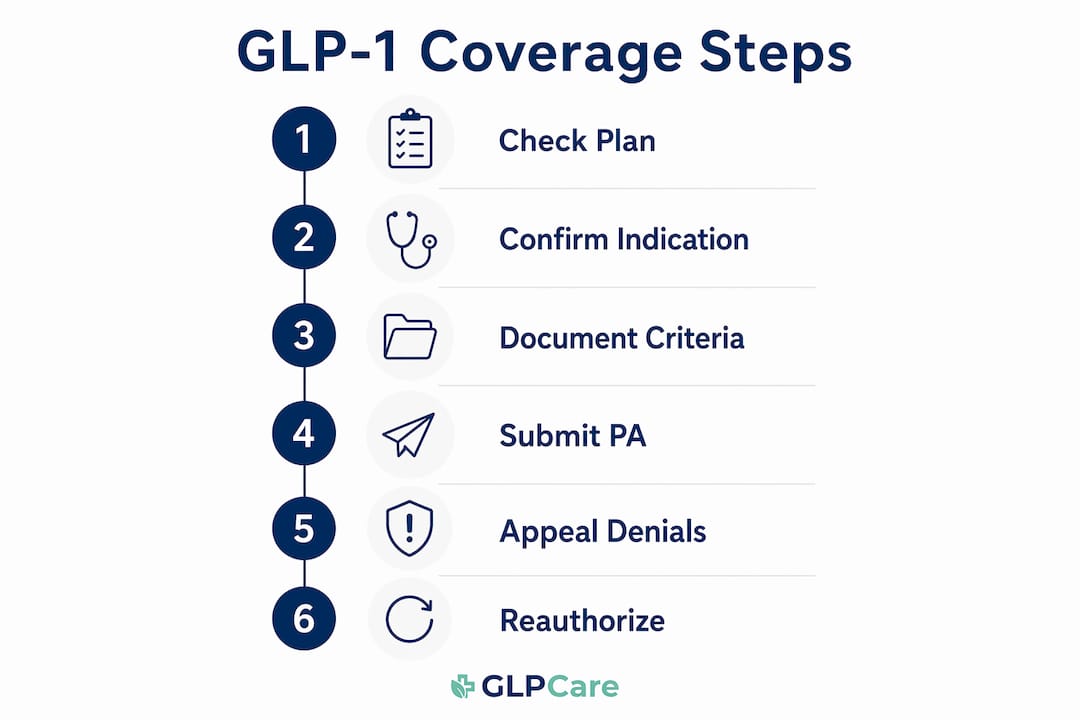
How do you get a GLP-1 covered step by step?
Once you know your plan’s requirements, the PA process follows a predictable sequence. Here is the workflow your prescriber’s office and you should follow together.
- Benefits investigation. Your prescriber’s office (or a specialty pharmacy) contacts the PBM to verify coverage, confirm the PA criteria, and identify the correct submission method. This step takes 1–3 business days.
- Assemble the PA packet. Gather all required documentation (see the checklist in the eligibility criteria section above). The prescriber writes a letter of medical necessity that explicitly addresses the insurer’s criteria: BMI, diagnosis codes, prior treatments, and clinical rationale.
- Submit the PA. The prescriber submits via the PBM’s preferred channel (electronic PA portal, fax, or phone). Confirm the submission was received and record the PA reference number.
- PBM review window. Standard review takes 72 hours to 7 business days for non-urgent requests. Urgent or expedited requests (when a delay would seriously jeopardize health) are reviewed within 24–72 hours. Follow up if you have not received a decision within the stated window.
- Approval. If approved, the PBM issues an authorization number with a duration of approval (DOA). The prescriber sends the prescription to the pharmacy. Confirm the DOA date so you know when reauthorization is due.
- Denial. If denied, request the denial reason in writing immediately. The denial letter must state the specific clinical or administrative reason. This document is the foundation of your appeal.
- Appeal (if needed). File an internal appeal within the insurer’s stated window (typically 30–180 days). Request a peer-to-peer review between your prescriber and the insurer’s medical director. If the internal appeal fails, request an external independent review.
The Novo Nordisk denials and appeals guide provides PA templates and peer-to-peer preparation materials that prescribers can use directly.
Why do insurers deny GLP-1 coverage, and how do you appeal?
Most denials fall into six categories. Each has a targeted counter-strategy.
- Step therapy not completed. The plan required a trial of a less expensive agent first. Counter: submit documented evidence of the prior trial, including drug name, dates, dose, and reason for discontinuation. If the patient had a contraindication or adverse reaction, the prescriber should document that explicitly. A rigorous “trial and failure” documentation strategy is often the strongest single factor in overturning an initial denial.
- BMI below threshold. The submitted BMI did not meet the plan’s cutoff. Counter: verify the BMI calculation using current height and weight from a clinic visit. If the patient is close to the threshold, confirm whether a qualifying comorbidity (hypertension, sleep apnea, T2D) allows the lower ≥27 cutoff.
- No comorbidity documentation. The PA form required a comorbidity but none was coded. Counter: add the relevant ICD-10 codes to the submission and include clinic notes that describe the comorbidity and its clinical significance.
- Insufficient lifestyle-intervention evidence. The plan required proof of a structured program. Counter: submit program receipts, attendance records, or a letter from the program provider confirming participation dates and outcomes.
- Formulary exclusion. The drug is not on the plan’s formulary at all. Counter: request a formulary exception based on medical necessity, documenting why the covered alternatives are clinically inappropriate for this patient.
- “Not medically necessary.” A catch-all denial. Counter: submit a detailed LOMN that directly addresses the plan’s medical necessity criteria, cites clinical guidelines (such as AHA/ACC or Endocrine Society obesity guidelines), and explains why the prescribed drug is the appropriate choice for this patient’s specific clinical profile.
Appeal pathways and timing
Internal appeal: File within the insurer’s stated window (often 30–180 days from the denial date). Include the denial letter, the LOMN, updated labs, and any new clinical documentation.
Peer-to-peer review: The prescriber calls the insurer’s medical director directly. This is often the fastest path to reversal. The prescriber should prepare by reviewing the plan’s exact PA criteria and be ready to address each denial reason point by point.
External independent review: If the internal appeal fails, you have the right to an external review under the ACA. Request this in writing. The external reviewer’s decision is binding on the insurer.
Pro Tip: For the peer-to-peer call, the two documents that most often flip a denial are a detailed LOMN that mirrors the plan’s own criteria language and a written summary of documented failed alternatives with dates and clinical outcomes. Ask your prescriber to prepare both before the call.
How does reauthorization work and what do insurers require?
Approval is not permanent. Most plans require periodic reauthorization, and the criteria for continuation are often stricter than for initial approval.
Common reauthorization triggers include a weight-loss threshold within a set timeframe. Some policies, including UHC’s reauthorization guidance for Wegovy, specify that patients must demonstrate ≥4% weight loss within a defined window (often 12–16 weeks) to qualify for continuation. Missing this threshold can result in non-renewal even if the patient is tolerating the medication well.
To document progress effectively, keep records of:
- Weight measurements at each clinic visit, with dates
- Clinician notes describing adherence, tolerability, and clinical response
- Lab results (A1c, lipid panel) at the intervals your plan requires
- Program participation records if a structured lifestyle program is part of your plan’s criteria
- Biometric data from wearables or apps, including activity levels, sleep trends, and heart rate data
A practical timeline: initial approval typically covers 3–6 months. The first reauthorization checkpoint usually falls at 12–16 weeks. Set a reminder 4–6 weeks before the DOA expires so your prescriber has time to gather documentation and submit before coverage lapses.
Patients using technology to track their progress have a concrete advantage here. Continuous monitoring data, whether from a wearable device or an app log, creates a timestamped record that is far easier to present at reauthorization than reconstructed clinic notes. Glpcare’s GLP-1 tracker guide covers best practices for creating insurer-acceptable documentation from ongoing tracking.
Understanding how insurance quantity limits work is also relevant here: quantity limits on your PA can affect how many doses are dispensed per fill and whether a reauthorization is triggered earlier than you expect.
What do GLP-1s cost out of pocket, and what savings options exist?
Cost varies dramatically depending on your coverage path. Here is a realistic breakdown.
- Commercial plan with obesity benefit: Copays typically range from $25–$100 per month after the deductible, depending on the drug’s formulary tier. Step-therapy requirements may mean a lower-tier drug first.
- Commercial plan with diabetes-only coverage: Ozempic and Mounjaro are often on preferred tiers with copays in the $25–$75 range for patients with T2D.
- Medicare GLP-1 Bridge (July 1, 2026–December 31, 2027): Eligible beneficiaries pay a flat $50 per month for Wegovy, Foundayo, or the Zepbound KwikPen. Bridge payments do not count toward TrOOP, and no low-income subsidy applies to Bridge copays.
- Medicaid: Copays are typically $0–$4 in states that cover obesity GLP-1s. Most states do not yet cover the obesity indication.
- Cash pay (no insurance coverage): List prices for branded GLP-1s run over $1,000 per month without assistance. Compounded semaglutide has been available at lower prices but faces FDA regulatory scrutiny.
Savings routes
- Manufacturer savings programs: Novo Nordisk and Eli Lilly both offer savings cards for commercially insured patients who meet eligibility criteria. These can reduce monthly costs significantly for patients with commercial coverage who still face high copays.
- GoodRx: GoodRx coupons can reduce cash-pay prices at participating pharmacies. They are most useful when you have no coverage or are in a coverage gap. Note that using GoodRx instead of insurance means the cost does not count toward your deductible or out-of-pocket maximum.
- Costco subscription programs: Costco Pharmacy has offered discounted GLP-1 programs for members; check current availability and pricing directly with Costco Pharmacy, as offerings change.
- Specialty pharmacy patient assistance: Some specialty pharmacies work directly with manufacturers to enroll patients in patient assistance programs (PAPs) when income criteria are met.
- HSA/FSA: If your GLP-1 is prescribed for a qualifying medical condition (Type 2 diabetes, cardiovascular disease, OSA), the cost is generally HSA/FSA-eligible. Keep all pharmacy receipts and prescriptions for tax-advantaged reimbursement claims.
For a side-by-side look at affordable GLP-1 provider options, Glpcare’s pricing overview can help you decide when a managed subscription makes more financial sense than navigating insurance alone.
What does Medicare cover, and how does the GLP-1 Bridge work?
Medicare’s coverage of GLP-1s has historically been limited by a federal statute that excludes drugs prescribed “for weight loss” from Part D coverage. Two indication-specific exceptions now exist within Part D itself: Wegovy prescribed for cardiovascular risk reduction in adults with established CVD, and Zepbound prescribed for obstructive sleep apnea. For these indications, standard Part D coverage rules apply, including the deductible, cost-sharing, and TrOOP accounting.

The Medicare GLP-1 Bridge
The Medicare GLP-1 Bridge is a CMS short-term demonstration running from July 1, 2026, through December 31, 2027. It covers three drugs: Wegovy, Foundayo, and the Zepbound KwikPen. Eligible beneficiaries pay a flat $50 copay per month. The Bridge operates entirely outside the Part D benefit payment flow, which has several practical consequences:
- The Part D deductible does not apply to Bridge-covered drugs.
- The $50 copay does not count toward TrOOP, so it does not help you reach the catastrophic coverage threshold.
- No low-income subsidy (LIS) is available for Bridge copays.
- Part D plan sponsors do not need to opt in; CMS manages PA, claims, and pharmacy payments centrally.
Medicare-specific eligibility checklist
- You are enrolled in Medicare Part D.
- You have a qualifying diagnosis (obesity, CV risk reduction, or OSA depending on the drug).
- Your prescriber submits the PA through the CMS central processor (not your Part D plan’s standard PA channel).
- You meet the clinical criteria CMS specifies for the Bridge (BMI thresholds and comorbidity documentation apply).
Switching Part D plans
If you switch Part D plans during open enrollment, confirm that the new plan covers your GLP-1 under the indication you are using. A plan change can reset your PA, require a new step-therapy sequence, or change your tier. Request a coverage determination from the new plan before the switch takes effect.
How long does the PA process take?
Setting realistic expectations prevents gaps in your medication supply. The table below shows typical durations at each stage.
| Stage | Typical duration | Notes |
|---|---|---|
| Benefits investigation | 1–3 business days | Prescriber’s office or specialty pharmacy contacts PBM |
| PA initial review (standard) | 3–7 business days | PBM clock starts on receipt of complete submission |
| PA initial review (expedited/urgent) | 24–72 hours | Requires clinical justification for urgency |
| Approval notification | Same day as decision | Authorization number issued; prescription can be filled |
| Internal appeal review | 30–60 days (standard); 72 hours (expedited) | ACA-regulated timelines for most commercial plans |
| Peer-to-peer review | 1–5 business days after request | Prescriber schedules call with insurer’s medical director |
| External independent review | 60 days | Binding on insurer; request after internal appeal exhausted |
| Reauthorization submission | 4–6 weeks before DOA expiry | Submit early to avoid coverage lapse |
Escalation checklist
If the PBM misses its decision deadline:
- Document the submission date and the PBM’s stated review window.
- Call member services and request an expedited decision, citing the missed deadline.
- File a complaint with your state insurance commissioner if the delay continues.
- Request an external review if the internal process is stalled.
- Contact your state’s insurance department; most states have consumer assistance programs that can intervene.
For specialty pharmacy fulfillment after approval, confirm the authorization number has been transmitted before the pharmacy processes the fill. Some specialty pharmacies can begin the fulfillment process in parallel with the PA review to reduce the gap between approval and first dose.
How does integrated monitoring improve your PA and reauthorization outcomes?
The difference between a first-pass approval and a denial often comes down to documentation quality, not clinical eligibility. Patients who present a complete, timestamped record of their weight trend, program participation, and biometric data give their prescribers the strongest possible evidence package.
Consider a typical approval scenario: a patient with a BMI of 32 and documented hypertension submits a PA for Wegovy. The initial submission is denied because the lifestyle-intervention documentation is missing. The prescriber resubmits with program attendance records, a 6-month weight trend from a wearable device, and an updated LOMN. The peer-to-peer review takes 48 hours and the authorization is granted. The decisive data points were the weight trend graph and the program receipts, not the clinical notes alone.
Insurers accept a range of data types for both initial PA and reauthorization:
- Clinic notes and EHR exports with dated weight measurements
- Wearable device summaries (step counts, sleep duration, activity levels, heart rate trends)
- Lab results (A1c, lipid panel, liver enzymes for NASH documentation)
- Structured lifestyle program receipts and attendance records
- App-based dose and adherence logs
Continuous monitoring does more than track progress. It creates a defensible, timestamped record that insurers can review at reauthorization without requiring the patient to reconstruct months of history from memory. When a peer-to-peer review is requested, a prescriber who can hand the medical director a clean weight-trend graph and a documented program participation log closes the conversation faster than one relying on narrative notes alone.
Glpcare’s integrated system is built around exactly this need. The wearable fitness band tracks sleep, heart rate, and activity levels continuously, while the AI-driven app logs doses and dietary habits in real time. Clinicians on the Glpcare platform have access to this data stream and can generate documentation summaries that align with what PBMs and insurers request at PA and reauthorization. For patients who want to understand the clinical timeline insurers look for, Glpcare’s week-by-week GLP-1 guide explains the expected outcomes at each stage of treatment.
Key Takeaways
GLP-1 insurance coverage depends primarily on your payer type, the drug’s covered indication, and the quality of your PA documentation — getting all three right is the fastest path to approval.
| Point | Details |
|---|---|
| Coverage depends on indication | Diabetes and CV/OSA indications are covered more broadly than obesity alone; match your diagnosis to the right indication. |
| Medicare Bridge runs through 2027 | Eligible Part D beneficiaries pay $50/month for Wegovy, Foundayo, or Zepbound KwikPen; Bridge payments don’t count toward TrOOP. |
| Documentation wins approvals | Submit BMI, ICD-10 codes, labs, weight history, prior treatments, and lifestyle program proof in every PA packet. |
| Reauthorization requires ongoing data | Many plans require ≥4% weight loss within 12–16 weeks; continuous tracking creates the evidence needed to maintain coverage. |
| Glpcare centralizes your documentation | Glpcare’s wearable, app, and clinician support generate the timestamped data insurers require for PA and reauthorization. |
The documentation gap is the real barrier to GLP-1 coverage
Most people who get denied for a GLP-1 are clinically eligible. They have the BMI. They have the comorbidity. Their prescriber believes the medication is appropriate. The denial comes from a paperwork gap, not a clinical one.
What I see consistently is that the PA packet arrives without the lifestyle-intervention documentation, or the weight history only goes back 60 days instead of 6 months, or the LOMN uses generic language instead of mirroring the plan’s own criteria. Insurers are not looking for a reason to approve. They are looking for a reason to deny, and an incomplete packet gives them one.
The peer-to-peer review is underused. Many prescribers accept the first denial and move on to a savings card. But a peer-to-peer call, when the prescriber is prepared with the plan’s exact criteria and a clean evidence packet, reverses a surprising number of denials. The medical director on the other end of that call is often looking for clinical justification to approve, not a debate. Give them the data they need.
For patients, the most useful thing you can do is start documenting before the PA is submitted. Weight measurements, program participation, and adherence records from the first day of treatment create a baseline that makes every subsequent reauthorization easier. Technology that tracks this continuously, rather than relying on clinic visits alone, gives you a real advantage when the renewal window arrives.
Glpcare makes the PA and reauthorization process manageable
Navigating GLP-1 insurance coverage on your own means chasing formulary PDFs, coordinating between your prescriber and the PBM, and hoping the documentation packet is complete enough to survive the first review. Glpcare is built to remove that friction.
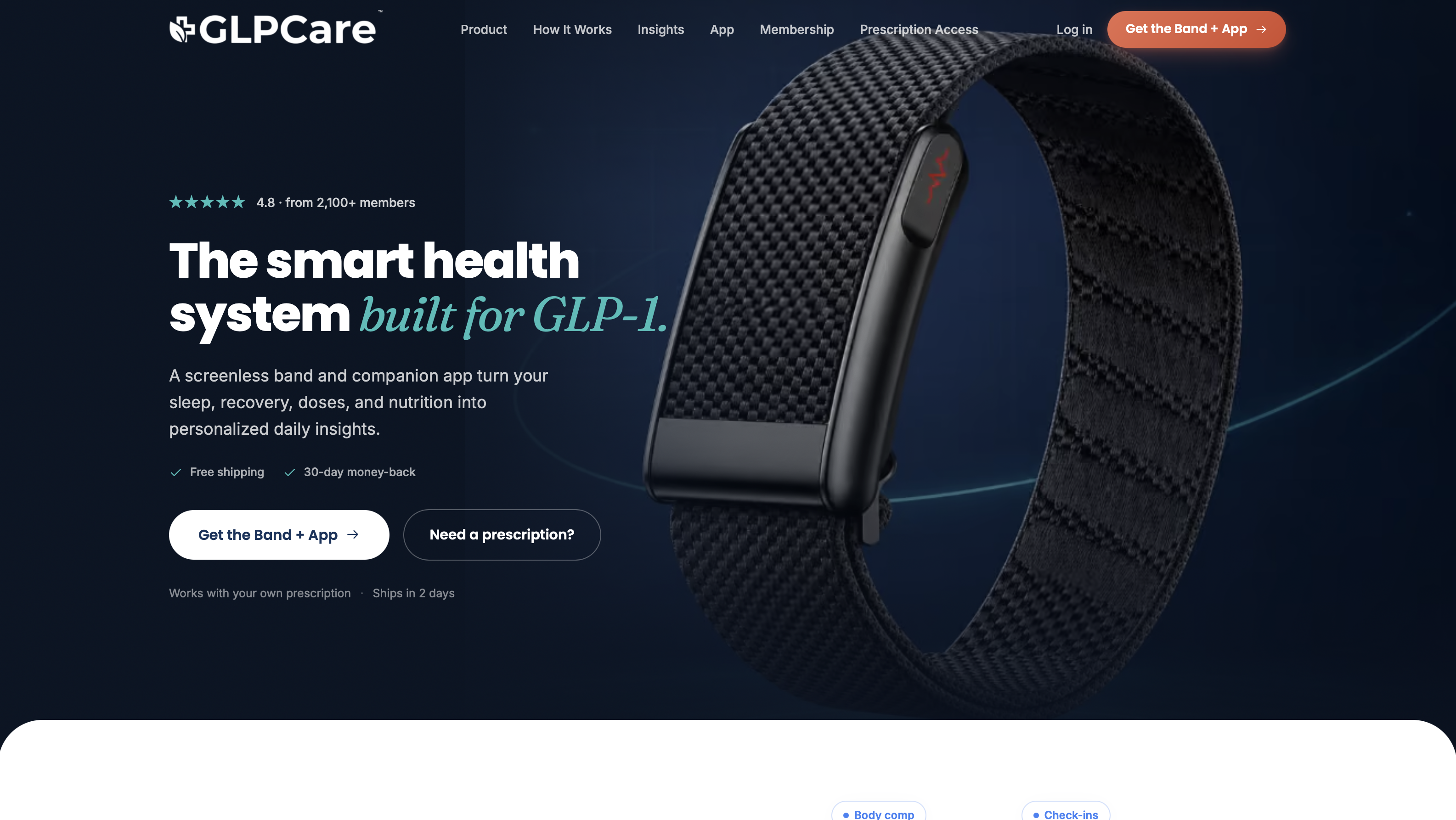
With Glpcare, you get a licensed clinician who manages your PA submission and reauthorization documentation, prescription fulfillment shipped to your door, and a wearable fitness band that continuously tracks the biometric data insurers ask for at renewal. The AI-driven app logs your doses, dietary habits, and progress in real time, so when your reauthorization window opens, the evidence is already organized. Clinicians on the platform can generate documentation summaries that align directly with PBM criteria, which means faster peer-to-peer reviews and fewer coverage gaps.
If you are ready to find out whether you qualify and what your path to coverage looks like, take Glpcare’s GLP-1 readiness quiz to get a personalized assessment in minutes. Or explore Glpcare’s plans and pricing to see which program fits your situation.
This article is general information, not medical or insurance advice. Confirm current coverage rules with your insurer, PBM, or a qualified healthcare professional for your specific situation.
FAQ
Does insurance cover GLP-1 medications for weight loss?
Coverage for weight loss depends on your plan type. Commercial plans with an obesity benefit cover GLP-1s for weight loss with PA; plans without that benefit typically do not, unless a non-obesity indication (CV risk reduction, OSA) applies. Medicare Part D historically excluded weight-loss drugs, but the GLP-1 Bridge now provides access at $50/month for eligible beneficiaries through December 31, 2027.
Will Zepbound be covered by insurance in 2026?
Zepbound (tirzepatide) is covered by commercial plans that include an obesity benefit, by Medicare Part D for obstructive sleep apnea, and by the Medicare GLP-1 Bridge (as the Zepbound KwikPen) at a $50 monthly copay for eligible Part D beneficiaries. Coverage for the obesity indication under Medicaid remains limited to a minority of states.
How do I get Ozempic for a lower cost with insurance?
Ozempic (semaglutide) is approved for Type 2 diabetes and appears on most commercial diabetes formularies, often at a preferred tier with copays in the $25–$75 range for patients with a T2D diagnosis. Submit a PA with your A1c results, ICD-10 E11.x diagnosis code, and prior treatment history to maximize your chances of approval at the lowest tier.
Which insurance covers GLP-1 medications for obesity?
Large employer-sponsored plans are the most likely to include an obesity drug benefit; an employer survey found that 43% of large employers covered a GLP-1 for obesity. ACA marketplace plans vary by insurer and state. Medicare covers obesity GLP-1s through the Bridge demonstration (not standard Part D), and Medicaid coverage is state-specific. Check your plan’s formulary and ask HR or your insurer whether an anti-obesity drug benefit is included.
What is the Medicare GLP-1 Bridge and who qualifies?
The Medicare GLP-1 Bridge is a CMS demonstration running from July 1, 2026, through December 31, 2027, that provides eligible Part D beneficiaries access to Wegovy, Foundayo, and the Zepbound KwikPen at a flat $50 monthly copay. It operates outside standard Part D, so the deductible does not apply and the copay does not count toward TrOOP. Eligibility requires Medicare Part D enrollment and a qualifying clinical diagnosis; PA is managed centrally by CMS.
Authoritative sources and official policy references
Use these primary sources to verify plan-specific policy language, download PA forms, and confirm current coverage rules.
- CMS Medicare GLP-1 Bridge FAQ: cms.gov/medicare/coverage/prescription-drug-coverage/medicare-glp-1-bridge — official demonstration details, eligibility criteria, and TrOOP guidance.
- Medicare.gov weight-loss drug coverage page: medicare.gov/coverage/weight-loss-drugs — beneficiary-facing summary of Part D exceptions and Bridge access.
- CVS Caremark Wegovy PA criteria PDF: info.caremark.com (Wegovy criteria) — PBM-specific indication rules, DOA values, and step-therapy requirements.
- Novo Nordisk provider PA initiation page (Wegovy): novomedlink.com/obesity/products/treatments/wegovy/cost-coverage/initiating-wegovy-pa.html — PA templates, benefits investigation steps, and formulary check guidance.
- Novo Nordisk denials and appeals guide (PDF): novomedlink.com denials and appeals PDF — peer-to-peer preparation, appeal letter templates, and external review instructions.
- UHC Wegovy prior authorization and reauthorization guidance (PDF): uhcprovider.com Wegovy PA PDF — reauthorization thresholds, weight-loss criteria, and DOA timelines.
- Medicaid.gov drug coverage: medicaid.gov — state-by-state Medicaid formulary and preferred drug list links.
- Healthcare.gov plan finder: healthcare.gov — ACA marketplace formulary search for GLP-1 coverage by plan.
- NHLBI BMI calculator: nhlbi.nih.gov/calculate-your-bmi — verify BMI calculations before submitting PA documentation.
For clinicians: Save or screenshot the PA criteria PDF from your PBM before submitting. These documents contain the exact form names, DOA values, and review windows that determine your submission’s completeness. An outdated criteria document is a common source of avoidable denials.