60 to 90 Minutes Weekly Strength Training Preserves Muscle on GLP-1
60 to 90 Minutes Weekly Strength Training Preserves Muscle on GLP-1
Resistance training two to four times a week, paired with a protein-first diet, is the single most reliable way to protect muscle while you lose weight on a GLP-1 medication. Aim for 60 to 90 minutes of resistance work weekly and around 1.2 to 1.8 grams of protein per kilogram of body weight daily. If you use insulin or manage significant health conditions, loop in your clinician before you change your routine.
TL;DR:
- Resistance training two to four times per week significantly reduces muscle loss during weight loss on GLP-1 medications, especially when combined with adequate protein intake.
- High-intensity resistance work improves functional outcomes such as stair-climb speed and oxygen efficiency, which are more meaningful indicators than scale weight.
- Starting with light, full-body workouts lasting 60 to 90 minutes weekly and progressing gradually helps preserve strength without overwhelming energy levels or increasing nausea.
- Monitoring progress through functional tests and keeping a detailed workout log provides real feedback, as scale weight may not reflect muscular improvements.
- Proper nutrition, especially consuming 1.2 to 1.8 grams of protein per kilogram of body weight daily and timing intake around workouts, supports muscle retention while on GLP-1 therapy.
Glpcareglpcare.orgSupport Your Muscle-Focused GoalsGLPCare combines GLP-1 therapy, nutrition coaching, wearable health insights, and clinician support for a more integrated approach to weight management.Explore GLPCare
Table of Contents
- Why Resistance Training Matters During GLP-1-Assisted Weight Loss
- What Does the Research Say About GLP-1 and Structured Exercise?
- How Often Should You Strength Train on a GLP-1 Medication?
- Sample Full-Body Workouts for the First Six Weeks
- How Do You Track Progress and Know When to Adjust?
- What Should You Eat to Support Muscle on a GLP-1?
- How Do You Train Through Nausea and Low Energy?
- Are There Special Safety Considerations for Older Adults or People on Insulin?
- How Does GLPCare Support Muscle-Focused Training?
- What Should You Actually Expect in the First Few Weeks?
- Ready to Put This Plan Into Action?
- Where to Learn More
- Sources
- FAQ
Why Resistance Training Matters During GLP-1-Assisted Weight Loss
Weight loss on a GLP-1 medication is not just fat loss. Without a counterstrategy, a meaningful share of that number on the scale is muscle, and that changes what your body can do long after the weight comes off.
Some studies show that up to 40% of the weight lost on GLP-1 therapy can be lean mass rather than fat, depending on age, baseline muscle, and activity level. Resistance training reduces that fraction and helps preserve the strength you have relative to your new body weight.
Losing lean mass carries consequences beyond appearance. Muscle drives your resting metabolic rate, so losing it can make long-term weight maintenance harder, not easier. It also affects the everyday tasks that depend on strength: climbing stairs, carrying groceries, standing up from a low chair without using your hands.
This is exactly why current clinical guidance treats exercise as a companion to medication, not an afterthought:
- The World Health Organization recommends muscle-strengthening activity on 2 or more days per week for all adults, GLP-1 users included.
- Recent literature reviews specifically recommend pairing GLP-1 receptor agonists with resistance training and higher protein intake to blunt muscle loss.
The takeaway is straightforward: the drug handles appetite and blood sugar. Your training decides what kind of weight you actually lose.
What Does the Research Say About GLP-1 and Structured Exercise?
The clearest signal comes from a secondary analysis of a randomized controlled trial that compared GLP-1 receptor agonist treatment alone against the medication combined with structured exercise in adults with obesity.
The combined group climbed stairs faster, and their bodies used oxygen more efficiently. Participants who added exercise to their GLP-1 treatment cut their stair-climb time by about 1.2 seconds, roughly an 8.6% improvement, and their peak oxygen consumption relative to fat-free mass rose by 3.0 mL/min/kg compared with the medication-only group. That is not a cosmetic difference. Stair-climb speed and oxygen efficiency are functional markers, meaning they reflect what your body can actually do, not just what a scale or DXA scan reports.
A separate clinical review reinforces the same conclusion from a different angle: recommendations for GLP-1 users to combine resistance training with increased protein intake, specifically to counter the muscle loss that accompanies rapid fat loss. The review synthesizes multiple trials and lands on a practical weekly target of roughly 60 to 90 minutes of resistance training.
There is also a mechanistic piece worth understanding. Resistance training appears to preserve muscle quality, not just quantity, likely through improved insulin sensitivity and reduced fat stored within muscle tissue, according to a recent review of combined GLP-1 and lifestyle interventions. In practice, that means even if the number on a body composition scan looks similar to someone who skipped exercise, the person who trained often functions better: stronger grip, faster stairs, easier days.
None of these findings suggest exercise is optional alongside a GLP-1 prescription. They point the other way: it is the variable most within your control.
How Often Should You Strength Train on a GLP-1 Medication?
A workable resistance-training prescription for GLP-1 users does not need to be complicated, and it should not feel like a second job layered on top of managing a new medication.
Frequency and weekly volume
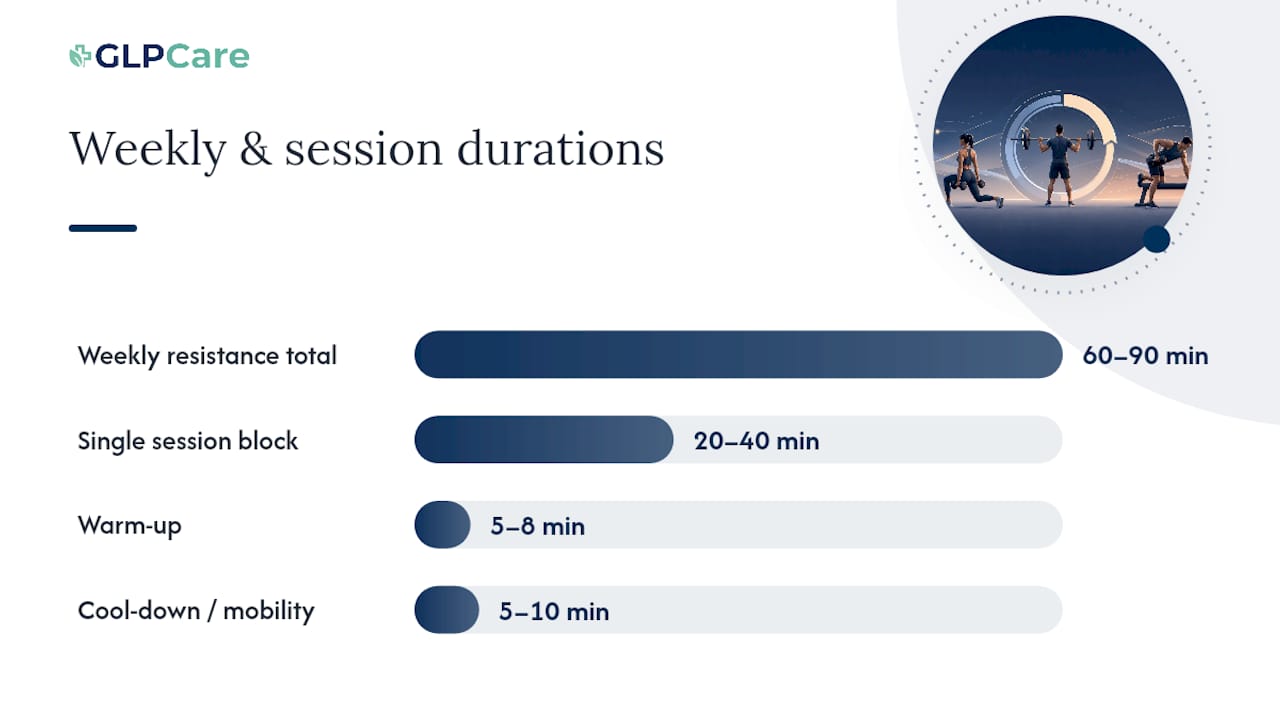
- Train full-body resistance sessions 2 to 4 times per week, totaling 60 to 90 minutes of resistance work weekly.
- If a full session feels like too much on a given day, break it into shorter 20 to 40 minute blocks rather than skipping it entirely.
- Space sessions so the same muscle groups get 48 to 72 hours of recovery before you load them again.
Session structure
A session that works for most beginners and intermediate lifters on GLP-1 therapy follows this shape:
- Warm up for 5 to 8 minutes: light cardio plus dynamic movement for the joints you are about to load.
- Perform 3 to 6 compound lifts, the exercises that move multiple joints and recruit the most muscle: squats, hip hinges, presses, rows, and their variations.
- Add 1 to 2 accessory movements that target smaller muscle groups or address a specific weakness.
- Close with 5 to 10 minutes of mobility work or a brief cool-down.
Sets, reps, and intensity
For most goals, including muscle preservation during weight loss, 2 to 4 sets of 6 to 12 reps per exercise covers the bulk of what the evidence supports. If you have lifted before and know how to judge effort, use a Rate of Perceived Exertion (RPE) of 6 to 8 out of 10, meaning you could squeeze out 2 to 4 more reps but choose to stop. New lifters should not chase a specific RPE number early on. Learning the movement pattern with lighter loads matters more than intensity in the first few weeks.
Progression rules
Progressive overload, gradually asking your muscles to do more over time, is what actually drives strength and muscle retention. The order matters, particularly for people managing appetite suppression or lower energy from GLP-1 side effects.
- Add reps first. If you can comfortably complete the top of your rep range for all sets, that is your signal to progress.
- Add a set next, once reps are maxed out and the movement still feels controlled.
- Increase load last, and increase it modestly, roughly 2.5 to 5% at a time for upper-body lifts and a bit more for lower-body compound movements.
Adding volume before load reduces the metabolic and gastrointestinal demand of a session, which matters when nausea or reduced appetite is already part of your week, according to guidance on training tips for GLP-1 users.
Pro Tip: Log every session as sets times reps times load, even on days that feel unremarkable. When appetite suppression dulls your sense of hunger and effort alike, that written log becomes the only objective evidence that you are actually getting stronger.
Sample Full-Body Workouts for the First Six Weeks
You do not need a gym membership or a barbell to start. What you need is a plan you will actually repeat.
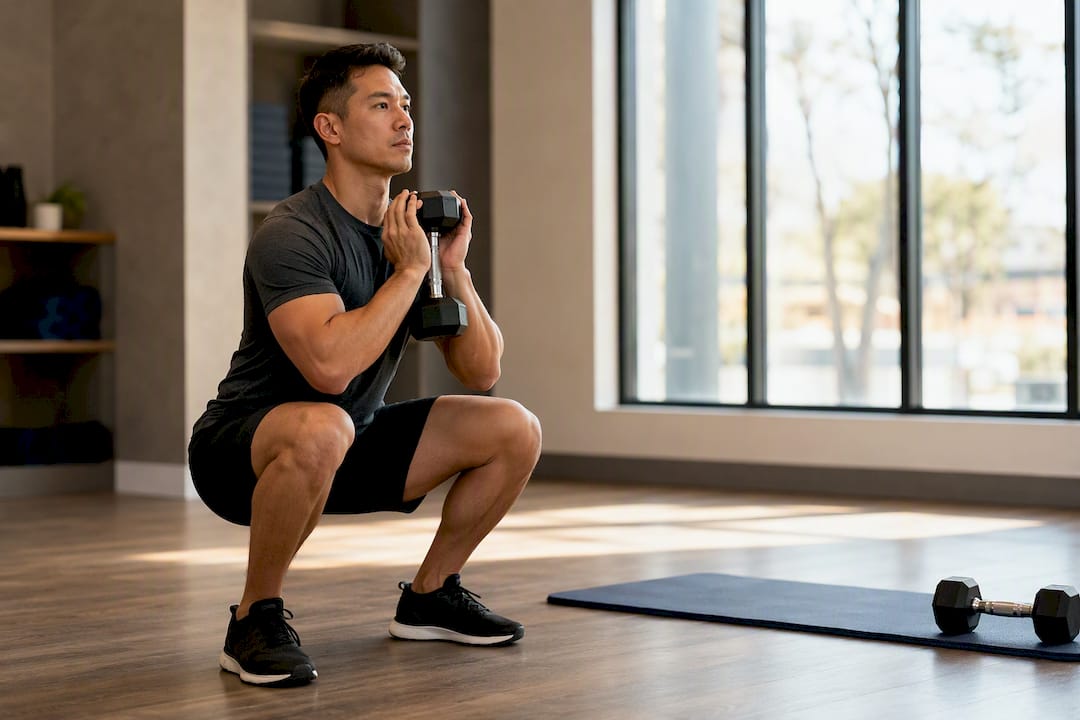
Workout A: Gym or home with dumbbells Goblet squat, dumbbell row, incline push-up or bench press, Romanian deadlift, plank hold. Three sets of 8 to 12 reps per exercise, resting 60 to 90 seconds between sets.
Workout B: Bodyweight or resistance band, minimal equipment Band-resisted squat, band row, push-up (knee-modified if needed), glute bridge, side plank. Three sets of 10 to 15 reps, since bands typically require a slightly higher rep range to reach the same effort level as free weights.
Workout C: Short-format, 20 to 30 minutes A tight circuit of squat, push, pull, and hinge movements performed back to back with minimal rest. Two rounds of 12 reps each. This is the version to keep in your back pocket for low-energy days rather than skipping training altogether.
Here is a simple six-week arc that respects the fact that most people escalate their GLP-1 dose during this window:
- Weeks 1 to 2: Focus on form. Two sessions per week, 2 sets per exercise. Expect this to feel harder than it should, since dose increases often bring the most fatigue and nausea during this stretch.
- Weeks 3 to 4: Add a third weekly session if energy allows. Move to 3 sets per exercise, same rep range.
- Weeks 5 to 6: Add small load increases where reps have maxed out. Consider a fourth session if recovery has been consistent.
On days when appetite or energy is low, cut the session in half rather than canceling it. A 15-minute version of Workout C still counts.
How Do You Track Progress and Know When to Adjust?
The scale is a poor coach for anyone on a GLP-1 medication, because weight can drop even during weeks when you are getting stronger. Function tells a more honest story.
Keep a simple log of sets, reps, and weight for every session, along with a basic calendar marking which days you trained. Objective tracking matters more here than in most fitness contexts, since appetite suppression can dull your subjective sense of effort and progress, making a written log the only reliable record.
Once a month, run a few functional checks that mirror the outcomes clinical trials actually measure:
- Time yourself climbing a flight of stairs at a brisk, controlled pace.
- Count how many times you can stand up and sit down from a chair in 30 seconds without using your hands.
- Test grip strength with a hand dynamometer if you have access to one, or simply note how heavy a grocery bag or gallon jug feels to carry.
These functional measures often mean more day to day than a lean-mass number pulled from a body scan.
Watch for signals that mean you should pull back rather than push through: persistent dizziness during or after sessions, an inability to recover between workouts even after extra rest days, or unexplained weakness that does not track with how hard you have been training. Any of those warrants a call to your prescriber before your next session.
What Should You Eat to Support Muscle on a GLP-1?
Protein is the nutrient that does the heavy lifting here, and it needs a plan, not luck.
Target roughly 1.2 to 1.8 grams of protein per kilogram of body weight daily, with the higher end of that range fitting older adults or anyone training hard multiple times a week. Split that across meals in chunks of about 20 to 40 grams rather than saving it all for dinner. Even distribution across the day supports muscle repair better than one large protein-heavy meal.
When appetite is suppressed, and it often will be, especially in the days after a dose increase, these options make hitting your target realistic without forcing down food you do not want:
- Greek yogurt, which packs 15 to 20 grams of protein into a small, easy-to-tolerate serving.
- Whey or plant-based protein powders mixed into a small smoothie when solid food feels unappealing.
- High-protein milk cartons or ready-to-drink shakes for days when chewing feels like too much effort.
- Cottage cheese or a hard-boiled egg as a low-volume snack that still delivers real protein.
Timing matters at the margins. Try to get a protein-containing meal or snack within a few hours after a resistance session, and if your energy is flagging before a workout, a small amount of easily digested carbohydrate can help you get through it without feeling depleted. A protein-first meal plan built around real foods, not just supplements, tends to be easier to sustain over months than a shake-only approach. Whole-food protein sources also carry other nutrients your body needs during a calorie deficit, a point echoed in broader guidance on food-based strength strategies.
Pro Tip: If a full meal feels like too much, split your protein target into three smaller check-ins across the day: breakfast, mid-afternoon, and after your workout. Small and frequent beats large and occasional when appetite is working against you.
How Do You Train Through Nausea and Low Energy?
Dose-escalation windows, the days after each increase in your GLP-1 dose, are when nausea and appetite loss hit hardest, typically easing over one to two weeks before the next increase.
During these stretches, lower your training intensity rather than skipping sessions outright. Shift your workout to whichever time of day you feel least nauseated, morning for some people, early evening for others. Hydration matters more than usual here, since fluid intake often drops along with appetite.
If nausea is severe enough that you cannot keep food or water down, or if vomiting persists beyond a day or two, stop training and contact your prescriber. That is a medication response issue, not a fitness problem to push through.
Are There Special Safety Considerations for Older Adults or People on Insulin?
If you take insulin or an insulin secretagogue alongside a GLP-1 medication, resistance training can lower blood sugar further, which raises hypoglycemia risk. Check your glucose before training, keep a fast-acting carbohydrate source nearby, and talk with your prescriber about how to time meals and insulin doses around workouts.
Older adults benefit from extra emphasis on balance work and lower-impact progressions, alongside resistance training that includes bone-loading movements like weighted squats or step-ups where appropriate. These are frequently discussed in osteoporosis-focused exercise guidelines, which apply well beyond a bone-density diagnosis.
Anyone with cardiovascular disease, uncontrolled diabetes, or another major health condition should get medical clearance before starting or significantly increasing resistance training intensity. This applies even if you feel generally well; some risks do not announce themselves with symptoms.
How Does GLPCare Support Muscle-Focused Training?
The plan above only works if you can see whether it is working, which is exactly the gap Glpcare’s system is built to close. The GLP Care Band tracks activity, heart rate, and recovery signals in the background, giving you a fuller picture than a workout log alone. Clinician support is built into the program, so questions about training around a dose increase or a comorbidity do not go unanswered.
Nutrition guidance can follow the same protein-first logic covered above and be translated into personalized daily targets rather than generic ranges. None of this replaces individualized medical advice. It is designed to sit alongside it, giving you real data to bring to your next clinical conversation instead of guesswork about what happened between visits.
What Should You Actually Expect in the First Few Weeks?
Progress on a GLP-1 medication rarely arrives in a straight line, and the first few weeks of resistance training are usually the least impressive on paper.
Start lighter than your ego wants to. The goal during weeks one and two is learning the movement, not setting a personal record, especially if you are also adjusting to a new dose. Track everything, because a written log will tell you the truth that your energy levels might not, particularly during dose-escalation weeks when fatigue can mask real strength gains happening underneath.
Weigh function over the scale. A faster set of stairs or an easier grocery haul in week five matters more than what the number reads that morning. Consistency, not intensity, is what separates people who keep their muscle through a GLP-1 program from people who do not.
— Dominique
Ready to Put This Plan Into Action?
Reading a training and protein plan is one thing. Following one that adjusts to your actual dosage, appetite, and recovery data is another, and that is the gap this combination of wearable and app technology, with clinician support, closes. Instead of guessing at protein targets or wondering whether your fatigue is normal for this week’s dose, wearable devices and companion apps can track your activity, sleep, and recovery in real time and connect that data to clinician support.

Start by using the protein intake calculator to get a personalized daily target instead of relying on the general range in this article. If you are still deciding whether medical weight management fits your situation, the GLP-1 readiness quiz takes a few minutes and gives you a clear next step, with a licensed clinician available to review your answers and talk through a plan built around preserving muscle, not just losing weight.
Where to Learn More
For readers who want to go straight to the primary literature, the randomized trial secondary analysis in Sports Medicine covers the stair-climb and fitness outcomes referenced above. The PMC review on GLP-1 agonists and exercise synthesizes broader lifestyle recommendations, while Cleveland Clinic’s patient guidance and Diatribe’s muscle health resource translate the research into day-to-day practice. Glpcare’s own guide on preventing muscle loss during GLP-1 treatment rounds out the practical side.
This article is general information, not a substitute for advice from a qualified doctor. Consult a qualified healthcare professional about your own circumstances before acting on anything here.
Sources
- GLP-1 agonists and exercise: the future of lifestyle prioritization
- Exercise for GLP-1 use | Cleveland Clinic
FAQ
Can You Still Lift Weights on a GLP-1 Medication?
Yes, and clinical guidance actively recommends it. Resistance training alongside a GLP-1 medication helps preserve muscle mass and improves functional outcomes like stair-climb speed compared with medication alone.
How Much Strength Training Per Week Should You Do on a GLP-1?
Aim for 60 to 90 minutes of resistance training weekly, spread across 2 to 4 full-body sessions. Shorter 20 to 40 minute sessions work fine if a full hour feels like too much on a given day.
Can You Lift Weights While Taking Zepbound?
Yes. The same resistance-training principles apply regardless of which specific GLP-1 medication you use, since the muscle-loss risk comes from rapid weight loss itself, not the drug’s brand name.
Is It Hard to Build Muscle on a GLP-1?
Building significant new muscle is harder in a calorie deficit, but preserving the muscle you already have is very achievable with resistance training and adequate protein. Most people on a GLP-1 medication should focus on protecting existing strength and function rather than chasing hypertrophy during active weight loss.
Should You Consult a Clinician Before Starting Resistance Training on a GLP-1?
If you take insulin, have cardiovascular disease, or manage another significant health condition, talk with your prescriber before starting or increasing resistance training intensity. Otherwise, starting light and progressing gradually is appropriate for most people beginning GLP-1 therapy.