Weight Regain After GLP-1: What to Expect and How to Limit It
Weight Regain After GLP-1: What to Expect and How to Limit It
Most people who stop GLP-1 therapy regain a significant portion of their lost weight within 12 months. A Cambridge modeling study estimated that a Cambridge modeling study estimated that most people regain a significant portion of lost weight within a year after stopping, with a smaller portion of the initial loss generally sustained over the long term, but only with active management. Weight regain after GLP-1 discontinuation is not a personal failure. It is a predictable biological response, and the clinical evidence is clear: obesity requires ongoing management, not a one-time course of medication.
If you are stopping, tapering, or considering a break from GLP-1 therapy, here are three steps to take right now:
- Talk with your clinician before stopping. Discuss tapering options, maintenance dosing, and a monitoring schedule before your last dose.
- Set a weight and metabolic check-in schedule. Plan clinic visits at 4, 8, and 12 weeks post-stop to catch early regain before it compounds.
- Start a protein and resistance-training plan now. The composition of regained weight matters as much as the amount. Protecting lean mass from day one limits long-term metabolic harm.
Pro Tip: Use Glpcare’s protein intake calculator to set a daily protein target before your last injection, not after. Starting with a muscle-preserving nutrition plan in place gives you a meaningful head start.
Key Takeaways
Most people regain a significant portion of lost weight after stopping GLP-1 therapy, but the trajectory is manageable with a clinician-guided plan that prioritizes lean-mass preservation, structured nutrition, and ongoing monitoring.
| Point | Details |
|---|---|
| Expect substantial regain | Cambridge modeling estimates ~60% of lost weight returns by 52 weeks; plan for it rather than be surprised by it. |
| Rate varies by agent | Semaglutide and tirzepatide users average ~0.8 kg/month of regain; liraglutide users regain more slowly. |
| Protect lean mass first | Regained weight is disproportionately fat; protein targets and resistance training limit long-term metabolic harm. |
| Maintenance dosing works | Switching to a lower-dose injectable or oral GLP-1 preserved substantial weight loss over one year in clinical trials. |
| Glpcare for the transition | Glpcare’s clinician support, wearable monitoring, and nutrition coaching directly address the highest-risk phase after stopping. |
Table of Contents
- What does the research say about weight regain after GLP-1 discontinuation?
- Why does weight come back after stopping GLP-1 therapy?
- Who is at higher risk for faster or greater regain?
- Practical strategies to reduce weight regain after stopping GLP-1 therapy
- What to discuss with your clinician before and after stopping
- Reframing what success looks like after GLP-1 therapy
- How Glpcare supports your GLP-1 transition and long-term maintenance
- Sources
- FAQ
What does the research say about weight regain after GLP-1 discontinuation?
The evidence on post-discontinuation regain is now substantial, drawn from large randomized controlled trials, systematic reviews, and modeling studies. The numbers are consistent enough to set realistic expectations, and they differ meaningfully by drug, dose, and treatment duration.
STEP trials: semaglutide off-treatment data
The STEP-1 extension trial is the most-cited dataset on this question. After stopping, they regained roughly two-thirds of that loss within 12 months, with net weight sitting approximately 5.6% below baseline at week 120. Cardiometabolic improvements, including reductions in blood pressure, HbA1c, and lipids, largely reverted toward pre-treatment levels alongside the weight regain.
STEP-4 told a similar story from a different angle. Participants who continued semaglutide after an initial 20-week run-in maintained their losses; those switched to placebo regained an average of 6.9 percentage points of body weight over the following 48 weeks. The contrast between the continuation and withdrawal arms in STEP-4 makes the drug-dependence of the effect unusually clear.
SURMOUNT and tirzepatide data
SURMOUNT trial extensions for tirzepatide (Zepbound/Mounjaro) show a comparable pattern. Participants who stopped tirzepatide after achieving substantial losses regained weight at rates consistent with the semaglutide literature, though head-to-head off-treatment comparisons between agents remain limited. Given tirzepatide’s dual GIP/GLP-1 mechanism and typically larger on-treatment losses, the absolute kilograms regained after stopping can be greater even when the percentage trajectory is similar.
Systematic review: rate of regain by agent
An Oxford systematic review of 37 studies found an average regain rate of approximately 0.4 kg per month across all weight-management drugs. For newer agents, specifically semaglutide and tirzepatide, the rate was roughly 0.8 kg per month in the available data, with projections suggesting return to baseline weight within about 1.5 years for many patients who stop without additional support.
Meta-analysis: pooled rebound and cardiometabolic consequences
A pooled meta-analysis of randomized trials quantified the rebound at a mean of approximately 5.6 kg (95% CI: 3.52–7.73 kg) across GLP-1 receptor agonist discontinuation studies, with subgroup signals showing greater rebound for semaglutide than for liraglutide (Saxenda). Beyond weight, the meta-analysis documented significant worsening of HbA1c and blood pressure after withdrawal, underscoring that the metabolic benefits of these drugs are also time-limited without continuation or a structured maintenance plan.
Pro Tip: Trial populations are typically well-supported with behavioral counseling during the study. Real-world regain without that support structure may be faster. Use GLP-1 therapy evidence to understand what the trial conditions actually looked like before comparing your own results.
Liraglutide vs. semaglutide vs. tirzepatide: a snapshot
| Agent | Typical on-treatment loss | Approximate regain rate after stopping | Net loss at ~1 year off-treatment |
|---|---|---|---|
| Liraglutide (Saxenda) | ~5–8% body weight | ~0.4 kg per month | Modest net loss or near baseline |
| Semaglutide (Wegovy) | ~15% body weight | ~0.8 kg/month | ~5–6% below baseline (STEP-1 data) |
| Tirzepatide (Zepbound) | ~20% body weight | ~0.8 kg/month (estimated) | Limited long-term off-treatment data |
Key figure: A Cambridge modeling study projects that even with rapid early regain, approximately 25% of initial weight loss may persist long-term for many patients, provided some behavioral strategies remain in place.
Emerging research: preventing rebound pharmacologically
Early-stage preclinical research from UAB has identified an experimental oral compound (TIX100) that prevented weight regain after stopping semaglutide in animal models. This is not yet a clinical option, but it signals that pharmacologic strategies specifically targeting post-discontinuation rebound are an active area of investigation.
Why does weight come back after stopping GLP-1 therapy?
Understanding the biology behind regain changes how you approach it. This is not about willpower. It is about what GLP-1 drugs actually do in your body and what happens when that signal disappears.
The return of appetite signaling
GLP-1 receptor agonists suppress appetite partly by slowing gastric emptying and partly by acting on hunger-regulating centers in the brain. When the drug clears your system, those central effects reverse. Hunger signals return, often described by patients as a sudden reappearance of “food noise,” the persistent background drive to eat that the medication had quieted. VCU Health experts note that this biological return of appetite, not a lapse in discipline, is the primary driver of early rapid regain.
Metabolic adaptation
Weight loss itself, regardless of method, lowers resting energy expenditure. Your body adapts to a smaller mass by burning fewer calories at rest. After stopping a GLP-1, you face a double challenge: appetite returns to its pre-treatment level while your metabolism remains calibrated to a lighter body. That gap between energy intake and expenditure drives rapid early regain, typically fastest in the first 12–20 weeks off treatment.
Body composition: why the fat-to-lean ratio matters
A clinically important but underappreciated issue is that regained weight tends to be disproportionately fat. During GLP-1 treatment, some lean mass is lost alongside fat, particularly when protein intake and resistance training are insufficient. When weight returns after stopping, it returns primarily as fat tissue. This means a patient’s fat-to-lean mass ratio can actually worsen compared with their pre-treatment baseline, even if their scale weight is similar. Harvard Health guidance specifically flags this as a reason to prioritize muscle preservation strategies during and after treatment.
The core problem with stopping abruptly: Your appetite returns to its pre-treatment level, your metabolism stays adapted to a lighter body, and any lean mass lost during treatment gets replaced by fat. The result is a body composition that can be metabolically worse than where you started, even at a similar weight.
Timing of regain: fast then slower
Regain is not linear. The steepest slope occurs in the first 12–20 weeks after the last dose, driven by the rapid return of appetite signaling. After that initial surge, the rate slows as body weight approaches a new equilibrium. The Oxford systematic review’s projection of return to baseline in roughly 1.5 years reflects this curve: fast early, then a gradual plateau. Knowing this timeline helps you focus your most intensive behavioral support in the first three to four months after stopping.
Pro Tip: Tracking your weight weekly, not daily, in the first three months after stopping gives you a cleaner signal of the trend without the noise of normal day-to-day fluctuation. Glpcare’s wearable and app make this automatic.
Who is at higher risk for faster or greater regain?
Not everyone regains at the same rate. Several patient and treatment factors predict a steeper trajectory, and identifying them helps you and your clinician build a more targeted plan.
Risk factors to review with your clinician
- Shorter treatment duration. Patients who stop after fewer months on therapy tend to regain faster, likely because behavioral habits and metabolic adaptations have had less time to consolidate.
- Greater initial percentage lost. The more weight you lost on treatment, the more absolute weight is available to return. A 20% loss carries more regain risk than a 7% loss, even if the percentage trajectory is similar.
- Agent used. The Oxford data suggest semaglutide and tirzepatide users face roughly double the monthly regain rate compared with liraglutide users, reflecting the larger on-treatment losses those agents produce.
- Older age and lower baseline muscle mass. Both reduce the metabolic buffer against regain and increase the proportion of lost weight that was lean tissue.
- Abrupt cessation vs. tapering. Stopping cold turkey removes the appetite-suppressing signal suddenly, while tapering gives behavioral habits more time to compensate.
- No concurrent behavioral support. Patients who relied entirely on the drug’s appetite suppression without building structured eating and activity habits have less to fall back on after stopping.
- Financial or coverage-driven abrupt stops. Insurance loss or cost changes are among the most common real-world reasons for unplanned discontinuation, and they rarely allow time to prepare a transition plan.
A quick self-assessment checklist
Use this list before your next clinician conversation:
- [ ] I have been on GLP-1 therapy for fewer than 12 months
- [ ] I lost more than 15% of my body weight on treatment
- [ ] I am stopping due to cost or insurance, not a planned taper
- [ ] I have not been doing regular resistance training during treatment
- [ ] My protein intake is below 1.2 g per kg of body weight per day
- [ ] I have no structured follow-up appointment scheduled after my last dose
- [ ] I have a history of weight cycling before starting GLP-1 therapy
The more boxes you check, the more important it is to discuss a formal maintenance or tapering plan before stopping.
Pro Tip: Bring this checklist to your appointment. Clinicians can address each item specifically, from adjusting your taper schedule to referring you to a registered dietitian for protein planning.
| Risk factor | Why it increases regain |
|---|---|
| Short treatment duration | Less time to build behavioral habits that outlast the drug |
| High % weight lost | More absolute weight available to return |
| Abrupt cessation | Sudden appetite return without behavioral buffer |
| Low muscle mass | Lower resting metabolism, more fat-dominant regain |
| No behavioral support | Drug was the sole driver; no independent strategies in place |
Practical strategies to reduce weight regain after stopping GLP-1 therapy
The evidence supports a layered approach: medication strategies first, then behavioral, then structured monitoring. None of these work in isolation, and the strongest outcomes come from combining at least two or three.
1. Medication strategies: tapering, lower dose, and oral options
Abrupt cessation is rarely the best option when alternatives exist. Clinical trial data show that switching from high-dose injectable therapy to a lower-dose injectable or an oral GLP-1 formulation preserved a substantial share of prior weight loss over one year in selected patients. Longer-term durability beyond one year needs more study, but the one-year signal is clinically meaningful.
Case series and small studies also suggest that alternate-week dosing, spacing injections to every other week rather than weekly, may help some patients maintain much of their loss during a cost-driven transition. This is worth discussing explicitly with your clinician as a bridge strategy.
A structured taper, reducing dose over 8–12 weeks rather than stopping at full dose, gives your appetite-regulating systems time to adjust and allows behavioral habits to carry more of the load gradually.
2. Nutrition: protein, fiber, and meal timing
Harvard Health’s transition guidance recommends three specific nutrition anchors:
- Prioritize protein at every meal. Target at least 1.2–1.6 g of protein per kg of body weight daily. Protein preserves lean mass, increases satiety, and has the highest thermic effect of any macronutrient.
- Eat every 3–5 hours. Regular meal timing prevents the deep hunger that drives overeating when appetite signals return.
- Build meals around fiber. Vegetables, legumes, and whole grains slow gastric emptying and support satiety in the absence of the drug’s direct effect on gut motility.
A sample day that applies these principles: breakfast with Greek yogurt, eggs, and berries; a mid-morning snack of cottage cheese and almonds; lunch with grilled chicken, lentils, and roasted vegetables; an afternoon snack of edamame; dinner with salmon, quinoa, and a large salad. This structure delivers roughly 130–150 g of protein and 35–40 g of fiber for a 180-pound person.
3. Resistance training: the non-negotiable lever
Strength training is the most direct tool for preserving lean mass and keeping resting metabolism from dropping further. A beginner-friendly plan for the first 12 weeks after stopping:
- Weeks 1–4: Two sessions per week, full-body compound movements (squats, rows, push-ups, hip hinges). Three sets of 10–12 reps per exercise.
- Weeks 5–8: Three sessions per week, add one isolation exercise per session (bicep curls, lateral raises). Increase load when 12 reps feel easy.
- Weeks 9–12: Three to four sessions per week, introduce progressive overload systematically. Track weights lifted to confirm progression.
Even two sessions per week produces measurable lean-mass preservation compared with no training. The goal is not a bodybuilder’s program. It is enough stimulus to signal your body to hold onto muscle while caloric intake adjusts.
4. Sleep and stress management
Chronic sleep deprivation raises ghrelin (the hunger hormone) and lowers leptin (the satiety hormone), directly counteracting your nutrition and training efforts. Aim for 7–9 hours per night. Stress management matters for the same reason: cortisol elevation drives preferential fat storage, particularly visceral fat.
5. Monitoring schedule
| Timepoint | What to measure | Action threshold |
|---|---|---|
| Week 4 post-stop | Weight, blood pressure | >2 kg gain: intensify behavioral support |
| Week 8 post-stop | Weight, blood pressure, fasting glucose | >4 kg gain or glucose rising: discuss re-starting therapy |
| Week 12 post-stop | Weight, HbA1c (if diabetic/prediabetic), lipids | >5 kg gain or HbA1c worsening: strong case for pharmacotherapy |
| Month 6 post-stop | Full metabolic panel, body composition if available | Reassess long-term maintenance strategy with clinician |
Pro Tip: Prioritize lean-mass preservation above all other strategies. The composition of regained weight, fat vs. muscle, determines your long-term metabolic trajectory more than the number on the scale. Start protein and strength training before your last dose, not after.
What to discuss with your clinician before and after stopping
A structured conversation before your last dose can prevent months of unmanaged regain. Here is a checklist organized by phase.
Before stopping
- Confirm the reason for stopping and whether alternatives exist (cost assistance programs, lower-dose options, oral formulations).
- Record baseline measures: current weight, blood pressure, fasting glucose or HbA1c if applicable, and waist circumference.
- Agree on a taper schedule or dose-reduction plan rather than an abrupt stop.
- Get a referral to a registered dietitian if you do not already have structured nutrition support.
- Establish your resistance-training plan and confirm protein targets.
During the taper or transition
- Follow the agreed dose-reduction schedule and note any return of hunger or food cravings in a symptom log.
- Start the nutrition and training plan on the same week as your first reduced dose, not after stopping completely.
- Ask your clinician about alternate-week dosing as a bridge if cost is the driver.
- Identify a medication alternative (oral GLP-1, lower-dose injectable) in case regain accelerates faster than expected.
After stopping: monitoring and re-engagement thresholds
- Schedule clinic check-ins at 4, 8, and 12 weeks post-stop.
- Know your personal threshold for re-starting therapy: most clinicians use a 5–10% weight regain from nadir as a trigger for reassessment.
- Contact your clinician promptly if you notice blood pressure rising, fasting glucose increasing, or energy levels dropping significantly.
- If you have cardiovascular disease or type 2 diabetes, cardiometabolic monitoring is especially time-sensitive given the trial data showing rapid reversal of HbA1c and blood pressure improvements after stopping.
Questions to ask your clinician
- “What taper schedule do you recommend for my current dose?”
- “Am I a candidate for an oral GLP-1 or a lower-dose injectable as a maintenance option?”
- “What weight regain threshold should trigger a call to your office?”
- “Should I have labs drawn at my 12-week visit, and which markers matter most for me?”
- “Is there a behavioral support program or dietitian you can refer me to before I stop?”
Pro Tip: Write your questions down before the appointment. Clinician visits are short, and patients who arrive with a written list consistently leave with more complete answers and clearer plans.
Reframing what success looks like after GLP-1 therapy
The conventional framing of GLP-1 therapy as a “course of treatment” sets patients up for disappointment. Obesity is a chronic condition with a biological basis, not a temporary problem that resolves after a fixed period of medication. The STEP and SURMOUNT data make this explicit: the benefits of these drugs persist only as long as the drug is active. That is not a failure of the medication. It is how chronic disease management works.
What success actually looks like after stopping is more nuanced than the scale suggests. A patient who regains 10 of 20 lost pounds but maintains improved blood pressure, better sleep, more muscle mass, and a structured eating pattern has achieved something real. The net cardiometabolic benefit of even partial weight maintenance is clinically meaningful, particularly for cardiovascular risk and insulin sensitivity.
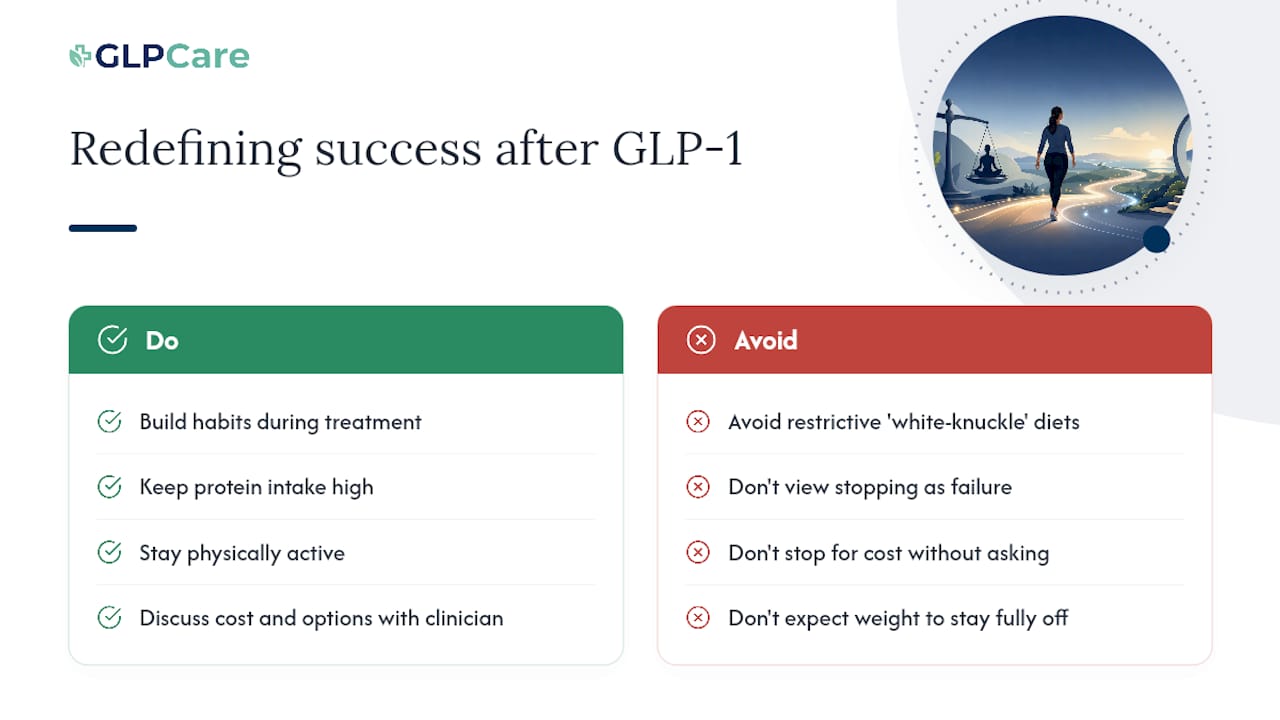
The patients who do best after stopping are not the ones who white-knuckle a restrictive diet. They are the ones who built habits during treatment, kept protein high, stayed active, and stayed connected to clinical support. The drug gave them a window. What they did inside that window determines how much they keep.
One practical reality worth naming: many patients stop GLP-1 therapy not because they want to, but because of cost or coverage changes. That is a systems problem, not a personal one. If cost is your reason for stopping, the conversation with your clinician should start there, because maintenance dosing, oral options, and manufacturer assistance programs may change the calculus before you reach your last injection.
How Glpcare supports your GLP-1 transition and long-term maintenance
Stopping or tapering GLP-1 therapy is one of the highest-risk moments in a weight management program, and it is exactly where most programs leave you without support. Glpcare is built for this transition.

Glpcare’s integrated care model pairs licensed clinician oversight with personalized nutrition coaching, a proprietary wearable fitness band that tracks sleep, heart rate, and activity in real time, and an AI-driven app that logs your doses, meals, and biometric trends in one place. When you are tapering or transitioning off high-dose therapy, that continuous data stream gives your clinician a clearer picture than a quarterly office visit ever could.
Three ways Glpcare directly addresses the regain risk this article describes:
- Muscle-preserving coaching. Registered dietitians and clinicians set protein targets specific to your body weight and activity level, and the app tracks your intake daily so gaps get caught early.
- Wearable-enabled monitoring. The Glpcare band tracks the biometrics that matter most during a transition: sleep quality, resting heart rate, and activity levels, feeding them into your care team’s dashboard between visits.
- Stepwise tapering and maintenance planning. Clinicians work with you to build a taper schedule, assess oral or lower-dose options, and set clear re-engagement thresholds before you stop.
Ready to build your maintenance plan? Take the GLP-1 readiness quiz to assess where you are now and what your next step should be.
Sources
The primary studies and reviews cited in this guide:
- Patients regain weight rapidly after stopping weight loss drugs – but still keep off a quarter of weight lost | University of Cambridge
- New study finds stopping weight-loss drugs linked to faster regain than ending diet | University of Oxford
- Off-treatment outcomes after 68 weeks of semaglutide 2.4 mg (STEP-1 extension) | PMC9542252
- Weaning off a GLP-1? Tips for the transition | Harvard Health
- Lower dose or oral pill may help sustain weight loss | Medical News Today
Bottom line from the evidence: Stopping GLP-1 therapy without a structured plan is the single largest modifiable risk factor for rapid weight regain. The biology is predictable. The response to it can be too.
FAQ
Do most people regain weight after stopping semaglutide?
Yes.
How quickly does weight return after stopping a GLP-1?
Regain is fastest in the first 12–20 weeks after the last dose. The Oxford systematic review found semaglutide and tirzepatide users average approximately 0.8 kg per month, with projections suggesting return to baseline in roughly 1.5 years without additional support.
How many people regain weight after stopping Zepbound or Mounjaro?
SURMOUNT extension data show a regain pattern consistent with the semaglutide literature. Because tirzepatide typically produces larger initial losses, the absolute kilograms regained can be greater, even when the percentage trajectory is similar to semaglutide.
Can a lower dose or oral GLP-1 help you keep weight off after stopping full-dose therapy?
Clinical trials show that switching to a lower-dose injectable or an oral GLP-1 formulation preserved a substantial share of prior weight loss over one year in selected patients, making maintenance dosing a practical alternative to full cessation for many people.
Why do people feel so much better on GLP-1 medications?
GLP-1 receptor agonists suppress appetite signaling in the brain, slow gastric emptying, and improve insulin sensitivity, reducing the persistent hunger and blood sugar fluctuations that many people experience before treatment. When the drug stops, those effects reverse, which is why structured behavioral strategies are critical to sustain the gains.
This article provides general health information and is not a substitute for professional medical advice. Consult your clinician or a qualified healthcare provider before making changes to your GLP-1 therapy, dosing schedule, or treatment plan.