GLP-1 Therapy for Weight Loss: 2026 Evidence Guide
GLP-1 Therapy for Weight Loss: 2026 Evidence Guide
TL;DR:
- GLP-1 therapy results in significant weight loss for adults with obesity, with most losing around 9% of body weight in the first year. Long-term success depends on integrated support, behavioral changes, and a sustained plan, as weight often returns after stopping medication. Proper medical evaluation, clinician oversight, and combining medication with nutrition and activity strategies improve outcomes and safety.
GLP-1 therapy produces clinically meaningful weight loss for adults with obesity, with major trials showing body weight reductions averaging roughly 9% at three months and continuing through the first year. Tirzepatide (a dual GLP-1/GIP agonist) reached notable weight loss at its highest doses in the SURMOUNT-1 trial, while semaglutide produced substantial weight loss in comparable studies. If your BMI is 30 or above, or 27 or above with a weight-related condition such as high blood pressure, type 2 diabetes, or sleep apnea, you likely meet standard eligibility criteria. The most important safety signals are gastrointestinal side effects during dose escalation, a rare thyroid tumor signal seen in rodent studies, and the well-documented tendency for weight to return after stopping medication without an active maintenance plan. The WHO recommends pairing GLP-1 therapy with intensive behavioral support for long-term results.
Your clearest next step is a consultation with a licensed clinician who can review your medical history, order baseline labs, and prescribe through a regulated pharmacy. Avoid any source offering GLP-1 medications without a prescription or medical review.
Stat to know: In pooled trial data, fat mass declined substantially while lean mass loss remained modest, meaning most of what you lose is fat, not muscle, when the therapy is properly supported.
Pro Tip: Take Glpcare’s GLP-1 Readiness Quiz before your first clinician appointment. It takes three minutes and gives you a structured summary of your eligibility factors to bring into the conversation.
Table of Contents
- How GLP-1 receptor agonists actually work in your body
- What the clinical evidence actually shows about weight loss results
- Which GLP-1 medications are approved and used in the U.S.
- Who qualifies for GLP-1 therapy for weight loss
- How GLP-1 treatment is started, titrated, and monitored
- Side effects, serious risks, and when to stop
- What happens when you stop GLP-1 therapy
- Cost, insurance coverage, and how to get a safe prescription
- How integrated, clinician-led programs like Glpcare support better outcomes
- Key Takeaways
- The case for treating GLP-1 therapy as a long-term commitment, not a quick fix
- Glpcare gives you a clinician-led path to GLP-1 care that goes beyond the prescription
- Useful sources
- FAQ
How GLP-1 receptor agonists actually work in your body
GLP-1 stands for glucagon-like peptide-1, a hormone your gut naturally releases after you eat. It signals the pancreas to produce insulin in a glucose-dependent way, tells the stomach to slow down emptying, and sends satiety signals to appetite-regulating centers in the brain. GLP-1 receptor agonists are synthetic molecules that mimic and amplify these effects, keeping them active far longer than the natural hormone does.
The practical result: you feel full sooner, stay full longer, and eat less without consciously fighting hunger. Gastric slowing also blunts post-meal blood sugar spikes, which is why these drugs were originally developed for type 2 diabetes before their weight loss potential became clear.
Here is where the mechanism differences between drug classes matter:
- Pure GLP-1 agonists (semaglutide, liraglutide): activate only the GLP-1 receptor; produce meaningful satiety and weight loss.
- Dual GLP-1/GIP agonists (tirzepatide): activate both GLP-1 and GIP receptors; GIP co-activation appears to amplify fat-cell metabolism and further reduce appetite, producing larger average weight loss in trials.
- Central appetite circuits: GLP-1 receptors in the hypothalamus and brainstem reduce food-seeking behavior, which is why many patients report that food “noise” quiets significantly within weeks of starting therapy.
- Visceral fat reduction: Beyond the scale, these agents reduce visceral adipose tissue and inflammatory markers, contributing to cardiometabolic improvements independent of total weight lost.
Understanding the mechanism also explains the side effect profile. Slowed gastric emptying causes the nausea and fullness that peak during dose escalation. It also affects how quickly oral medications are absorbed, which matters if you take other drugs by mouth.

What the clinical evidence actually shows about weight loss results
The evidence base for GLP-1 drugs for weight loss is now substantial, built on large randomized controlled trials and confirmed by meta-analyses.
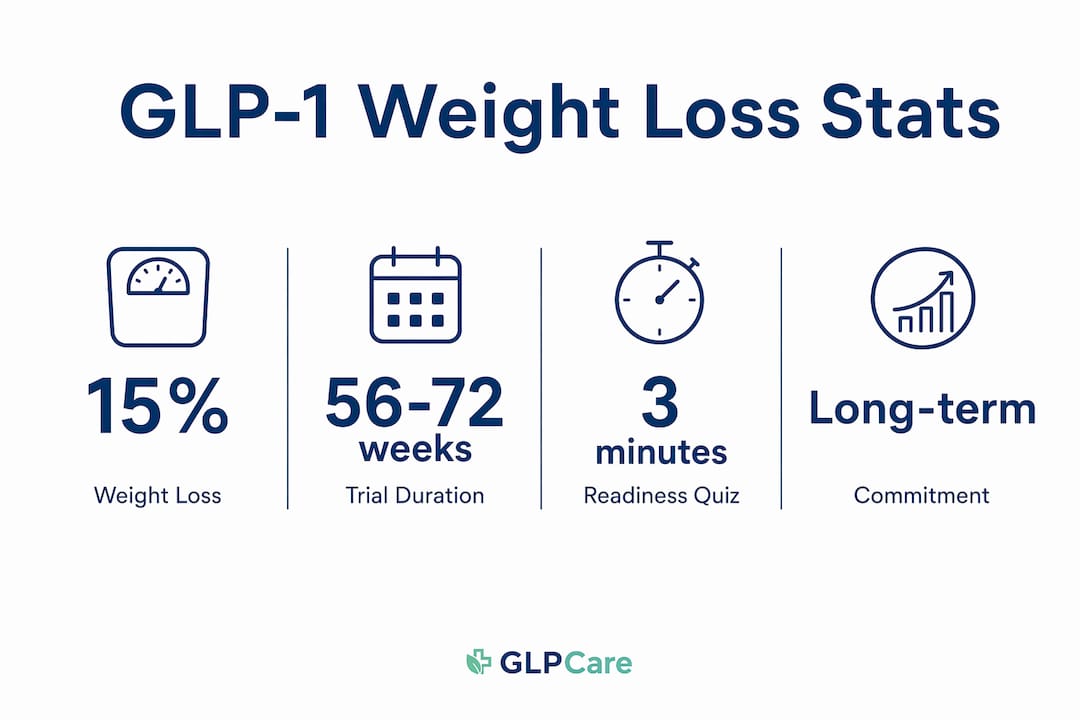
Trial results and timelines
| Drug | Trial | Duration | Mean weight loss | Notable finding |
|---|---|---|---|---|
| Semaglutide 2.4 mg/wk | STEP 1 | 56 to 72 weeks | ~15% body weight | — |
| Tirzepatide 15 mg/wk | SURMOUNT-1 | 72 weeks | ~20% body weight | Largest average loss in a GLP-1 class trial |
| Semaglutide 2.4 mg/wk | SELECT | ~34 months | Weight loss + CV benefit | Reduced MACE by ~20% vs placebo |
| Liraglutide 3 mg/day | SCALE Obesity | 56 weeks | ~8% body weight | Daily injection; lower persistence in practice |
The greatest changes happen early. Meta-analysis data show mean body weight declining roughly 9% at three months, with the rate of loss slowing through months six and twelve as the body adapts. Most patients reach a plateau somewhere between months 12 and 18 at their maintenance dose.
What this means for your timeline: Expect the most visible progress in the first three to six months. If you are not seeing meaningful movement by month three, that is a signal to revisit dose, adherence, or behavioral factors with your clinician, not to give up.
Real-world outcomes tend to run lower than trial averages. Trials provide structured support, frequent check-ins, and near-perfect medication supply. In practice, adherence gaps, insurance interruptions, and limited behavioral support all reduce average results. Programs that combine medication with coaching and monitoring close some of that gap.
One important limitation: most pivotal trials ran 56–72 weeks. Long-term data beyond two years, and especially data on what happens after stopping, remain limited.
Which GLP-1 medications are approved and used in the U.S.
Four agents dominate U.S. clinical practice. Understanding their indications matters because insurance coverage, prior authorization requirements, and prescribing decisions all turn on whether a drug carries an FDA weight-management label.
- Wegovy (semaglutide 2.4 mg, weekly subcutaneous injection): FDA-approved specifically for chronic weight management in adults with BMI ≥30, or ≥27 with a weight-related comorbidity. This is the primary GLP-1 prescription for weight loss in adults without diabetes.
- Ozempic (semaglutide, up to 2 mg, weekly subcutaneous injection): FDA-approved for type 2 diabetes. Widely prescribed off-label for weight loss, but its diabetes indication affects insurance coverage for weight management specifically.
- Zepbound (tirzepatide, weekly subcutaneous injection): FDA-approved for chronic weight management. Produces the largest average weight loss of any currently approved agent, making it the strongest option by trial data for patients who tolerate it.
- Mounjaro (tirzepatide, weekly subcutaneous injection): FDA-approved for type 2 diabetes. Same molecule as Zepbound; the indication determines which label and coverage pathway applies.
Pro Tip: If your insurer denies Wegovy or Zepbound, ask your clinician whether a diabetes diagnosis supports a different coverage pathway, or whether a compounded formulation through a licensed 503B pharmacy is appropriate for your situation. See Glpcare’s guide to GLP-1 options for a fuller breakdown.
Choosing between agents involves more than efficacy numbers. Weekly injectable agents show better real-world persistence than daily injections, which is one reason semaglutide and tirzepatide have largely displaced liraglutide in new prescriptions. Clinicians also weigh comorbidities: a patient with established cardiovascular disease may specifically benefit from semaglutide given the SELECT trial’s cardiovascular outcome data. A patient whose primary goal is maximum weight loss and who tolerates GI effects well may be a stronger candidate for tirzepatide.
Oral semaglutide (Rybelsus) exists for diabetes but is not FDA-approved for weight management and produces less weight loss than the injectable formulation at currently approved doses.
Who qualifies for GLP-1 therapy for weight loss
Standard U.S. eligibility criteria align with FDA labeling and major society guidelines. Most clinicians follow these thresholds:
- BMI ≥30 kg/m² (obesity): qualifies without any additional condition.
- BMI ≥27 kg/m² with at least one weight-related comorbidity: qualifying conditions typically include hypertension, type 2 diabetes, dyslipidemia, obstructive sleep apnea, nonalcoholic fatty liver disease, or elevated cardiovascular risk.
- Prior weight loss attempts: most insurers and many clinicians expect documented attempts at lifestyle modification before approving medication.
Contraindications and special populations your clinician will evaluate:
- Personal or family history of medullary thyroid carcinoma or Multiple Endocrine Neoplasia type 2 (MEN2): absolute contraindication for all GLP-1 receptor agonists.
- History of pancreatitis: requires careful risk-benefit discussion; GLP-1 therapy is generally avoided or used with caution.
- Pregnancy or planned pregnancy: GLP-1 medications are not recommended during pregnancy; effective contraception is advised for women of childbearing age.
- Severe gastroparesis or inflammatory bowel disease: slowed gastric emptying from GLP-1 therapy can worsen these conditions.
- Hypersensitivity to any component of the formulation.
When GLP-1 therapy may not be the first choice, your clinician might discuss bariatric surgery (for BMI ≥40, or ≥35 with severe comorbidities), lifestyle-first approaches for lower-risk patients, or adjunctive medications with a different mechanism. Clinician judgment matters here: your comorbidity profile, prior treatment history, and capacity for sustained behavioral change all shape the right path.
How GLP-1 treatment is started, titrated, and monitored
Starting GLP-1 therapy is not a single appointment. It is a structured clinical process designed to minimize side effects and confirm the medication is working safely.

Typical initiation and titration
Slow up-titration is the standard approach for all approved agents. For semaglutide (Wegovy), the starting dose is 0.25 mg weekly for four weeks, stepping up every four weeks until reaching the 2.4 mg maintenance dose over approximately 16–20 weeks. Tirzepatide (Zepbound) follows a similar stepwise schedule. This gradual increase gives your GI system time to adapt and is the single most effective strategy for reducing nausea.
Baseline assessments your clinician should complete before prescribing:
- Medical history review including thyroid history, pancreatitis history, and current medications
- Baseline weight, blood pressure, and heart rate
- Fasting glucose and HbA1c (to screen for undiagnosed diabetes)
- Liver function tests and lipid panel where clinically indicated
- Pregnancy test for women of childbearing age
Routine follow-up while on therapy:
- Weight and blood pressure at each visit
- Glycemic markers every three to six months if you have diabetes or prediabetes
- Assessment of GI side effects and dose tolerability at each titration step
- Medication review to check for absorption interactions with oral drugs
Telehealth has expanded access significantly. Licensed clinicians can conduct initial evaluations and follow-ups via video, and many programs ship medication directly to your home. This model works well for patients who are stable and adherent, but it requires that the prescribing clinician still reviews labs and conducts structured check-ins, not just refills. Glpcare’s GLP-1 tracker guide walks through how to log your dose, symptoms, and biometrics between visits to make those check-ins more productive.
Pro Tip: If nausea peaks during a titration step, ask your clinician about holding the current dose for an extra four weeks before stepping up. Slower titration is clinically supported and often more sustainable than pushing through.
Side effects, serious risks, and when to stop
GLP-1 therapy is generally well-tolerated, but the side effect profile is real and worth understanding before you start.
Common GI effects (most frequent during titration):
- Nausea: the most reported side effect, typically peaking in the first four to eight weeks at each new dose level and improving with time
- Vomiting and diarrhea: less common than nausea but occur in a meaningful proportion of patients
- Constipation: often underreported; slowed gastric transit affects the whole GI tract
- Decreased appetite and early satiety: technically the therapeutic effect, but can lead to inadequate protein and calorie intake if not managed
Less common but serious risks:
- Pancreatitis: rare; stop the medication and seek care immediately if you develop severe, persistent abdominal pain radiating to the back
- Gallbladder disease: rapid weight loss of any cause increases gallstone risk; GLP-1 therapy adds a modest additional signal
- Thyroid C-cell tumors: seen in rodent studies at high doses; not confirmed in humans, but the contraindication for personal or family history of medullary thyroid carcinoma stands
- Hypoglycemia: low risk when used alone; risk increases when combined with insulin or sulfonylureas
Stat to know: In the SELECT cardiovascular outcomes trial, semaglutide 2.4 mg reduced major adverse cardiovascular events compared to placebo over approximately 34 months, a meaningful benefit for high-risk patients that extends well beyond weight alone.
Drug interactions to discuss with your clinician:
- Oral medications with narrow therapeutic windows (thyroid hormones, oral contraceptives, certain antibiotics): slowed gastric emptying can alter absorption timing
- Insulin and sulfonylureas: dose reduction may be needed to avoid hypoglycemia
- Warfarin: INR monitoring may need to be more frequent during initiation
Stop the medication and contact your clinician or seek urgent care if you experience: severe or persistent abdominal pain, signs of a severe allergic reaction (swelling of the face or throat, difficulty breathing), or symptoms of pancreatitis.
What happens when you stop GLP-1 therapy
Stopping GLP-1 medication without a maintenance plan typically leads to weight regain. This is not a personal failure; it reflects the biology of obesity as a chronic, relapsing condition. The WHO frames obesity this way explicitly, recommending long-term therapy as part of integrated care rather than a time-limited course.
“Long-term” in clinical and regulatory language generally means continuous use for six months or longer. Beyond that threshold, the evidence on optimal tapering strategies remains limited. Most practice reviews note this as an important gap: many patients and clinicians lack a clear, evidence-based plan for what comes after the medication stops.
Strategies that help preserve weight loss after or during dose reduction:
- Intensive behavioral therapy (IBT): structured counseling focused on diet, physical activity, and behavior change; the WHO conditionally recommends combining IBT with GLP-1 therapy for better long-term outcomes
- Resistance training: preserves lean mass and maintains metabolic rate during and after weight loss
- Higher protein intake: supports muscle preservation; most clinicians recommend 1.2–1.6 g of protein per kilogram of body weight daily during active weight loss
- Structured follow-up: scheduled check-ins at 1, 3, and 6 months after stopping to catch early regain before it becomes significant
- Contingency planning: agreeing in advance with your clinician on the threshold (e.g., 5–10% weight regain) that would prompt restarting or adjusting therapy
Pro Tip: Build your maintenance plan before you reach your goal weight, not after. Patients who have a written plan for diet, exercise, and follow-up at the time of their peak dose tend to navigate the transition more successfully.
For practical guidance on protecting muscle during and after therapy, Glpcare’s resource on preventing muscle loss covers protein targets, training approaches, and monitoring strategies in detail.
Cost, insurance coverage, and how to get a safe prescription
GLP-1 medications are among the most expensive drugs in U.S. outpatient practice. Retail list prices for brand-name weekly injectables run over $1,000 per month without insurance. What you actually pay depends on your coverage, the specific drug, and how you access it.
Insurance coverage patterns:
- Commercial insurance: coverage varies widely by plan. Drugs with an FDA weight-management indication (Wegovy, Zepbound) are more likely to be covered than off-label use of diabetes-labeled agents, but prior authorization is nearly universal and requirements differ by insurer.
- Medicare: as of current policy, Medicare does not broadly cover weight-loss drugs for obesity alone; coverage may apply when the drug is prescribed for a covered condition such as cardiovascular disease risk reduction (as with semaglutide post-SELECT).
- Medicaid: coverage varies by state; some states cover GLP-1 agents for obesity, others do not.
- Manufacturer savings programs: Novo Nordisk and Eli Lilly offer savings cards that can significantly reduce out-of-pocket costs for commercially insured patients who qualify.
- Compounded formulations: licensed 503A and 503B compounding pharmacies have supplied semaglutide and tirzepatide at lower cost during shortage periods; the FDA’s regulatory posture on compounded GLP-1 agents has evolved and continues to change, so confirm current status with your clinician.
Safe access: what a legitimate prescription process looks like:
- A licensed clinician reviews your full medical history, not just your weight
- Baseline labs are ordered before or shortly after initiation
- The prescription is sent to a licensed, regulated pharmacy (retail or mail-order)
- You receive a follow-up appointment within 4–8 weeks of starting
Red flags that signal an unsafe source:
- Medication offered without a prescription or without any medical history review
- Prices dramatically below market with no explanation
- No licensed clinician involved in the prescribing decision
- Shipping from unverified international or compounding sources with no pharmacy license information
For a practical overview of affordable GLP-1 access, Glpcare’s blog covers program pricing models and what to look for when evaluating cost vs. clinical quality.
Pro Tip: Ask any telehealth program you consider whether their prescribing clinicians are licensed in your state, whether they order baseline labs, and what their refill policy is if you have a side effect that requires a dose hold. A program that cannot answer all three questions clearly is not the right fit.
How integrated, clinician-led programs like Glpcare support better outcomes
Medication alone rarely produces the best long-term results. The evidence consistently shows that combining GLP-1 therapy with behavioral support improves outcomes, and the WHO’s conditional recommendation reflects exactly that. What an integrated program adds, in practice, is the structure most patients lack when they get a prescription and a refill schedule with nothing else.
Glpcare is built around this model. Here is what the program includes:
- Clinician prescribing and oversight: licensed clinicians evaluate eligibility, review your medical history, and manage titration; they remain available between visits, not just at refill time
- Medication delivery: prescriptions fulfilled through regulated channels and shipped to your home, with clear policies on refills and dose adjustments
- Nutrition coaching focused on muscle preservation: personalized guidance on protein targets and meal structure to minimize the lean mass loss that can occur during rapid weight reduction
- Proprietary wearable fitness band: a screenless device with medical-grade sensors that tracks sleep, heart rate, HRV, and activity levels in real time, giving clinicians and patients objective data rather than self-reported estimates
- AI-driven app: logs your dose, dietary habits, and biometric data; surfaces personalized insights and flags patterns that warrant clinician attention
The wearable component addresses a real gap in standard GLP-1 care. Most programs track weight at monthly visits. Glpcare’s wearable technology captures continuous data on sleep quality, recovery, and activity, which are all factors that affect both weight loss rate and lean mass preservation.
What to look for when evaluating any integrated GLP-1 program:
- Clinician credentials and state licensure verification
- Baseline and follow-up laboratory monitoring included in the program
- Clear refill and dose-hold policies
- Secure, HIPAA-compliant data handling
- Transparent pricing with no hidden fees at refill
Pro Tip: Use Glpcare’s protein intake calculator to set your daily protein target before your first nutrition coaching session. Arriving with a baseline number makes the first conversation more specific and more useful.
Key Takeaways
GLP-1 therapy produces clinically meaningful fat loss for eligible adults, but sustained results require integrated clinical support, behavioral change, and a clear plan for long-term management.
| Point | Details |
|---|---|
| Efficacy ranges by drug | Semaglutide produces ~13–15% weight loss; tirzepatide reaches ~20% at the highest trial doses. |
| Fat vs. lean mass | Fat mass declines substantially while lean mass loss remains modest when therapy is properly supported. |
| Eligibility thresholds | BMI ≥30, or BMI ≥27 with a weight-related comorbidity such as hypertension or type 2 diabetes. |
| Stopping carries regain risk | Weight typically returns after discontinuation without an active maintenance plan; the WHO recommends long-term integrated care. |
| Glpcare’s integrated approach | Glpcare combines clinician oversight, medication delivery, nutrition coaching, wearable tracking, and AI-driven adherence support in one program. |
The case for treating GLP-1 therapy as a long-term commitment, not a quick fix
The framing that bothers me most in public coverage of GLP-1 drugs is the before-and-after narrative. Someone loses 40 pounds, the story ends, and the reader is left with the impression that the medication did the work and the work is now done. That framing is not just incomplete; it actively sets people up for disappointment.
What the clinical evidence actually describes is a chronic disease management model. Obesity is not a willpower failure that a drug corrects. It is a condition with biological drivers, including hormonal dysregulation, altered appetite signaling, and metabolic adaptation, that medication can modulate but not permanently fix. When the drug stops, those drivers do not disappear. The weight returns because the underlying biology reasserts itself, not because the patient failed.
This matters for how you approach therapy from day one. The patients who do best long-term are not the ones who lose the most weight fastest. They are the ones who use the appetite suppression window to build habits: higher protein intake, consistent resistance training, structured meal timing, and a relationship with a clinician who knows their history. The medication creates the conditions for change; the behavioral work is what makes that change durable.
There is also a muscle loss issue that does not get enough attention. GLP-1 therapy reduces appetite broadly, which means patients often under-eat protein without realizing it. Combined with the caloric deficit, this can produce disproportionate lean mass loss if resistance training and protein targets are not actively managed. A program that hands you a prescription and a refill schedule without addressing this is leaving a significant piece of the outcome on the table.
The most responsible approach to GLP-1 care, in my view, is one that treats the medication as one component of a structured system: clinician oversight, behavioral support, nutrition coaching, and objective monitoring. That is not a luxury add-on. It is what the evidence says works.
Glpcare gives you a clinician-led path to GLP-1 care that goes beyond the prescription
Most GLP-1 programs stop at the prescription. Glpcare starts there and builds the full clinical structure around it: licensed clinician evaluation, regulated medication delivery, personalized nutrition coaching to protect your lean mass, a proprietary wearable that tracks your sleep, heart rate, and activity between visits, and an AI-driven app that connects your dose log to your biometric data in real time.

The difference shows up in the details that matter most. Your clinician sees your actual recovery and activity data, not just your weight at a monthly check-in. Your nutrition coach sets protein targets specific to your starting weight and rate of loss. And if a side effect requires a dose hold, you have a clinical team to call, not a refill queue.
If you already have a GLP-1 prescription, Glpcare’s bring-your-own-medication plan lets you add the coaching, wearable, and monitoring layer without switching providers. If you are starting from scratch, the full program covers clinician evaluation, prescribing where appropriate, and medication delivery.
Take the GLP-1 Readiness Quiz to see whether you meet standard eligibility criteria and get a personalized summary to bring to your first clinician conversation.
Useful sources
The following primary references and guidelines informed this article. Each is publicly accessible for readers who want to verify claims or read deeper.
- WHO GLP-1 Guideline (2025): WHO issues global guideline on the use of GLP-1 medicines in treating obesity — conditional recommendations for long-term GLP-1 therapy combined with intensive behavioral support.
- JAMA publication of WHO Guideline: World Health Organization Guideline on GLP-1 Therapies for Obesity in Adults — peer-reviewed publication of the WHO recommendations with clinical commentary.
- Meta-analysis on body composition: GLP-1 agonists and changes in body mass and composition in adults with overweight or obesity — pooled trial data on fat mass, lean mass, and weight loss timelines.
- StatPearls clinical review: Obesity Medications: Evidence-Based Management — comprehensive review of approved agents, mechanisms, and comparative efficacy.
- SELECT trial and broader GLP-1 benefits: The expanding benefits of GLP-1 medicines — cardiovascular outcomes and organ-system effects beyond weight loss.
- FDA DailyMed labeling: Liraglutide injection prescribing information — official U.S. label including indications, dosing, and clinical trial data.
- Medicare coverage policy: Medicare weight-loss drug coverage — current federal coverage guidance for GLP-1 agents under Medicare.
- National Academy of Medicine: Understanding GLP-1 Drugs: Cost, Safety, and Access — policy-level analysis of cost, equity, and access considerations in the U.S.
This article is general health information, not medical advice. Confirm your eligibility, current drug availability, and coverage status with a licensed clinician and your insurer before starting any GLP-1 therapy.
FAQ
Which GLP-1 is strongest for weight loss?
Tirzepatide (Zepbound) produces the largest average weight loss of any currently approved agent, reaching approximately 20% body weight reduction at the highest dose in the SURMOUNT-1 trial, compared to roughly 13–15% for semaglutide (Wegovy) in comparable studies.
Where can you get a GLP-1 prescription for weight loss?
A licensed clinician, whether through an in-person practice or a telehealth program like Glpcare, can evaluate your eligibility and prescribe through a regulated pharmacy; never purchase GLP-1 medications from any source that does not require a valid prescription and medical history review.
Does Medicare cover GLP-1 drugs for weight loss?
Medicare currently does not broadly cover GLP-1 medications prescribed solely for obesity; coverage may apply when the drug is prescribed for a qualifying condition such as cardiovascular disease risk reduction, and state Medicaid programs vary significantly in their coverage policies.
How long does it take to lose 20 pounds on GLP-1 therapy?
Timeline depends on your starting weight, dose, and adherence, but most patients reach their most rapid loss in the first three to six months; for many adults, losing 20 pounds falls within the first three to four months at a therapeutic dose, though individual results vary considerably.