Weekly Semaglutide: Clinician Backed Timing to Reduce Side Effects
Weekly Semaglutide: Clinician Backed Timing to Reduce Side Effects
For weekly injectable semaglutide, the hour of day doesn’t change how well it works. Pick a day and time you can repeat every week, and stick with it. For oral semaglutide (Rybelsus), the rule is strict: take it in the morning on an empty stomach with no more than 4 ounces of water, then wait a suitable period before eating, drinking anything else, or taking other pills. When your prescription instructions differ from general advice, follow the label and your prescriber.
TL;DR:
- Injectable semaglutide’s effectiveness is unaffected by injection time due to its long half-life, allowing flexibility in scheduling.
- Oral semaglutide requires strict timing with an empty stomach and specific water intake to ensure proper absorption, limiting when it can be taken.
- Night injections may reduce side effects like nausea and fatigue, while morning doses better align with appetite suppression during waking hours.
- Choosing a consistent weekly dose time based on routine helps improve adherence more than trying to optimize for peak effects.
- Monitoring individual responses and side effects through clinician support and wearable data can improve tolerability and long-term compliance.
Table of Contents
- Semaglutide Morning or Night: Why the Rules Differ by Formulation
- Morning vs. Night for Your Weekly Injection: The Real Trade-Offs
- What Should Actually Drive Your Injection Time
- How to Manage Side Effects and Stay on Schedule
- The Rybelsus Morning Protocol, Step by Step
- What to Do If You Miss or Delay Your Weekly Dose
- What the Clinical Evidence Actually Says
- How Clinician Monitoring Changes Timing Decisions in Practice
- Get Supervised GLP-1 Care Built Around Your Actual Data
- Sources
- FAQ
Semaglutide Morning or Night: Why the Rules Differ by Formulation
The injectable and oral versions of semaglutide behave nothing alike once they enter your body, which is why one comes with almost no timing restrictions and the other comes with a strict morning ritual.
Injectable semaglutide has a half-life of roughly one week, so a single weekly dose keeps circulating at a fairly steady level the entire time. Whether you inject at 7 a.m. Monday or 9 p.m. Monday, the drug’s presence in your bloodstream over the following seven days looks nearly identical. The FDA’s prescribing information confirms this steady-state exposure is what makes clock hour irrelevant for injectable dosing. The Wegovy label states it plainly: administer once weekly, any time of day, with or without meals.
Oral semaglutide plays by a completely different set of physics. Rybelsus tablets rely on an absorption enhancer called SNAC to survive the stomach long enough to get into your bloodstream at all, and that enhancer only works under narrow conditions. The tablet label requires:
- An empty stomach, first thing in the morning
- A small amount of plain water to swallow the tablet
- A minimum 30-minute wait before food, drinks, or other oral medications
Miss any one of those three conditions and absorption can drop sharply, which is why the oral form has almost no flexibility compared to the shot.
Morning vs. Night for Your Weekly Injection: The Real Trade-Offs
Since efficacy doesn’t shift with clock hour, choosing morning or night for your injectable dose comes down to lifestyle and how you want to experience side effects. This is a comfort decision, not a medical one.
- Night dosing lets you sleep through the worst of it. Nausea and fatigue tend to peak in the hours right after a dose, especially following a dose increase. Injecting before bed means you’re often asleep during that window, which is part of why clinical guidance on GLP-1 timing frequently mentions evening dosing as a tolerability strategy during titration.
- Morning dosing pairs appetite suppression with your waking hours. If your biggest food challenges happen at lunch or through the afternoon, a morning shot may line up your reduced appetite with the hours you actually need it.
- Routine fit often decides it for you. An early riser who already has a consistent 6 a.m. coffee-and-vitamins routine can bolt the injection onto that habit easily. A shift worker with a rotating schedule may find a fixed calendar time (say, every Sunday at 8 p.m., regardless of what shift they worked that day) easier to protect than any specific hour.
None of these change how much weight you lose. They change how your week feels while you’re losing it, which for most people is the difference between sticking with treatment and quietly skipping doses.
What Should Actually Drive Your Injection Time
The right time to inject is the one you’ll actually repeat 52 weeks a year, not the one that sounds optimal on paper. A few concrete factors help narrow it down:
- Anchor it to something you already do. Tying the injection to an existing weekly habit, like Sunday meal prep or Monday morning coffee, cuts the chance you’ll forget far more than any app alone.
- Think about who’s around you at your chosen hour. If nausea after a dose increase would interfere with work calls or driving kids to school, shifting to evening dosing may spare your daytime.
- Check what else you’re taking. Semaglutide slows gastric emptying, which can change how other oral medications are absorbed; if you take time-sensitive prescriptions, ask how semaglutide interacts with your other medications before locking in a schedule.
- Plan around shift work and travel. Crossing time zones or rotating shifts doesn’t require injecting at the exact same clock hour every week, only staying within roughly the same day. If a trip will push you more than a day or two off schedule, call your prescriber rather than guessing.
Pro Tip: Set a recurring phone alarm labeled with the actual day (“Sunday dose”), not just a time. A day-based reminder survives time zone changes and shift swaps far better than an hour-based one.
How to Manage Side Effects and Stay on Schedule
Side effects, not clock hour, are what actually derail people on semaglutide. The pacing of your dose increases matters far more than whether you inject at dawn or midnight.
- Follow your prescriber’s titration schedule exactly. Dose escalation is the single biggest driver of nausea, vomiting, and stomach discomfort, and slower, prescriber-directed increases reduce peak symptoms more reliably than any timing trick.
- Adjust meals around dose days. Smaller, blander meals with less fat and sugar in the 24 hours after a dose (or dose increase) tend to sit better. Hydration also helps, since nausea and reduced fluid intake compound each other.
- Track what your body does over the first few weeks. Knowing what to expect during that stretch, covered in detail in a six-week Ozempic timeline, makes it easier to tell normal adjustment from something worth calling about.
- Build reminders into a routine you won’t skip. Calendar alerts, a habit you already repeat weekly, or a dose-tracking app all reduce the odds of a missed or doubled dose.
- Know your red flags. Severe, persistent vomiting, intense abdominal pain that radiates to your back, or symptoms of dangerously low blood sugar are reasons to call your care team immediately, not wait it out.
Adverse reactions reported across semaglutide’s labeling include nausea, diarrhea, vomiting, constipation, and fatigue as the common ones, with pancreatitis and gallbladder disease listed as rarer but serious concerns worth knowing.
The Rybelsus Morning Protocol, Step by Step
Rybelsus tolerates almost none of the flexibility injectable semaglutide allows. The absorption enhancer that lets the tablet work at all is fragile, and skipping a step can mean your dose barely gets absorbed.
Here’s the sequence that matters every single morning:
- Take the tablet as soon as you wake, before coffee, food, or other pills
- Swallow it whole with no more than 4 ounces of plain water (no coffee, juice, or flavored water)
- Wait at least 30 minutes before eating, drinking anything else, or taking any other oral medication
Deviate from this, and studies behind the tablet’s absorption requirements suggest you may absorb meaningfully less of the dose, which can blunt its effect over time even though you technically took the pill.
To make the routine stick, keep the tablet somewhere you’ll see it before anything else, like next to your toothbrush or on your nightstand. If you occasionally wake up and realize you already ate, skip that day’s dose rather than taking it late with food, and resume the normal schedule the next morning.
What to Do If You Miss or Delay Your Weekly Dose
Missed doses happen. What you do next depends almost entirely on how much time has passed.
- Within a few hours to a day: Take the injection as soon as you remember, as long as your next scheduled dose isn’t within a day or two. Resume your normal weekly day after that.
- More than 2 days late but within about 5 days: Most label guidance still allows taking the dose late and simply shifting your weekly injection day going forward; confirm this against your specific product’s instructions.
- More than 5 days (roughly a week or more): Skip the missed dose entirely. Do not double up. Contact your prescriber, since a long gap sometimes means restarting at a lower dose to avoid side effects that come with losing your body’s adjustment to the medication.
Guessing here is the riskiest move you can make. The product label and your prescriber’s instructions outrank any generic advice, including this article, when the two conflict.
What the Clinical Evidence Actually Says
The flexibility built into injectable semaglutide and the rigidity built into Rybelsus both come straight from FDA labeling, not convention or convenience.
- The Wegovy injection label explicitly permits dosing at any time of day, with or without food, as long as the weekly day stays consistent.
- The drug’s roughly one-week half-life, confirmed in the FDA pharmacology data, means blood levels stay steady across the week regardless of injection hour.
- NEJM trial data establishes semaglutide’s weight-loss efficacy under these same weekly dosing conditions, without tying results to any specific hour of administration.
- Public health guidance from NIDDK reinforces that consistency, not clock time, is the operative rule for GLP-1 medications broadly.
How Clinician Monitoring Changes Timing Decisions in Practice
Most timing advice online is generic because it has to be. Real dosing decisions look different once someone is actually watching how your body responds week to week.
At GLPCare, clinicians use wearable data (sleep quality, resting heart rate, activity levels) alongside your own symptom reports to see patterns you might miss on your own. If a patient logs disrupted sleep for two nights after a Sunday-night dose, that’s a concrete signal worth testing a morning switch instead of guessing. If nausea keeps someone from eating enough protein and a wearable shows falling activity, the response might be pausing an escalation step rather than pushing through on schedule.
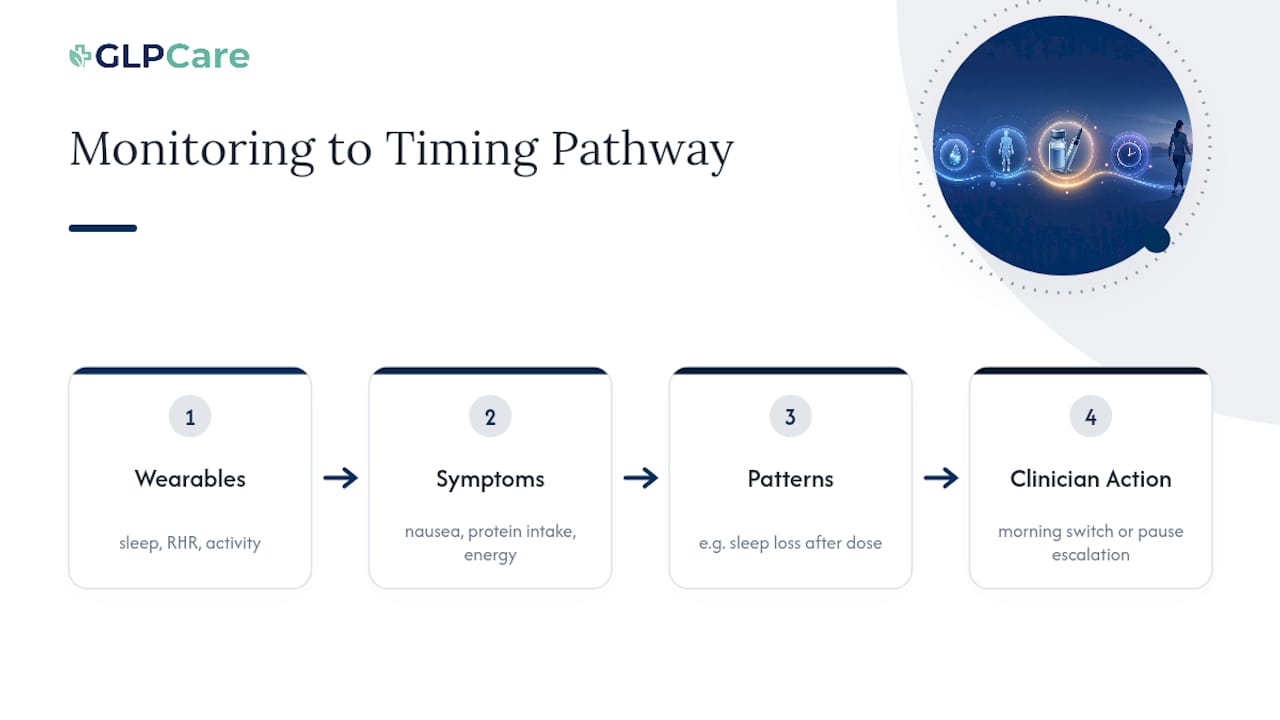
This is the piece a label can’t give you: how your specific pattern of side effects, sleep, and energy should shape your specific schedule. Titration pace and timing tweaks work best when someone is actually looking at your data, not applying a one-size rule to everyone.
Get Supervised GLP-1 Care Built Around Your Actual Data
Reading label instructions gets you the rules. Knowing how your body is actually responding week to week takes more than a printed schedule. Glpcare pairs prescription GLP-1 medication, shipped to your door, with licensed clinician support and a wearable band that tracks sleep, heart rate, and activity so your care team can see the patterns behind your side effects instead of guessing at them.

That combination matters most during dose escalation, when small timing and pacing adjustments make the biggest difference in whether you stick with treatment. Instead of managing titration and side effects alone, you get ongoing clinician input paired with objective data from your own body, plus dose-tracking tools that keep your weekly schedule consistent. If you’re wondering whether supervised GLP-1 care fits your situation, take the GLP-1 Readiness Quiz to see what a personalized program would look like for you.
This article is general information, not a substitute for advice from a qualified doctor. Consult a qualified healthcare professional about your own circumstances before acting on anything here.
Sources
- WEGOVY (semaglutide) injection and tablets - Highlights of prescribing information
- NEJM semaglutide trial publication
FAQ
Is It Better to Take Semaglutide Before Bed?
Night dosing isn’t required, but many patients prefer it during dose escalation because it lets transient nausea occur while they’re asleep. Efficacy stays the same whether you inject in the morning or at night, as confirmed by Wegovy’s dosing information.
What Day Is Semaglutide the Strongest?
Semaglutide doesn’t have a “strongest” day; its roughly one-week half-life keeps blood levels fairly steady across the entire seven days between doses, per FDA pharmacology data. What matters is picking a consistent weekly day, not chasing a peak.
Can I Lose Weight on 0.25 mg Semaglutide?
The initial dose is a starting titration step meant to help your body adjust, not a target maintenance dose, so meaningful weight loss typically follows once you reach a higher maintenance dose under your prescriber’s schedule. Staying on the starting dose too long without escalating, or skipping doses, can slow progress regardless of the time of day you inject.
Does Semaglutide Make You Sleepy?
Fatigue is a listed side effect for some patients, particularly during dose increases, though it isn’t universal. If fatigue is significant, some patients switch to evening dosing so tiredness overlaps with normal sleep hours rather than the workday; a program that tracks your sleep and energy through a wearable device can help confirm whether that adjustment actually helps in your case.