Once Weekly, Not the Hour: Clinician Backed Semaglutide Timing
Once Weekly, Not the Hour: Clinician Backed Semaglutide Timing
The exact clock time you inject semaglutide does not change how well it works. What matters is picking one weekday you can realistically keep every single week. Beyond that, timing becomes a tool for managing side effects: an evening shot can let you sleep through early nausea, while a morning shot lets you monitor how you feel during the day. Always follow your prescribed dose-escalation plan and talk to your clinician before changing how or when you dose.
TL;DR:
- The exact time of week you inject semaglutide does not affect its efficacy, but consistency in choosing a regular day supports adherence.
- Changing injection days is acceptable if at least 48 hours pass between doses to prevent side effects without reducing effectiveness.
- Morning or evening injections mainly influence side effect experience, with evening doses often reducing early nausea for better sleep.
- Injection can be done with or without food, and rotating injection sites weekly minimizes skin irritation and maintains absorption.
- Clinician support, wearable tracking, and personalized adjustments improve tolerance and long-term success with the medication.
GlpcareMake Weekly Weight Management More PersonalGLPCare combines GLP-1 therapy, nutrition coaching, wearable insights, and continuous clinician support for individualized weight management.Explore GLPCare
Table of Contents
- Semaglutide Injection Timing: The Weekly Rules You Actually Need
- Morning vs. Evening Injections: Which Fits Your Life?
- Injection Timing Around Meals and Choosing an Injection Site
- What to Do If You Miss a Dose or Need to Shift Your Day
- Dose Escalation: Why Slow and Steady Reduces Nausea
- Building a Weekly Routine That Actually Sticks
- How Clinician Oversight Shapes Smarter Timing Decisions
- Why Consistency Beats Perfect Timing
- Get Clinician-Backed Support for Your Injection Schedule
- Sources
- FAQ
Semaglutide Injection Timing: The Weekly Rules You Actually Need
The label rules are simpler than most people expect. Injectable semaglutide is dosed once a week, on the same day, at any hour you choose, and you can take it with or without food. That flexibility exists because the drug has a long half-life of about a week, so blood levels stay steady regardless of whether you inject at 7 a.m. or 9 p.m.
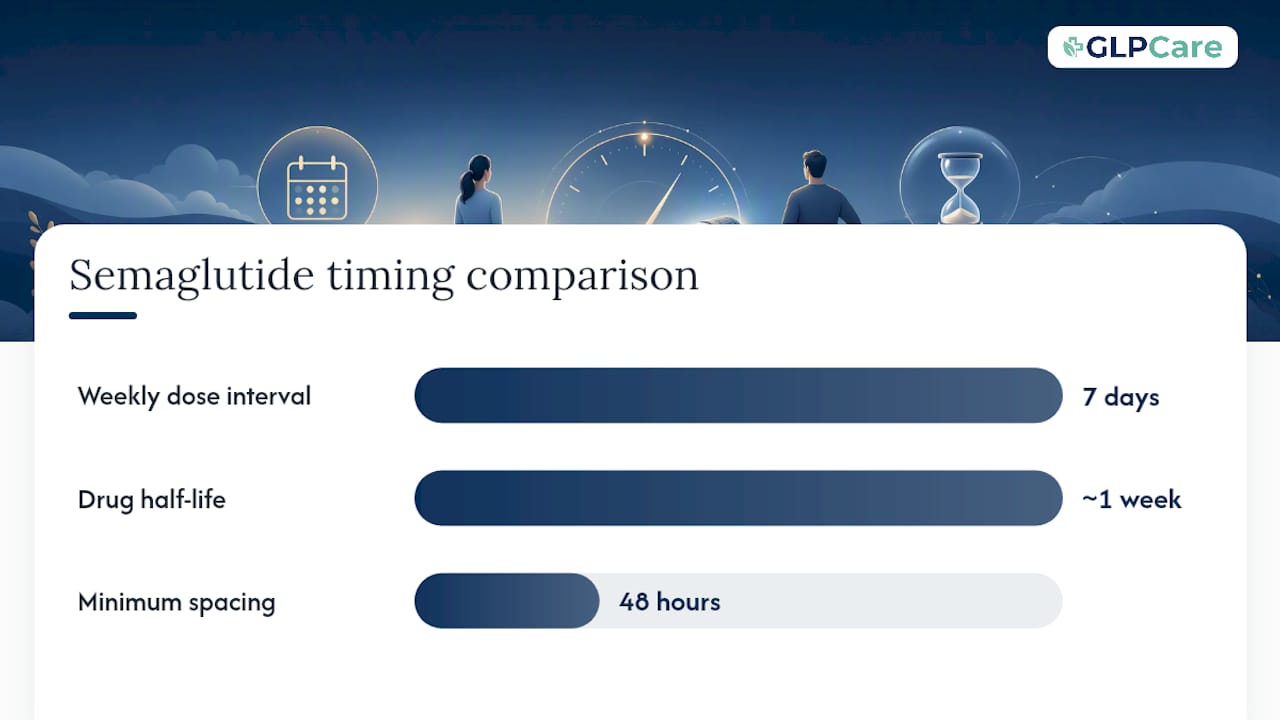
You can change your weekly injection day when life gets in the way, as long as at least 48 hours pass between the two doses. Miss that 48-hour window, and you risk stacking doses too close together, which raises the odds of nausea and other GI side effects without adding any benefit.
Picking a day that survives real life matters more than picking a “perfect” one. A few anchors that tend to work:
- Weekend mornings, when your schedule is less rigid and you can absorb any early side effects without a workday hanging over you.
- A recurring routine day, like grocery shopping or a weekly errand, that already has a reliable cue attached to it.
- The same day you fill a weekly pill organizer, so the two habits reinforce each other.
A phone alarm, a recurring calendar event, or the GLPCare app and wearable combination all do the same basic job: they turn “I’ll remember” into a system you don’t have to think about.
Morning vs. Evening Injections: Which Fits Your Life?
There’s no universal answer here, but there is a pattern worth knowing. GI symptoms like nausea, bloating, and mild fatigue tend to show up within the first several hours after an injection, especially during the early weeks of treatment. That timing window is exactly why the time of day you choose can change how you experience semaglutide, even though it doesn’t change how well it works.
Evening dosing is a common choice for people who get mild, transient nausea after their shot. You inject before bed, sleep through the roughest hours, and often wake up feeling closer to normal. Morning dosing works better for people who prefer to be awake and alert while monitoring how their body reacts, particularly in the first few weeks when you don’t yet know your own response pattern.
A few practical factors to weigh before you settle on one:
- Driving and work: if nausea or fatigue hits hard, avoid scheduling your shot right before a commute or a demanding shift.
- Caregiving duties: if you’re responsible for young kids or dependents shortly after your usual dose window, evening dosing after they’re asleep can reduce the pressure.
- Exercise plans: intense workouts on injection day can amplify GI discomfort for some people, so consider spacing your dose and your hardest training session apart.
Pro Tip: Test one time-of-day choice for at least three to four weeks before switching. Side effects usually settle down as your body adjusts, so a single rough week doesn’t mean the schedule is wrong for you.
If nausea is severe, persistent, or paired with vomiting that limits fluid intake, that’s a conversation for your clinician, not a scheduling fix. For general guidance on choosing between the two, a breakdown of morning or night dosing walks through both scenarios in more detail.
Injection Timing Around Meals and Choosing an Injection Site
Injectable semaglutide gives you real flexibility here: you can take it with a full meal, an empty stomach, or anywhere in between. That’s a meaningful contrast to the oral version, Rybelsus, which comes with strict rules. Rybelsus has to be taken first thing in the morning on an empty stomach, with no more than 4 ounces of plain water, followed by a 30-minute wait before eating, drinking anything else, or taking other oral medications. Confusing the two administration styles is one of the most common mistakes people make when switching between formulations.
For the injectable version, three steps cover almost everything you need:
- Choose your site. The abdomen, thigh, and upper arm are all approved injection sites, and no single spot is required for every dose.
- Rotate weekly. Moving the exact spot each week, even within the same general region, reduces skin irritation and helps keep absorption consistent.
- Check the pen before you inject and be aware of using the right diluent, as discussed in detail in the guide on Semaglutide mengen: BAC water of NaCl gebruiken?. Let it warm to room temperature, inspect the solution for clarity, and hold the injection in place for the full duration your device instructions specify, usually around 10 seconds.
GLPCare’s guide to semaglutide injection sites covers site rotation and pen handling step by step if you want a visual walkthrough.
What to Do If You Miss a Dose or Need to Shift Your Day
Missed doses happen, and the right response depends on which product you’re using and how many days have passed. For many injectable diabetes formulations, you can administer a missed dose within 5 days of the original scheduled time. Beyond that window, you skip the missed dose entirely and resume your normal schedule the following week. Never double up to make up for a missed injection.
Weight-management labeling can be more conservative, sometimes using a tighter window, so check the guidance for your specific prescription rather than assuming diabetes and weight-loss products follow identical rules.
A few rules that apply across the board:
- If you’re shifting your weekly day going forward, keep at least 48 hours between the two doses.
- Skipping a single dose rarely requires any dosage change. Just resume your regular schedule.
- Missing several doses in a row is different. Clinicians sometimes recommend re-titrating from a lower starter dose rather than jumping back into your previous maintenance dose, since your GI tolerance may have reset.
If you’re unsure which window applies to your medication, GLPCare’s missed-dose guide by product type breaks down the differences, or you can call your prescriber directly.
Dose Escalation: Why Slow and Steady Reduces Nausea
The standard escalation path starts at 0.25 mg and increases roughly every 4 weeks, climbing toward a maintenance dose over a period of months rather than weeks. That gradual ramp isn’t arbitrary. Clinical evidence on GLP-1 medications consistently shows that GI side effects cluster during dose increases, and slower titration schedules improve tolerability compared to rushing the climb.
A handful of everyday habits make each step easier:
- Eat smaller, blander meals for the first few days after any dose increase.
- Sip water consistently through the day. Dehydration makes nausea worse, not better.
- Ginger tea or ginger chews are a low-risk option some people use to settle mild queasiness.
If GI symptoms are hitting hard, some clinicians will slow the escalation timeline rather than push forward on schedule, and in some cases they’ll prescribe short-term antiemetics to bridge the transition.
Pro Tip: If you’re vomiting repeatedly, can’t keep fluids down, or feel signs of dehydration like dizziness or a racing heart, contact your clinician before your next scheduled dose. This is not a symptom to push through on your own.
A full breakdown of the dosing schedule walks through each 4-week step in more detail, including when a slower ramp makes sense.
Building a Weekly Routine That Actually Sticks
The medication only works if the schedule survives your actual life, not the ideal version of it. A few approaches that hold up:
- Anchor to a fixed weekday, not a rolling “every 7 days” count from your last dose. Calendar-day anchoring is easier to track and harder to drift on.
- Set two reminders, not one. A phone alarm catches the moment; a calendar entry catches you if you silence the alarm and forget.
- Plan around travel in advance. If you know a trip will disrupt your usual day, decide the backup day before you leave, and keep the 48-hour minimum between doses in mind.
- Pick one alternate day for shift work or irregular schedules, and use it consistently instead of picking a new day every time something conflicts.
Pairing your injection reminder with a habit you already track, such as a fitness app or a medication organizer, cuts down on the mental math. If your routine keeps getting disrupted despite your best efforts, switching to a more forgiving anchor day and writing down the change is more sustainable than trying to force the original day to work.
How Clinician Oversight Shapes Smarter Timing Decisions
Reading label instructions gets you most of the way there, but individual response varies more than a printed schedule can capture. Some people tolerate morning dosing without issue; others need the evening switch to function normally at work. That’s where ongoing clinician support and real biometric data change the picture.
Some telehealth programs pair prescribing guidance with a wearable that tracks sleep, heart rate, and activity alongside the dose and symptom logs you enter yourself, giving your care team a clearer picture of how your body actually responds to each injection, not just what the label predicts. When nausea, sleep disruption, or energy dips show up in that data, a clinician can suggest a timing adjustment that fits your real patterns instead of a generic rule. If you’re evaluating whether a more hands-on approach fits your situation, the GLP-1 readiness quiz and GLPCare’s precision care model are both built around that kind of individualized adjustment.
Why Consistency Beats Perfect Timing
Most of the anxiety around semaglutide timing is misplaced. People agonize over whether 8 a.m. beats 8 p.m., when the real variable that predicts long-term success is whether you keep the same weekly rhythm month after month. The pharmacology backs this up: with a week-long half-life, the drug doesn’t care what hour you chose. It cares whether you show up on schedule.
Where conventional advice falls short is treating side-effect management as an afterthought instead of a first-order decision. Nausea drives more missed doses and early discontinuations than any confusion about the “right” time. Choosing evening dosing because you know you’ll sleep through the rough hours isn’t a workaround. It’s arguably the more clinically sound decision for a lot of people starting treatment.
If you take one thing from this, prioritize the day-of-week decision first, then the time-of-day decision second, and treat both as adjustable based on how your body actually responds. Integrated tracking, like the kind coaching and wearable data provide, makes that adjustment based on evidence instead of guesswork. The goal isn’t a perfect schedule on paper. It’s one you’ll still be following in month six.
— Dominique
Get Clinician-Backed Support for Your Injection Schedule
Reading through escalation charts and missed-dose windows is one thing. Having a clinician actually watch how your body responds to each week’s dose is another. Some programs include prescription GLP-1 medication delivered to your door, paired with a wearable band and app that track sleep, heart rate, and activity alongside your dosage log, so timing adjustments are based on your real data instead of a generic chart.

If you’re not yet on a prescription, the GLP-1 readiness quiz is the fastest way to see whether you qualify and what a personalized plan could look like. If you’re already dosing and want more precision around timing, side effects, and long-term progress, GLPCare’s precision care plans combine clinician support with the wearable’s biometric tracking to fine-tune your schedule over time. Whatever you decide, talk to your prescriber before changing your dose, your day, or your escalation pace. This article is a guide, not a substitute for the person who knows your chart.
Sources
- DailyMed - OZEMPIC (semaglutide) injection, solution
- MedlinePlus - Semaglutide injection
- Mayo Clinic - Semaglutide (subcutaneous route) description
- Cleveland Clinic - Semaglutide tablets (Rybelsus)
FAQ
Why Do You Have to Wait 30 Minutes After Taking Semaglutide?
That 30-minute wait applies specifically to oral semaglutide (Rybelsus), which needs an empty stomach to absorb properly. Injectable semaglutide has no such waiting requirement and can be taken with or without food.
Can You Lose Weight on the 0.25 mg Starting Dose?
The 0.25 mg dose is designed primarily to ease your body into treatment and reduce GI side effects, not to deliver maximum weight-loss effect. Most meaningful weight-loss results appear after dose escalation reaches a therapeutic maintenance level over several months.
Is It Better to Inject Semaglutide in the Thigh or Stomach?
Both are approved injection sites, and neither one is more effective than the other. What matters more is rotating between sites, including the abdomen, thigh, and upper arm, each week to reduce skin irritation.
What Day Is Semaglutide the Strongest?
No single day is “stronger” than another. Semaglutide’s roughly week-long half-life keeps drug levels steady throughout the entire week, which is exactly why the specific clock time and day of your injection don’t affect its overall effectiveness.
Does Glpcare Help With Injection Timing and Side Effects?
Yes. Glpcare pairs clinician oversight with a wearable that tracks sleep, heart rate, and activity alongside your dosage log, helping you and your care team fine-tune timing based on how your body actually responds.