Missed a Semaglutide Dose? Clinician Rules by Product Type
Missed a Semaglutide Dose? Clinician Rules by Product Type
If you missed a semaglutide dose, take it now only if you’re still inside the safe window listed on your product’s label, usually within a few days of your regular injection day. If that window has closed, skip it entirely and take your next dose on schedule. Never take two doses close together to “catch up,” and call your prescriber if you’ve missed more than one dose in a row or you’re unsure what to do.
TL;DR:
- For weekly injectable semaglutide, taking a missed dose is acceptable only within the product’s specified window, which varies by formulation; beyond that, skip it and resume on schedule.
- Oral semaglutide tablets require skipping a missed dose and returning to the normal schedule the next day, as stacking doses disrupts absorption and effectiveness.
- Missing two or more doses, especially over a two-week period, warrants consulting a clinician to adjust dosage safely and avoid gastrointestinal side effects.
- Doubling doses or taking doses too close together can cause severe gastrointestinal issues and risks for those on insulin or sulfonylureas; urgent medical attention may be necessary for serious symptoms.
- Using reminders, consistent storage, and dose logging tools like the Glpcare app helps maintain adherence and provides critical data to healthcare providers if a treatment restart is needed.
GlpcareStay Supported Between DosesGLPCare combines clinician support, personalized nutrition coaching, and practical tools to help you manage weight with greater consistency.Explore GLPCare
Table of Contents
- Semaglutide Missed Dose: Timing Rules by Product Type
- What Happens After Multiple Missed Doses or a Long Gap?
- Why Doubling Up on Semaglutide Is Dangerous
- When Should You Call Your Prescriber or Pharmacist?
- Preventing Missed Doses: Reminders, Travel, and Storage
- A Clinician-Framed View on Safety Over Speed
- How GLPCare Helps You Stay on Schedule
- Sources
- FAQ
Semaglutide Missed Dose: Timing Rules by Product Type
The right response depends entirely on which semaglutide product you use, because the label windows aren’t the same across formulations. Weekly injectable semaglutide and daily oral tablets behave differently in the body, and the manufacturers built different missed-dose instructions around that difference.
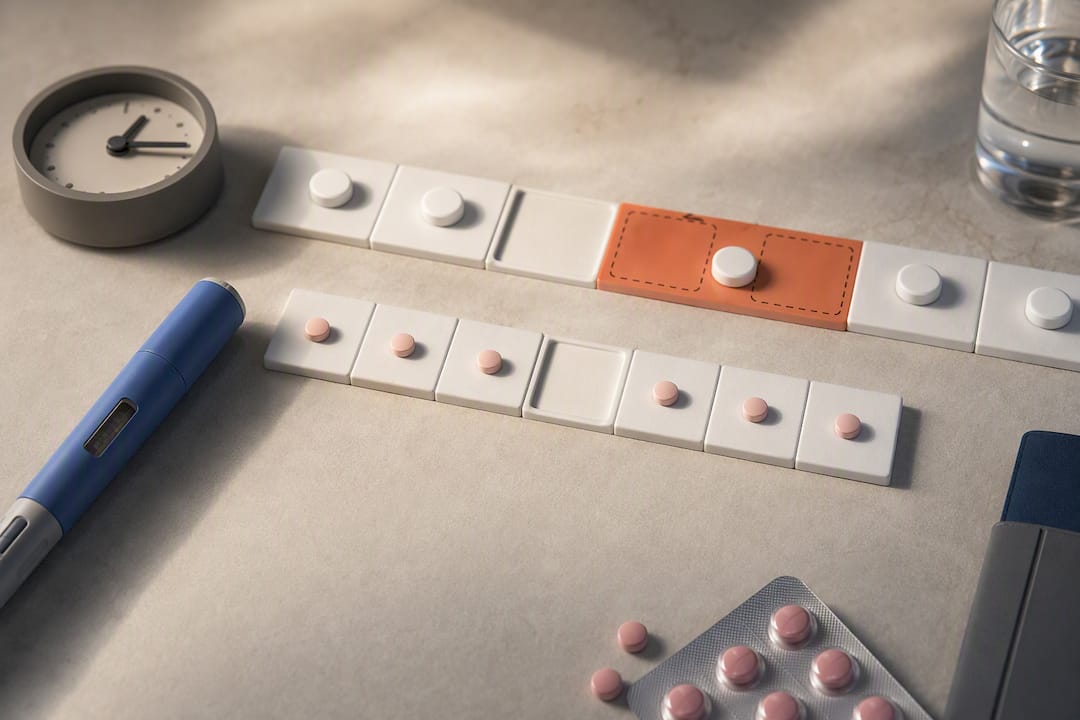
For weekly injectable semaglutide, guidance generally allows you to take the missed shot as soon as you remember, provided you’re still within the product’s specified window. Some labels allow taking a missed weekly injection within several days; others advise a 48-hour rule relative to the next scheduled dose. MedlinePlus confirms that these dosing windows differ by product, so the safest move is checking the exact instructions that came with your prescription rather than assuming your neighbor’s rule applies to you.
Oral semaglutide tablets follow a simpler, stricter logic. If you miss a tablet, the standard advice is to skip it and resume your normal schedule the next day. You don’t take two tablets to compensate, and you don’t shift your entire weekly rhythm around one missed pill.
Why the discrepancy? It comes down to half-life and absorption. Injectable semaglutide releases slowly and stays active in your system for days, which is why a short grace period exists before the drug’s effect meaningfully drops off. Oral tablets absorb and clear faster, and they require a very specific fasting and water protocol to work at all. Stacking a missed tablet with today’s dose disrupts that absorption process rather than fixing it.
To apply this practically:
- Check your calendar or app reminder for your actual next scheduled dose before deciding anything.
- If you’re on a weekly injectable and it’s still within the product’s allowed window, take it now.
- If the allowable window has passed, skip it and inject on your normal day instead.
- If you’re on the oral tablet and you missed this morning’s dose, wait until tomorrow.
- Confirm your specific product’s window using the prescribing information on DailyMed, since not every semaglutide label uses identical language.
What Happens After Multiple Missed Doses or a Long Gap?
One missed dose is a timing question. Two or more in a row, or a longer treatment interruption, is a different conversation, and it usually involves your clinician. Your body’s tolerance to semaglutide doesn’t stay frozen while you’re off it. The nausea and GI adjustment you pushed through during your first few weeks on the drug can return in force if you resume at your previous dose after a long break.
That’s why clinicians often recommend restarting at a lower dose and working back up through the escalation schedule, rather than jumping straight back to wherever you left off. Harvard Health notes that resuming a previously tolerated high dose after an extended interruption raises the risk of gastrointestinal side effects, which is exactly the scenario a slower restart is designed to avoid.
A few thresholds tend to trigger that clinician conversation:
- You’ve missed two or more consecutive weekly injections.
- More than two weeks have passed since your last dose.
- You’re uncertain which dose to resume at, or whether to resume at all.
What a clinician-led restart typically looks like: a review of your last documented dose and date, a decision on whether to re-escalate from a lower starting point, and a revised schedule that accounts for how long you’ve been off therapy.
Pro Tip: Keep a simple log, even a note on your phone, of your last injection date and dose. It turns a vague “it’s been a while” into an exact answer your prescriber can act on immediately.
Why Doubling Up on Semaglutide Is Dangerous
Dose stacking, taking two doses too close together to make up for lost time, doesn’t accelerate your progress. It overloads your system and typically backfires within hours.
The most common consequences are gastrointestinal:
- Intensified nausea and vomiting
- Diarrhea
- Abdominal pain
- Dehydration from fluid loss
If you also use insulin or a sulfonylurea, the stakes go up. MedlinePlus specifically flags that people on these glucose-lowering medications should contact their clinician after a missed GLP-1 dose, since blood sugar swings can compound quickly when multiple medications are adjusting your glucose at once.
Watch for these emergency-level symptoms: severe or persistent vomiting, dizziness or fainting, a racing heartbeat, confusion, or visible signs of dehydration like dark urine and dry mouth. Any of those warrants urgent medical attention rather than a wait-and-see approach. Semaglutide’s long half-life also means its effects fade gradually over weeks, not hours, so a second dose won’t “restart” anything faster. It just adds risk on top of a system that’s still processing the first one.
When Should You Call Your Prescriber or Pharmacist?
Call your prescriber if you’ve missed more than one or two doses, you use insulin or a sulfonylurea, or you’ve had severe side effects on this medication before. A quick call is also the right move any time you’re genuinely unsure whether to take a late dose or skip it.
Seek emergency care instead of waiting for office hours if you experience severe dehydration, vomiting that won’t stop, or signs of dangerously low blood sugar, including shakiness, confusion, or loss of consciousness.
Before you call, have these details ready:
- The date and amount of your last dose
- Any other medications you’re currently taking, especially insulin or sulfonylureas
- Whether you’re pregnant, trying to conceive, or breastfeeding
- A clear description of any symptoms you’re having right now
Having this information ready means your pharmacist or prescriber can give you a real answer on the first call instead of a callback later.
Preventing Missed Doses: Reminders, Travel, and Storage
Most missed doses aren’t about forgetting the medication exists. They’re about life interrupting the routine, a trip, a schedule change, a refrigerator that runs out of space. A few habits close most of that gap.
- Pair your injection day with something you already do weekly, like grocery shopping or a Sunday routine, so it’s attached to an existing cue.
- Set a recurring phone alarm labeled with the actual dose, not just “medication.”
- When traveling, pack injectable semaglutide in an insulated case with an ice pack, and never let it freeze.
- Keep tablets in their original packaging away from heat and humidity.
- Use a connected app to log each dose so you always know exactly when your last one was.
A digital tracker paired with clinician access does more than log timestamps. It flags patterns before they turn into a missed week, and it gives your care team the exact data they need if a restart conversation becomes necessary. The GLPCare app is built around that kind of dose logging alongside clinician support.
Pro Tip: Store your injection pen in the same spot in your refrigerator door every time. Consistency in storage location cuts down on the “did I already take this?” confusion that leads to accidental doubling.
A Clinician-Framed View on Safety Over Speed
When in doubt, the conservative choice almost always wins here. Skipping a dose and getting back on schedule is rarely a setback. Restarting too aggressively after a gap, or stacking doses to compensate, creates real physical risk for a marginal timing gain.
Document your last dose. Write your questions down before you call your prescriber. And treat tracking tools as part of your safety net, not an optional extra. The goal isn’t perfect adherence. It’s steady, informed adjustment when things go sideways, which they eventually will for almost everyone on a long-term GLP-1 regimen.
— Dominique
How GLPCare Helps You Stay on Schedule
Glpcare gives you something a pillbox alarm can’t: a clinician who can actually see your dosing history and weigh in before a missed dose turns into a bigger question. The Glpcare app logs every dose automatically, sends reminders before your window closes, and pairs that data with a proprietary wearable band that tracks sleep, heart rate, and activity, so your care team sees the full picture, not just a checkbox.

If a gap happens anyway, Glpcare’s clinician support means you’re not guessing about a restart or re-escalation schedule alone. The program includes prescription guidance for those who need it and ongoing coaching for those managing an existing prescription. If you’re weighing whether a clinician-connected GLP-1 program fits your situation, the GLP-1 readiness quiz takes a few minutes and gives you a clear next step, whether that’s starting fresh or adding structure to a prescription you already have.
This article is general information, not a substitute for advice from a qualified doctor. Consult a qualified healthcare professional about your own circumstances before acting on anything here.
Sources
- Semaglutide (subcutaneous route) - Side effects & dosage — MedlinePlus
- Weaning off a GLP-1? Tips for the transition — Harvard Health
- DailyMed — U.S. National Library of Medicine
FAQ
What Should I Do Immediately After a Missed Semaglutide Dose?
Take it now if you’re within your product’s label window, typically a few days for weekly injections; otherwise skip it and resume your regular schedule. Never take an extra dose to compensate.
Is a Missed Wegovy Dose Handled the Same as Ozempic?
Both use injectable semaglutide, so the same product-window logic applies. Check your specific prescribing information, since exact windows can vary slightly by label.
What Happens if I Miss My Ozempic Dose by Several Days?
If you’re past your product’s grace window, skip the missed dose and take your next one on your normal scheduled day. Doubling up raises your risk of nausea, vomiting, and dehydration.
When Should I Contact My Clinician About a Missed Dose?
Reach out if you’ve missed more than one or two doses, use insulin or a sulfonylurea, or have had severe side effects previously. Also call if you’re simply unsure what to do next.
Can Glpcare Help Me Track My Semaglutide Doses?
Yes. The Glpcare app logs doses, sends reminders, and connects your data to a clinician who can guide any restart decisions safely.