Zepbound Cost per Month: What You'll Actually Pay
Zepbound Cost per Month: What You’ll Actually Pay
TL;DR:
- Most patients pay between $0 and $449 monthly for Zepbound, depending on insurance coverage, dose, and savings programs. The actual out-of-pocket cost varies based on insurance type, refill timing, and whether the patient qualifies for discounts or assistance. Bundled care models can reduce costs and improve treatment adherence and outcomes.
Most patients pay somewhere between $0 and $449 per month for Zepbound, depending on three things: whether your commercial insurance covers it, which dose and formulation you use, and whether you qualify for Lilly’s Savings Card. With covered commercial insurance and the Savings Card, eligible single-dose pens can cost as little as $25 per month. Without insurance, LillyDirect self-pay pricing runs $299–$449 per month depending on dose. The manufacturer’s list price (WAC) can be high, but almost no one pays that.
Here’s the fast breakdown before you read further:
- Covered commercial insurance + Savings Card: as low as $0–$25/month for eligible single-dose pens
- Commercial insurance that excludes Zepbound + Savings Card KwikPen path: $299–$449/month
- Uninsured / self-pay via LillyDirect: $299–$449/month by dose
- Telehealth-bundled retail pricing: often a few hundred dollars per month (often includes a prescriber visit)
- Government insurance (Medicare, Medicaid, Tricare, VA): Savings Card excluded; check your plan separately
If you’re on Medicare or another government plan, the Savings Card is off the table entirely. Check your plan’s formulary and confirm eligibility before assuming any of the prices above apply to you.
Table of Contents
- How is Zepbound priced, and what does “one month” actually mean?
- What does Zepbound cost without insurance, by dose?
- What do you pay with commercial insurance and the Savings Card?
- How can you lower your monthly Zepbound out-of-pocket cost?
- Four realistic monthly-budget scenarios
- Does bundled subscription care change your monthly cost picture?
- Key Takeaways
- The real cost question most patients aren’t asking
- Glpcare: integrated GLP-1 care that covers more than the prescription
- Useful sources for verifying Zepbound prices
- FAQ
How is Zepbound priced, and what does “one month” actually mean?
The number on Lilly’s pricing page is the wholesale acquisition cost (WAC), which is the price manufacturers charge wholesalers, not patients. WAC for Zepbound ranges from $499 to $1,086.37 per fill, but that figure rarely equals what you pay at the pharmacy counter. Your actual out-of-pocket cost is shaped by your insurer’s negotiated rate, your plan’s copay or coinsurance tier, and any manufacturer assistance you qualify for.
One “month” of Zepbound is defined as a 28-day supply. Depending on the formulation, that means:
- Single-dose pens: up to 4 pens per fill (one injection per week)
- KwikPen (multi-dose): 1 pen per fill, covering the same 28-day window
- Single-dose vials: require drawing the dose with a syringe; same 28-day cadence
Available doses run from 2.5 mg (the starting titration dose) through 5 mg, 7.5 mg, 10 mg, 12.5 mg, and 15 mg. You’ll typically start at 2.5 mg for four weeks, then titrate upward as your clinician directs. That titration schedule matters for budgeting because the price changes with the dose.
Pro Tip: Watch the refill window carefully. LillyDirect’s self-pay program ties its lower advertised prices to a 45-day refill cadence. Miss that window and you’ll pay the higher regular price, which can jump to $499–$699 for maintenance doses. Calendar your refill date the day you pick up each fill.

What does Zepbound cost without insurance, by dose?
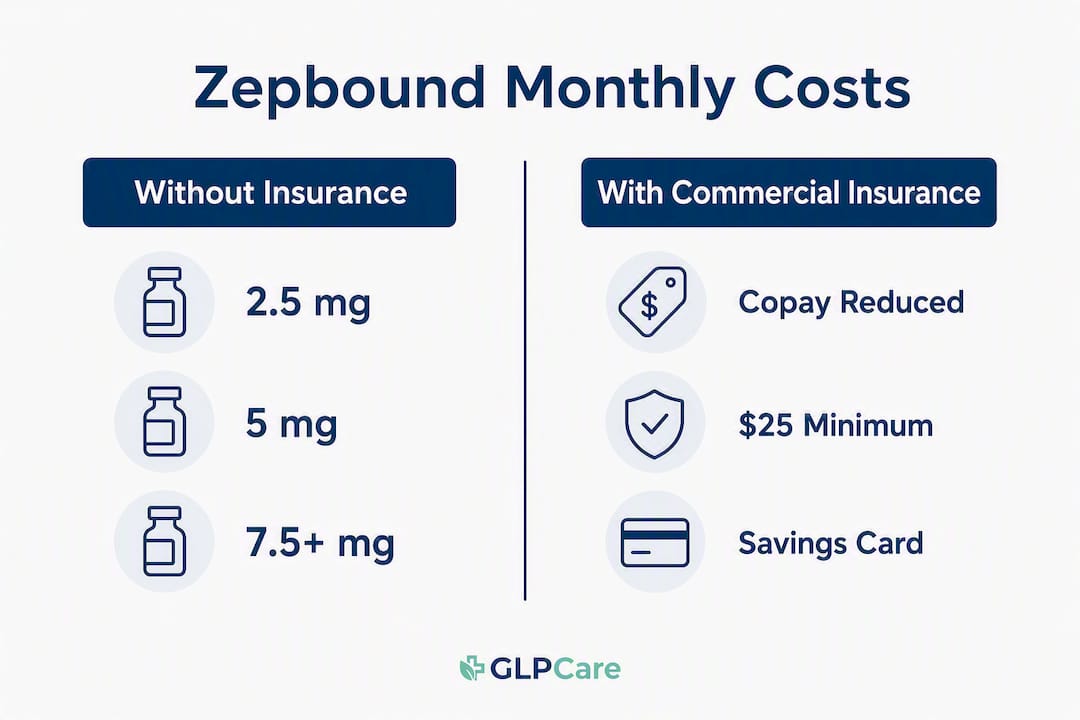
For patients paying out of pocket, LillyDirect is currently the most direct self-pay route. Prices are dose-dependent and tied to refill timing:
| Dose | Formulation | LillyDirect Self-Pay Price | Notes |
|---|---|---|---|
| 2.5 mg | Vial or KwikPen | $299/month | Starting titration dose |
| 5 mg | Vial or KwikPen | $399/month | Common second-step dose |
| 7.5–15 mg | Vial or KwikPen | $449/month | Maintenance range (within refill window) |
| Any dose (missed window) | Vial or KwikPen | higher monthly price | Regular price applies outside refill window |
| Telehealth-bundled retail | Single-dose pens | retail monthly pricing | Often includes prescriber visit |
Drugs.com confirms that uninsured prices range from $299 to $449 depending on dose and refill timing, consistent with LillyDirect’s published schedule and typical refill-window pricing.
One practical note on vials: switching from prefilled pens to vials saves money at some dose levels, but vials require drawing the dose manually with a syringe. If you’re new to self-injection, plan for a brief training session with your clinician before making that switch. The cost savings are real, but so is the learning curve.
What do you pay with commercial insurance and the Savings Card?
This is where most patients get confused, because the Zepbound Savings Card actually operates on two separate paths, and conflating them leads to budget surprises.
Path 1: Your plan covers Zepbound. The Savings Card reduces your copay to as low as $25 per month for eligible single-dose pens. Some patients pay $0 depending on their plan’s tier structure and the card’s monthly maximum. This is the best-case scenario for commercially insured patients.

Path 2: Your plan excludes Zepbound. A separate Savings Card path lets you purchase a KwikPen at self-pay pricing starting at $299 for 2.5 mg and up to $449 for higher doses. You’re essentially bypassing your insurance and buying direct, but the card facilitates the transaction.
Key limits that affect annual budgeting:
- Annual savings cap: subject to a manufacturer-defined limit per year
- Maximum fills per calendar year: limited number depending on program path
- Once you hit the cap, you pay full copays or self-pay pricing until the cap resets
Government payor exclusions are absolute. Medicare, Medicaid, Tricare, and VA patients cannot use the Savings Card. The CMS Medicare GLP-1 bridge program is a separate pathway worth checking if you’re on Medicare.
Common insurance hurdles that delay your first fill
Prior authorization (PA) is the most common barrier. Most plans require PA for Zepbound, and approval typically takes 3–14 business days, though complex cases can run longer. Step therapy requirements, where your plan insists you try another medication first, can add weeks or months before Zepbound is approved. Budget for at least one full month of potential delay before your first covered fill arrives.
How can you lower your monthly Zepbound out-of-pocket cost?
There’s a clear priority order here, and working through it systematically can save you hundreds of dollars per month.
- Verify Savings Card eligibility first. Go to zepbound.lilly.com/coverage-savings and confirm which path applies to your insurance situation before filling your first prescription.
- Use LillyDirect if you’re uninsured. The $299–$449/month self-pay pricing through LillyDirect is consistently lower than retail pharmacy cash prices for most doses.
- Compare GoodRx and pharmacy discount cards. GoodRx prices vary by pharmacy and location; check it alongside LillyDirect before committing to a fill location.
- Ask your prescriber about vials vs. pens. Vials are generally priced the same as KwikPens on LillyDirect, but some pharmacy programs price them differently. Confirm before switching.
- Stay inside the 45-day refill window. Missing it is the single most avoidable cost increase for self-pay patients.
- Ask about samples for your first fill. Some prescribers have starter samples for the 2.5 mg titration dose, which can offset the first month’s cost while insurance PA is pending.
- Explore patient assistance programs (PAPs). Lilly’s patient assistance program covers patients who meet income eligibility criteria and don’t qualify for the Savings Card.
Pro Tip: Track your Savings Card usage in a simple spreadsheet: date of fill, amount saved, and running annual total. The $1,300 annual cap can run out faster than expected if you’re on a higher dose. Knowing your remaining balance 2–3 months in advance gives you time to plan backup funding before the cap resets.
Four realistic monthly-budget scenarios
These scenarios reflect common patient situations. Ancillary costs include shipping (where applicable), a telehealth prescriber visit, and basic self-monitoring.
| Scenario | Dose | Payor Status | Medication Cost | Est. Total Monthly Budget |
|---|---|---|---|---|
| Covered commercial + Savings Card | 10 mg single-dose pens | Commercial insurance, Zepbound covered | ~$25/month | ~$50 (adds shipping/visit) |
| Excluded commercial + KwikPen path | 7.5 mg KwikPen | Commercial insurance, Zepbound excluded | ~$449/month | ~$500 |
| Uninsured, LillyDirect self-pay | 5 mg vial | No insurance | $399/month | ~$430 |
| Telehealth-bundled plan | 10 mg | Self-pay via telehealth provider | ~$499/month | ~$499 (prescriber visit included) |
- Covered commercial: The best-case monthly cost is around $25 for the medication itself, but factor in a copay for your prescriber visit (typically $20–$50 with insurance) and any shipping fees if using mail-order pharmacy.
- Excluded commercial: You’re essentially self-paying at $449/month for maintenance doses. The Savings Card KwikPen path makes this manageable, but watch the annual cap.
- Uninsured on LillyDirect: At $399/month for 5 mg, your first-month budget should include the cost of the prescriber visit separately, since LillyDirect covers medication only.
- Telehealth bundle: The ~$499/month telehealth-retail price often bundles the prescriber visit, which simplifies billing but doesn’t always include ongoing coaching or monitoring.
For first-month planning specifically: if PA is pending, budget for one month of self-pay pricing as a bridge. Most PA decisions arrive within two weeks, but having the cash ready prevents a gap in treatment.
Does bundled subscription care change your monthly cost picture?
Medication-only pricing tells you the drug cost. It doesn’t tell you the full cost of managing your treatment well, and that gap is where bundled care changes the math.
A pure medication-only path at $449/month covers tirzepatide. It doesn’t include nutrition coaching to preserve muscle mass, a clinician available between fills, or any monitoring of how your body is responding to the dose. Those gaps often show up as downstream costs: a separate dietitian visit ($80–$150/session), an out-of-pocket telehealth check-in when side effects emerge, or dose adjustments that take longer without continuous data.
Bundled subscription care, like what Glpcare offers, shifts the frame from “what does the drug cost?” to “what does my monthly health investment cover?” The Glpcare model pairs tirzepatide prescriptions with personalized nutrition coaching, a proprietary wearable band that tracks sleep, heart rate, and activity, and an AI-driven app for dose logging and real-time insights. Clinician support is built in, not billed separately.
- Medication-only self-pay path: $299–$449/month for the drug, plus separate costs for coaching, monitoring, and clinician access
- Bundled subscription care: one monthly fee that covers medication management, wearable monitoring, nutrition coaching, and clinician oversight
For patients who need GLP-1 tracking and adherence support to stay on track, the bundled model often costs less over 12 months than medication plus piecemeal support services. Muscle preservation during GLP-1 therapy is a real clinical concern, and structured nutrition guidance built into a subscription addresses it without adding a separate line item to your budget.
Key Takeaways
Most patients pay $25–$449 per month for Zepbound depending on insurance coverage, dose, and whether they qualify for the Lilly Savings Card.
| Point | Details |
|---|---|
| Self-pay range by dose | LillyDirect prices run $299 (2.5 mg), $399 (5 mg), and $449 (7.5–15 mg) within the 45-day refill window. |
| Savings Card paths | Two distinct paths exist: copay reduction for covered plans (as low as $25/month) and KwikPen pricing for excluded plans ($299–$449/month). |
| Annual savings cap | The Savings Card carries an annual maximum of approximately $1,300 per year. |
| Government payor exclusion | Medicare, Medicaid, Tricare, and VA patients cannot use the Savings Card; check the CMS GLP-1 bridge program separately. |
| Glpcare bundled option | Glpcare combines tirzepatide management, nutrition coaching, wearable monitoring, and clinician support in one monthly subscription, changing the cost-per-outcome calculation. |
The real cost question most patients aren’t asking
Most cost articles stop at the drug price. That’s a useful number, but it’s not the number that predicts whether you’ll succeed.
The patients who get the most value from tirzepatide are the ones who stay on it long enough, at the right dose, with enough nutritional support to preserve muscle and sustain results. A $25/month copay is a great deal if the treatment works. It’s an expensive experiment if poor adherence, muscle loss, or unmanaged side effects lead to stopping early.
The conventional wisdom is to find the cheapest path to the medication and figure out the rest later. That logic works for a short course of antibiotics. For a long-term GLP-1 program, the “rest” is actually most of the work. Dose titration, nutrition adjustments, activity monitoring, and regular clinician check-ins aren’t optional extras. They’re what turns a prescription into a result.
The patients who benefit most from a bundled care model aren’t necessarily the ones with the most complex medical histories. They’re often the motivated, busy adults who know they need structure and accountability to stay consistent. If that’s you, the monthly cost comparison isn’t medication-only vs. bundled. It’s bundled care vs. medication plus all the support you’d eventually pay for anyway, billed separately and less efficiently.
Glpcare: integrated GLP-1 care that covers more than the prescription
Paying $449/month for tirzepatide and then separately sourcing a dietitian, a clinician for check-ins, and a way to track your progress adds up fast. Glpcare is built for patients who want those pieces connected from day one.
A Glpcare subscription includes tirzepatide prescription management (shipped to your door), personalized nutrition coaching designed to minimize muscle loss, the GLP Care Band for real-time biometric tracking, and an AI companion app that logs your doses, activity, and sleep in one place. Clinician support is ongoing, not just at the initial visit. For patients who already have a GLP-1 prescription, a bring-your-own-medication tier is available so you can add the monitoring and coaching layer without switching your pharmacy.
Plans start with a clinical assessment to confirm eligibility. To see which option fits your situation, take the GLP-1 Readiness Quiz and get a personalized recommendation in minutes. You can also view current plans and pricing, including a $100 discount on your first month.
This article provides general information about Zepbound pricing and is not a substitute for advice from your prescriber, pharmacist, or insurer. Confirm your exact copay and eligibility with your plan before starting treatment.
Useful sources for verifying Zepbound prices
Prices change, formularies update, and Savings Card terms are revised periodically. These are the primary sources to check before making any budget decisions:
- Lilly Zepbound Pricing Page: The manufacturer’s official WAC table and patient-facing cost information, including the two Savings Card paths and their terms.
- Zepbound Coverage and Savings Page: Savings Card eligibility, annual caps, fill limits, and government payor exclusions. Read the full terms and conditions before enrolling.
- LillyDirect Zepbound: Self-pay pricing by dose and formulation, with refill window details and ordering instructions.
- Drugs.com Zepbound Cost Summary: Independent aggregator that summarizes cash prices and insurance scenarios; useful for cross-checking LillyDirect prices.
Always confirm your specific copay with your insurer and pharmacist. A plan’s formulary tier for Zepbound can change mid-year, and your actual out-of-pocket cost may differ from any published range.
FAQ
How much does Zepbound cost per month without insurance?
Without insurance, LillyDirect self-pay pricing runs $299/month for 2.5 mg, $399 for 5 mg, and $449 for 7.5–15 mg doses, provided you refill within the 45-day window. Missing that window raises prices to $499–$699 for maintenance doses.
Does commercial insurance typically cover Zepbound?
Coverage varies by plan and formulary. When a commercial plan covers Zepbound, the Savings Card can reduce your copay to as low as $25/month for eligible single-dose pens. If your plan excludes it, a separate Savings Card path offers KwikPen pricing starting at $299/month.
Who cannot use the Zepbound Savings Card?
Patients covered by Medicare, Medicaid, Tricare, or VA benefits are excluded from the Savings Card program. The CMS Medicare GLP-1 bridge program is a separate option worth reviewing if you’re on Medicare.
Are semaglutide pills cheaper than Zepbound injections?
Oral semaglutide (Rybelsus) is FDA-approved for type 2 diabetes, not weight management, and its cost structure differs from Zepbound. Compounded semaglutide has been widely available at lower price points, but the FDA has taken steps to limit compounding as branded supply stabilizes. Confirm current availability and pricing with your prescriber.
What is the success rate of Zepbound for weight loss?
In the SURMOUNT-1 clinical trial, tirzepatide (the active ingredient in Zepbound) produced significant weight loss compared to placebo. Clinical outcomes depend on dose, adherence, and lifestyle factors including nutrition and activity.