Traveling With Semaglutide: A Complete Guide for Safe Trips
Traveling With Semaglutide: A Complete Guide for Safe Trips
Yes, you can travel with semaglutide, on planes, road trips, and cruises alike. Three rules keep it safe: pack it in your carry-on (never checked luggage), keep it within its labeled temperature range, and plan your weekly dose around time zone changes before you leave.
Semaglutide pens are heat-sensitive, and airport rules around syringes and liquids trip up even experienced travelers. Get these three details wrong and you risk a degraded dose, a security delay, or a missed injection window.
- Carry-on only. Checked baggage holds can freeze or overheat, and temperature swings damage the drug.
- Control the temperature. Use an insulated case, never let the pen sit directly against a frozen ice pack.
- Plan your dose. Weekly injections can shift, but only within limits set by the drug label.
If you’re on a complex itinerary, a new dose, or have any health complications, call your prescribing clinician or your Glpcare care team before you pack. A five-minute check beats a ruined pen halfway through your trip.
Key Takeaways
Semaglutide travels safely when you control three variables: carry-on storage, temperature range, and the 48-hour minimum between weekly doses.
| Point | Details |
|---|---|
| Keep it in carry-on | Checked baggage risks freezing or overheating; TSA allows medically necessary liquids over 3.4 oz. |
| Respect the 48-hour rule | Weekly doses can shift timing, but only when at least 48 hours separate two injections. |
| Prevent freezing, not just heat | Use gel packs with a cloth or sleeve barrier so the pen never touches ice directly. |
| Declare syringes at security | Unused syringes are allowed in carry-on when packed with your injectable medication. |
| Plan refills before you leave | Contact your pharmacy or your Glpcare clinician ahead of extended trips to arrange emergency supply. |
This article is general information, not a substitute for advice from a qualified doctor. Consult a qualified healthcare professional about your own circumstances before acting on anything here.
Table of Contents
- Storage Timelines for Semaglutide While Traveling
- How Do You Keep Semaglutide Cold While Traveling?
- Can You Bring Semaglutide Through TSA Security?
- Managing Weekly Doses Across Time Zones
- Road Trips, Cruises, and Extended Travel
- Your Travel Packing Checklist for Semaglutide
- How Glpcare Helps You Travel With Confidence
- The Real Risk Isn’t the Rules, It’s the Assumptions
- Ready to Travel With a Care Team That Has Your Back?
- Sources
- FAQ
Storage Timelines for Semaglutide While Traveling
Semaglutide’s stability window is not a guess. It’s printed on the drug label, and it’s the single most important number for any traveler to know before packing a pen.
Ozempic can stay at room temperature for up to 56 days after first use, according to its DailyMed label. Wegovy’s room-temperature allowance runs shorter on its own label, so the two drugs aren’t interchangeable when it comes to travel planning even though they share the same active ingredient. Compounded semaglutide formulations often carry different storage instructions entirely, since the compounding pharmacy’s process and preservatives affect shelf stability. Check the paperwork that came with your specific prescription. Don’t assume a friend’s Ozempic timeline applies to your compounded vial.
“Room temperature” on most labels means roughly 68°F to 77°F (20°C to 25°C), with brief excursions tolerated up to about 86°F. That’s a narrower band than most people assume, and it rules out leaving your pen in a hot car, a sunny window seat, or a beach bag.
The 56-day window is the headline figure, but the real risk is temperature extremes, not time. A pen that freezes even once should be discarded, because freezing damages the protein structure of the medication in a way that no amount of thawing reverses. Heat is nearly as unforgiving. A pen baked on a car dashboard for a single afternoon can lose potency even if it’s still within its 56-day window.
Before any trip, do three things:
- Check your specific product’s label or the pharmacy printout for exact refrigeration and room-temperature durations.
- Note the date you first used the pen, since the countdown starts there, not at pickup.
- If you’re on a compounded formulation, call the pharmacy directly if the paperwork doesn’t specify travel stability.
How Do You Keep Semaglutide Cold While Traveling?
Keeping semaglutide cold on the road comes down to three tools: an insulated case, gel packs that are cool rather than frozen, and a barrier layer that keeps the pen from touching ice directly.
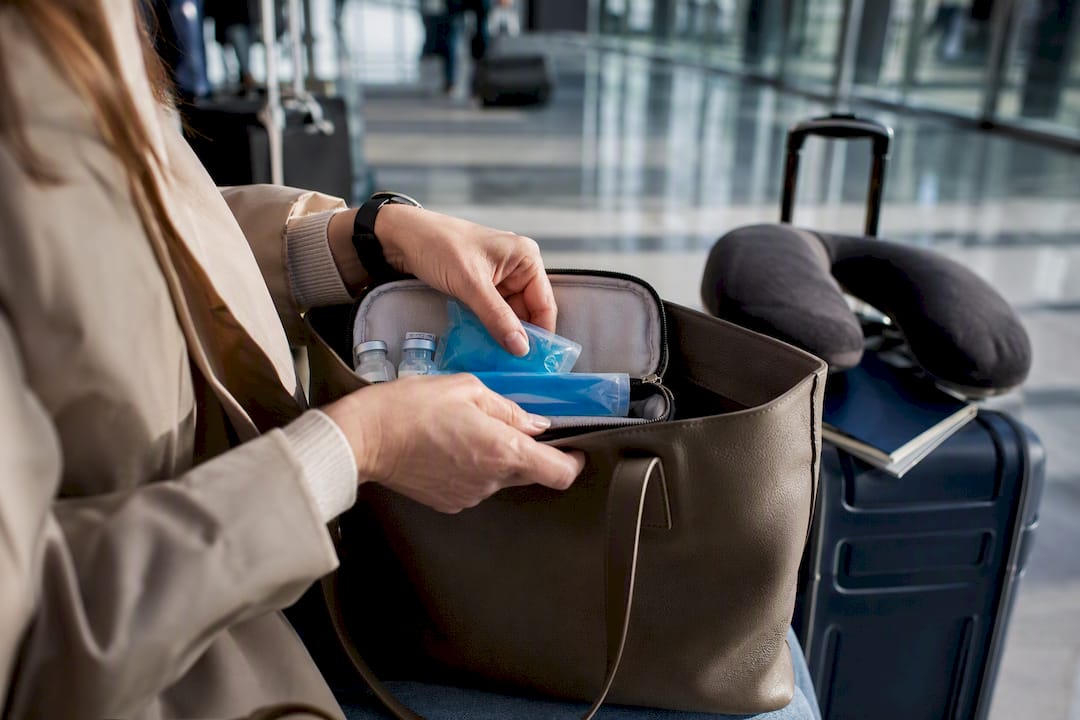
Skip the cheap zippered pouch. A proper insulated medication case or a small soft-sided travel cooler holds temperature far longer, and most are designed to fit standard pen sizes. Pair it with gel packs, not solid ice, since Healthline’s travel guidance on Wegovy recommends avoiding direct contact between frozen packs and the pen because freezing damages the medication.
Here’s the packing sequence that actually works:
- Wrap the pen in a thin cloth or its original box. This barrier layer keeps it from touching the cold pack directly.
- Place gel packs around, not against, the wrapped pen. A slim insulating sleeve between the two prevents accidental freezing.
- Add a thermometer strip or small temperature logger for trips over 24 to 48 hours. These cost very little and tell you immediately if the case experienced a heat or cold excursion during transit.
- Close the case and keep it in your carry-on bag, positioned so it’s easy to reach at airport security.
For a short domestic flight, this insulated case setup alone usually holds temperature for the entire trip. For a multi-day stay, refresh the gel packs once you land using a hotel refrigerator or ask the front desk for ice. Many hotels will store medication in a staff refrigerator on request, which is often steadier than a mini-fridge that cycles temperature more than a full-size unit.
Pro Tip: Buy two sets of gel packs before you leave and freeze one set at your destination the night you arrive. You’ll always have a cold, ready set for the return trip instead of scrambling to find ice at the airport.
Can You Bring Semaglutide Through TSA Security?
Yes. The TSA explicitly allows medically necessary liquids and medications to exceed the standard 3.4-ounce limit, and semaglutide pens fall squarely into that category.
You don’t need to fit your pen into a quart bag with your travel shampoo. According to TSA’s own guidance on traveling with medication, you should remove medically necessary liquids and medications from your carry-on for separate screening, and labeling them clearly speeds up the process. Officers are trained to screen insulin, GLP-1 pens, and similar injectables without requiring you to open the container.
Unused syringes and needles are also permitted in carry-on baggage as long as they accompany injectable medication like semaglutide. The TSA’s syringe policy recommends declaring them at the checkpoint rather than letting an officer discover them unannounced, which almost always speeds up screening rather than slowing it down.
Pack these items together and accessible:
- Your semaglutide pen in its insulated case, in your carry-on
- The original prescription label or pharmacy printout
- A doctor’s note, if your clinician provided one (not required, but helpful for international travel)
- Original packaging where possible, since it doubles as identification during screening
- Any unused syringes or pen needles, kept with the medication rather than loose in a bag
Pull the medication case out early in the screening line instead of waiting for an officer to ask. If you have a disability or medical condition that makes screening difficult, TSA Cares offers advance assistance by phone before your travel date.
Managing Weekly Doses Across Time Zones
Your weekly semaglutide dose has more scheduling flexibility than most patients realize, and understanding the exact rule prevents both accidental overdosing and anxious guesswork mid-trip.
According to the DailyMed label for Ozempic, you can change your weekly injection day as long as at least 48 hours separate the two doses. That single number, 48 hours, is the entire rule. It sounds simple, but travelers crossing multiple time zones often miscalculate it because they think in calendar days instead of actual elapsed hours.
Here’s the interval math, step by step:
- Note your last injection’s exact time and time zone. Say you injected Sunday at 9:00 AM Eastern.
- Convert that moment to your destination’s local time. Flying to Los Angeles, that becomes Sunday at 6:00 AM Pacific.
- Add 48 hours from that converted time to find the earliest safe moment for your next dose: Tuesday at 6:00 AM Pacific.
- Pick any time after that threshold that fits your new schedule, then keep that new day and time going forward.
The 48-hour minimum, not the calendar day, is what actually matters when you cross time zones. A traveler who injects Sunday morning and lands eight time zones ahead might feel like Monday evening is “close enough” to a full week, but the math can put them under 48 hours from the prior dose if they’re not careful.
If you miss your window entirely, don’t guess. Ozempic’s labeling includes specific instructions for missed doses depending on how many days have elapsed, and Wegovy’s label differs slightly. If you’re past the allowable catch-up window, skip that week’s dose and resume your regular schedule, but confirm this with your prescribing clinician or your Glpcare care team rather than assuming. Reviewing proper injection site rotation before a trip also helps you avoid site irritation when your schedule is already in flux.
Road Trips, Cruises, and Extended Travel
Car travel and multi-week trips introduce a problem air travel doesn’t: your medication sits in an uncontrolled environment for hours or days at a stretch, not just during a security line.
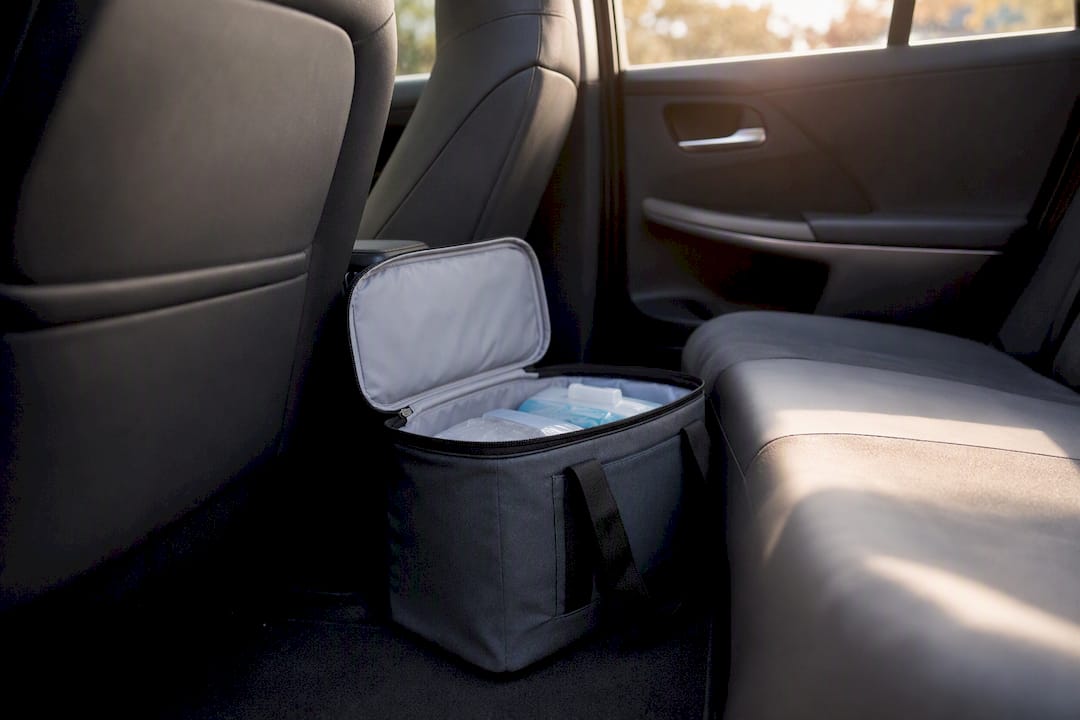
For road trips, a car cooler works, but placement matters more than most travelers think. Never leave the cooler in the trunk of a car parked in direct sun, where temperatures can exceed 140°F within an hour even in mild weather. Keep it in the passenger cabin, ideally on the floor behind the front seat where it’s shaded and away from vents blowing hot or cold air directly onto the case.
Cruises and extended stays raise a second issue: sharps disposal. A used pen needle can’t just go in a hotel trash can or overboard on a ship. The CDC’s guidance on traveling with medicine recommends keeping used sharps in a puncture-resistant container and checking local rules for disposal, since many pharmacies and clinics accept sealed sharps containers even if you didn’t buy the needles there.
For trips longer than a couple of weeks:
- Pack a portable sharps container, not a repurposed water bottle or soda can.
- Research pharmacy or clinic drop-off locations at your destination before you leave, particularly for international trips.
- Contact your pharmacy or your Glpcare clinician ahead of time if you’ll need a refill or an emergency replacement shipment while away.
- Bring a copy of your prescription in case a local pharmacy needs to verify your dose abroad.
Extended travel is where planning ahead saves the most stress. A pen that runs out mid-trip with no refill plan is a far bigger problem than one that briefly warms up in a cooler.
Your Travel Packing Checklist for Semaglutide
Print this list or save it to your phone before you pack. Order matters: items you’ll need at airport security should sit on top.
- Semaglutide pen(s), wrapped in a barrier layer inside an insulated case.
- Gel packs, cool but not frozen solid, positioned around rather than against the pen.
- Thermometer strip or small temperature logger, for any trip over 24 to 48 hours.
- Prescription label or pharmacy printout, kept with the medication case.
- Doctor’s note, if you have one, especially for international travel.
- Portable sharps container, sealed and separate from other toiletries.
- Clinician contact information, including your pharmacy’s phone number and your telehealth provider’s chat or messaging access.
- Extra doses, if your supply and refill timeline allow it, particularly for trips longer than two weeks.
For a short domestic trip, items 1 through 4 usually cover you. For international or extended travel, all eight matter, and you should add a second gel pack set for the return leg. Keep the whole kit in your carry-on, positioned for quick access during screening rather than buried under clothes.
How Glpcare Helps You Travel With Confidence
Missed doses and ruined pens usually trace back to the same root cause: nobody was tracking the schedule or the storage conditions in real time. Glpcare’s model is built to close that gap.
Every Glpcare membership includes ongoing clinician support, so if a dosing question comes up mid-trip, whether it’s an interval calculation across time zones or a pen that spent too long in a hot car, you have someone to ask rather than guessing. The wearable band tracks your activity and recovery patterns throughout travel, giving your care team a fuller picture if your routine shifts on the road. The companion app logs your dose timing automatically, which helps prevent the exact spacing errors that trip up travelers switching time zones.
Before any trip, it’s worth reviewing semaglutide drug interactions if you’re adding new medications for travel, like antihistamines or altitude sickness pills. Glpcare’s resource library also covers proper injection technique and safe sourcing, so you’re not relying on guesswork if something about your routine changes while you’re away from home.
The Real Risk Isn’t the Rules, It’s the Assumptions
Most semaglutide travel advice focuses on TSA rules, and that’s the part patients worry about most. In practice, security screening for injectable medication is well established and rarely causes real problems when you declare your supplies and keep them accessible.
The bigger risk is quieter: assuming your compounded formulation behaves like brand-name Ozempic, assuming “a few hours in the car” won’t matter, or assuming a missed dose window is flexible when the label says otherwise. These are calculation and assumption errors, not security ones, and they’re the ones that actually damage medication or disrupt treatment.
If you take one thing from this guide, let it be the 48-hour rule and the discipline to actually convert time zones rather than eyeballing it. That single number prevents more real-world dosing mistakes than any packing tip. Temperature control matters too, but a pen that briefly runs warm is often more forgiving than patients fear, while a dose given too close to the last one is not something you can undo.
Plan for the boring failure modes. They’re the ones that actually happen.
— Dominique
Ready to Travel With a Care Team That Has Your Back?
Packing lists and interval math help, but having a clinician you can actually reach when a travel question comes up changes the entire experience. Glpcare pairs your GLP-1 prescription with continuous clinician support, dose tracking through the app, and a wearable band that keeps your care team informed even when your routine is disrupted by travel.

If you’re not yet a member and want to know whether a clinician-backed GLP-1 program fits your situation, GLPCare’s GLP-1 readiness quiz takes a few minutes and gives you a clear next step, whether that’s starting a new prescription or transferring care for the medication you’re already on. Answer a few questions today and see what a connected system looks like before your next trip.
Sources
- I am traveling with medication, are there any requirements I should be aware of? | TSA
- DailyMed - OZEMPIC (semaglutide) injection highlights
- How to travel with Wegovy — Healthline
- Travel abroad with medicine | CDC
FAQ
Can I skip a week of semaglutide for vacation?
Skipping a dose isn’t recommended without checking your label’s missed-dose guidance first, since Ozempic and Wegovy have different catch-up windows. Contact your prescribing clinician before deciding to skip, rather than skipping and asking afterward.
How do I pack my semaglutide for travel?
Wrap the pen in a barrier layer, place it in an insulated case with cool (not frozen) gel packs, and keep the case in your carry-on with your prescription label attached. Add a thermometer strip for trips longer than 24 to 48 hours.
How long can semaglutide be unrefrigerated?
Ozempic can stay at room temperature for up to 56 days after first use according to its DailyMed label, while Wegovy’s allowance differs, so check your specific product’s paperwork.
How do you keep semaglutide cold when traveling?
Use an insulated medication case with gel packs kept cool rather than frozen, and never let the pen touch ice directly since freezing damages the medication permanently.
Can TSA agents stop me from bringing my semaglutide pen?
No. TSA explicitly permits medically necessary liquids and medications beyond the standard 3.4-ounce limit, and semaglutide pens qualify as long as you present them for separate screening.