How to Get Semaglutide Without Insurance: Safe Options
How to Get Semaglutide Without Insurance: Safe Options
TL;DR:
- Getting semaglutide without insurance requires a licensed prescription from a verified source such as NovoCare, telehealth programs, or the Medicare GLP‑1 Bridge. Prices vary widely, with compounded options offering lower costs but less regulatory oversight than FDA-approved brand-name drugs. Ongoing clinical oversight and comprehensive care significantly improve safety and long-term results.
If you’re paying out of pocket, the three fastest lawful routes to get semaglutide without insurance are: (1) NovoCare, Novo Nordisk’s direct pharmacy, which offers published cash-pay pricing for Wegovy; (2) a verified telehealth program that connects you with a licensed prescriber and ships from an accredited pharmacy; and (3) the Medicare GLP‑1 Bridge, which makes select FDA-approved GLP-1 medications available to eligible Part D members for $50 per month starting July 1, 2026. Every legitimate source requires a licensed prescription — there is no lawful way to buy semaglutide without one.
Cash-pay prices range widely. Compounded semaglutide through telehealth can start at relatively low monthly rates at starter doses, while brand-name Wegovy at retail without any discount can be considerably more expensive. The gap looks obvious, but compounded products are not FDA-approved finished drugs, which carry significant regulatory and safety implications covered below.
- NovoCare (Novo Nordisk direct pharmacy): Brand-name Wegovy, published cash prices, predictable supply
- Verified telehealth + licensed pharmacy: Clinician consult, prescription, and home delivery in one workflow
- Medicare GLP‑1 Bridge: $50/month for eligible Part D beneficiaries, effective July 1, 2026
- Compounded semaglutide via 503A/503B pharmacy: Lower cost potential, but distinct regulatory status
Pro Tip: Before comparing monthly rates, ask every provider for a written all-in price covering 6–12 months at maintenance dose, including consultation fees, labs, shipping, and any membership charges. The advertised starter rate is rarely what you pay at month four.
Table of Contents
- What are your lawful options for getting semaglutide without insurance?
- How to get semaglutide without insurance, step by step
- What does semaglutide actually cost without insurance?
- What are the safety and quality differences between branded and compounded semaglutide?
- What programs and discounts can help you pay for semaglutide?
- How do you choose a safe, affordable telehealth program or pharmacy?
- What are the red flags when buying semaglutide without insurance?
- Key Takeaways
- Why medication alone is rarely the whole answer
- Glpcare: an integrated, clinician-supervised path for self-pay patients
- Useful sources and links
- FAQ
What are your lawful options for getting semaglutide without insurance?
You have five main routes, each with a different cost profile, safety profile, and eligibility requirement.
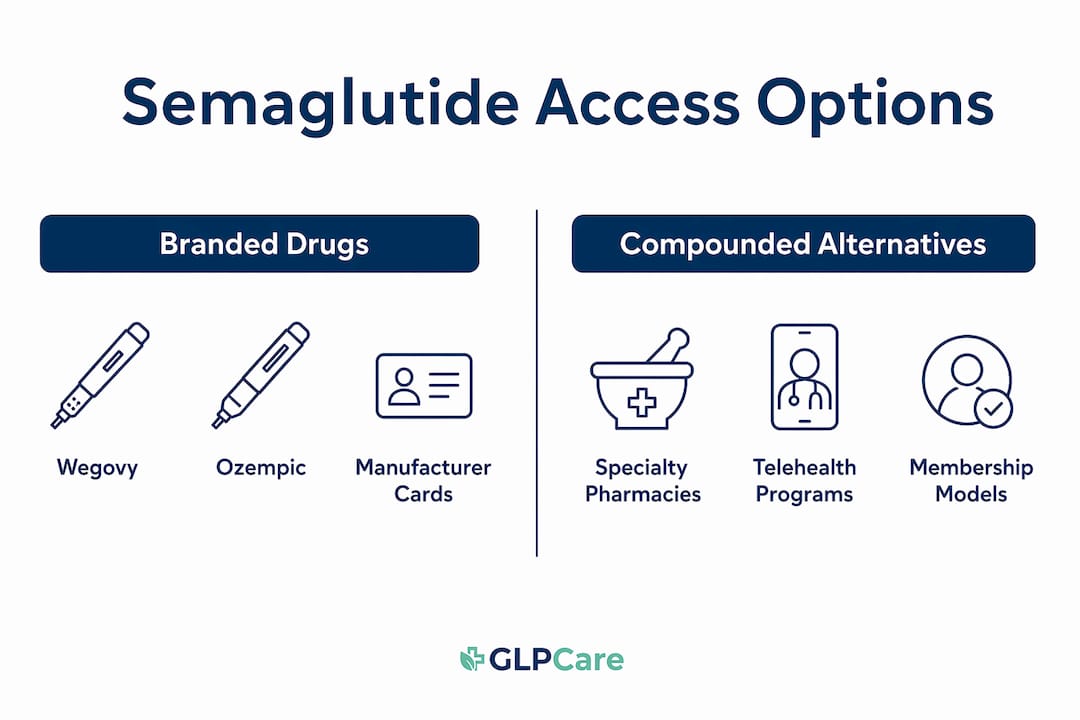
NovoCare (manufacturer direct pharmacy)
NovoCare is Novo Nordisk’s direct-to-patient pharmacy for Wegovy and Ozempic. For cash-paying patients, it offers published pricing and has historically provided introductory rates (such as $199 for a first fill) with standard cash prices for subsequent fills. Because you’re buying directly from the manufacturer, supply is more predictable than at retail pharmacies, and the pricing is transparent. This route suits patients who want brand-name, FDA-approved Wegovy and prefer a single, reliable source.
- Pros: FDA-approved drug, predictable supply, published cash prices, no third-party markup
- Cons: Brand-name pricing is higher than compounded alternatives; introductory rates don’t last
Verified telehealth + branded or compounded pharmacy
Telehealth programs connect you with a licensed prescriber via video or async consultation. The prescriber evaluates your medical history, writes a prescription, and routes it to a pharmacy that ships directly to your home. Some programs use brand-name drugs; others use compounded semaglutide from 503A or 503B pharmacies when clinically justified. Telehealth platforms commonly handle the entire workflow, from consult to delivery, outside of insurance billing.
- Pros: Convenient, fast (often same-day prescription), home delivery, clinician oversight included
- Cons: Quality varies significantly by provider; compounded options carry regulatory caveats
Compounded semaglutide via 503A/503B pharmacies
Compounded semaglutide is prepared by state-licensed compounding pharmacies to address an individual patient’s documented clinical need. It is not an FDA-approved finished drug and is not automatically interchangeable with Wegovy or Ozempic. The FDA distinguishes compounded products from finished drugs and regulates them differently. When filled by a reputable, accredited 503A or 503B pharmacy with a valid prescription, compounded semaglutide can be a lower-cost option. The key word is “reputable” — pharmacy verification matters enormously here.
- Pros: Lower monthly cost, accessible through telehealth, dose customization possible
- Cons: Not FDA-approved as a finished product; quality depends entirely on pharmacy standards; regulatory enforcement has tightened post-2025
Discount cards and pharmacy coupons
Services like SingleCare can reduce retail sticker prices at participating pharmacies. The important caveat: many manufacturer savings cards require commercial insurance and do not help uninsured buyers. Retail discount cards work differently — they negotiate cash prices at the pharmacy counter — but the savings on brand-name semaglutide are often modest compared to what NovoCare or a compounding telehealth program offers.
- Pros: No enrollment required, works at most retail pharmacies
- Cons: Manufacturer cards often exclude uninsured patients; savings on brand semaglutide may be limited
Medicare GLP‑1 Bridge
Starting July 1, 2026, the Medicare GLP‑1 Bridge program makes select FDA-approved GLP-1 medications available to eligible Part D beneficiaries for a fixed $50 per month, regardless of dose strength. If you’re on Medicare, this changes the math entirely. Check eligibility before pursuing any other route.
- Pros: $50/month flat rate, FDA-approved drugs, no income test for the price cap
- Cons: Medicare-only; requires a covered medical indication and Part D enrollment
How to get semaglutide without insurance, step by step
Follow this sequence from your first consult to your first dose. Most people complete steps 1–4 within a week.
-
Prepare your medical information. Gather your current weight and height (for BMI), a list of current medications, any relevant lab results (A1C, lipid panel, thyroid), and a brief medical history. Clinicians will ask about prior diagnoses, especially thyroid cancer or MEN2, which are contraindications. Having this ready shortens your consult.
-
Choose your route. If you’re on Medicare Part D, check the GLP‑1 Bridge first. If you want brand-name Wegovy, start with NovoCare. If cost is the primary driver and you’re comfortable with compounded semaglutide, a verified telehealth program with a named 503A/503B pharmacy is the most common path. Use the affordable GLP-1 provider comparison to evaluate options before committing.
-
Complete your consultation. Telehealth visits are typically asynchronous (questionnaire-based) or a short video call. Your prescriber will review your history, confirm you meet clinical criteria (usually BMI ≥30, or ≥27 with a weight-related condition), discuss dosing, and explain side effects and monitoring expectations. Ask these questions before you finish:
- What dose will I start on, and what is the escalation schedule?
- Which pharmacy will fill my prescription, and what is its license number?
- What labs do you require before and during treatment?
- How do I reach a clinician if I have side effects?
- What is the total cost at my maintenance dose?
-
Confirm your prescription and pharmacy. Your prescriber routes the script to a retail pharmacy, NovoCare, or a named compounding pharmacy. Verify the pharmacy name and license before your first payment. Telehealth programs that won’t name their fulfillment pharmacy are a red flag. Shipping from a licensed U.S. pharmacy typically takes 24–72 hours after the prescription is confirmed.
-
Schedule labs and follow-ups. Most clinicians order baseline labs before or shortly after initiation: fasting glucose or A1C, a basic metabolic panel, and sometimes a lipid panel. Follow-up appointments are typically monthly for the first three months, then quarterly. Budget for these separately if they’re not included in your program fee.
Timeline example: Consult and prescription same day → pharmacy processing 1–2 days → shipping 24–72 hours → first dose within 3–7 days of consult.
Cost checklist for your first month:
- Consultation fee (one-time or recurring)
- Medication cost at starting dose
- Lab draw (if not included)
- Shipping fee (if not free)
- Any enrollment or membership fee
What does semaglutide actually cost without insurance?
Price ranges for semaglutide vary more than almost any other prescription drug category. Here’s what you can realistically expect.

Brand-name pricing
Retail sticker prices for Wegovy without any discount can exceed $1,000 per month. NovoCare has historically offered introductory cash-pay pricing for Wegovy (such as $199 for a first fill) with set standard cash prices for subsequent fills; confirm the latest pricing on the Wegovy website. These are still significantly lower than retail, but higher than compounded alternatives. For a full picture of what Novo Nordisk charges cash-paying patients, the Wegovy pricing page is the authoritative source.
Compounded semaglutide pricing
Reported cash ranges for compounded semaglutide run from roughly $119 per month at starter doses to several hundred dollars at maintenance doses. Many telehealth programs advertise low starter rates that increase substantially at higher doses. A program that looks affordable at 0.25 mg may cost two to three times more at the 1 mg or 2.4 mg maintenance dose.
Common add-on fees to watch for
- Consultation fee: $0–$100+ depending on the program; some bundle it, others charge separately
- Lab fees: $30–$150+ per draw if not included in your program
- Shipping: $0–$30 per shipment; some programs charge per order
- Membership or enrollment fee: Some programs charge a monthly platform fee on top of medication cost
- Administrative fee: Charged by some programs if you request a specific pharmacy
Pro Tip: Ask for a written, itemized quote for months 1, 3, and 6 at your expected maintenance dose. A program charging $149/month at starter dose but $399/month at maintenance is not a $149/month program.
For a side-by-side look at how different pricing models compare, the semaglutide program comparison breaks down total-cost structures across common telehealth models.
What are the safety and quality differences between branded and compounded semaglutide?
A prescription is required for all semaglutide products without exception. There is no lawful over-the-counter or prescription-free path. Beyond that requirement, the safety and quality picture depends heavily on which product you’re getting and from whom.
FDA-approved branded semaglutide
Wegovy (semaglutide 2.4 mg) and Ozempic (semaglutide for type 2 diabetes) are finished, FDA-approved drugs manufactured under strict quality controls. Their safety and efficacy data come from large clinical trials. When you fill a brand-name prescription, you know exactly what’s in the pen.
Compounded semaglutide: what the FDA says
The FDA is explicit that compounded semaglutide is not an FDA-approved finished drug and is not automatically interchangeable with Wegovy or Ozempic. Compounded products are prepared to address an individual patient’s documented clinical need — an allergy to an excipient, a nonstandard dose, or a documented shortage situation. Post-2025 enforcement changes mean prescriptions must document the individualized medical need after a real clinical evaluation.
503A vs. 503B: what the license means
- 503A pharmacies are traditional compounding pharmacies that fill prescriptions for individual patients. They are state-licensed and regulated by state pharmacy boards.
- 503B outsourcing facilities are federally registered with the FDA, operate under current Good Manufacturing Practice (cGMP) standards, and can produce larger batches. They face more rigorous federal oversight.
A 503B facility generally offers stronger quality assurance than a 503A pharmacy, though both are lawful sources when operating within their scope.
How to verify a pharmacy and prescriber
- Ask for the pharmacy’s full name, state license number, and whether it is 503A or 503B registered.
- Search the pharmacy on your state board of pharmacy website and confirm the license is active.
- Check LegitScript or NABP (National Association of Boards of Pharmacy) Verified Pharmacy records.
- Confirm the prescriber is licensed in your state and holds an active DEA registration if controlled substances are involved.
- Verify the program has a HIPAA-compliant privacy policy and a traceable shipping chain (cold-chain packaging for temperature-sensitive medications).
Understanding the pharmacist’s role in fulfillment and cold-chain logistics is worth reading before you commit to any compounding program.
Contraindications and monitoring
Semaglutide is contraindicated in patients with a personal or family history of medullary thyroid carcinoma, multiple endocrine neoplasia type 2 (MEN2), or pregnancy. Clinicians screen for these before prescribing. Common side effects include nausea, vomiting, and GI discomfort, particularly during dose escalation. A licensed clinician should be reachable throughout your treatment for monitoring and dose adjustments.
What programs and discounts can help you pay for semaglutide?
Several programs exist, but eligibility varies significantly. Here’s what actually helps uninsured cash payers versus what’s primarily designed for insured patients.

Novo Nordisk Patient Assistance Program (NovoCare PAP)
Novo Nordisk offers a patient assistance program for qualifying patients who cannot afford their medication. Eligibility is income-based, and the application requires documentation of financial need. This program can provide Wegovy or Ozempic at low or no cost for qualifying patients. Apply directly through NovoCare.
- Requires income documentation and proof of U.S. residency
- Intended for patients who do not have insurance coverage for the medication
- Processing time varies; not an immediate solution
Wegovy and Ozempic savings cards
Manufacturer savings cards can significantly reduce out-of-pocket costs, but most require commercial insurance. If you have no insurance at all, these cards typically will not apply at the pharmacy counter. Confirm eligibility before counting on them.
Retail discount cards (SingleCare and similar)
Retail pharmacy discount services negotiate cash prices at participating pharmacies. Unlike manufacturer savings cards, these discount card services do not require insurance. Savings on brand-name semaglutide vary by pharmacy and location. They’re worth checking, but for most uninsured patients, the savings are more meaningful on generic medications than on brand-name GLP-1 injectables.
Medicare GLP‑1 Bridge program
Starting July 1, 2026, eligible Medicare Part D beneficiaries can access select FDA-approved GLP-1 medications for $50 per month through the Medicare GLP‑1 Bridge. The $50 price applies to all dose strengths when prescribed for a covered medical use. If you’re on Medicare, this is the most significant cost-reduction tool available and should be your first check.
- Must be enrolled in Medicare Part D
- Medication must be prescribed for a covered indication
- $50/month applies regardless of dose strength
Specialty pharmacy resources
For deeper background on how specialty pharmacies handle GLP-1 fulfillment and what accreditation means for your safety, the specialty pharmacy guide for diabetics explains accreditation standards and what to look for.
How do you choose a safe, affordable telehealth program or pharmacy?
The right program isn’t always the cheapest one. Use this checklist before you pay anything.
Questions to ask before you commit
- What is the full name and license number of the pharmacy filling my prescription?
- Is the pharmacy 503A or 503B registered?
- Are your prescribers board-certified and licensed in my state?
- What is the total monthly cost at my starting dose AND at my expected maintenance dose?
- Are consultation fees, labs, and shipping included, or billed separately?
- What is your cancellation and refund policy?
- How is medication shipped, and is cold-chain packaging used?
- How do I contact a clinician between visits if I have side effects?
Trust signals to look for
- Licensed prescribers with verifiable state credentials
- Named, accredited pharmacy (503A or 503B registered)
- LegitScript or NABP Verified Pharmacy certification
- HIPAA-compliant privacy policy
- Transparent, itemized pricing at all dose levels
- Clear cancellation terms with no large nonrefundable upfront fees
Membership models vs. reorder-only billing
Some programs use auto-billing membership models that lock in recurring charges; others bill only when you reorder. Membership models can hide cost escalation when your dose increases. Reorder-only billing gives you more control. Ask explicitly which model a program uses before enrolling.
How Glpcare meets these standards
Glpcare is built around exactly the assurances on this checklist. You get clinician oversight from board-certified prescribers, medication shipped from a named, licensed pharmacy, and a bundled program that includes personalized nutrition coaching and biometric monitoring through a proprietary wearable band. The GLP-1 readiness quiz takes a few minutes and tells you whether you’re likely to qualify before you spend anything. Pricing is transparent across dose levels, and the program supports both patients who need a new prescription and those who already have one.
Pro Tip: Calculate your 12-month all-in cost using this formula: (monthly medication cost at maintenance dose × 12) + (consultation fee × number of visits) + (lab cost × number of draws) + (shipping × 12) + any membership fee. A program with a slightly higher monthly rate but inclusive labs and follow-ups often costs less over a year than a low-advertised program with separate fees at every step.
What are the red flags when buying semaglutide without insurance?
Scams in the GLP-1 space are common, and the consequences of buying from an unverified source go beyond wasted money.
Red flags to walk away from immediately
- No prescription required: Any seller offering semaglutide without a prescription is operating illegally. Full stop.
- Anonymous or unnamed pharmacy: If a program won’t tell you which pharmacy fills your prescription, that’s a serious warning sign.
- Shipping from outside the U.S.: Medications shipped from foreign pharmacies are not subject to FDA oversight and may be counterfeit, mislabeled, or contaminated.
- Opaque pricing with sudden dose-driven jumps: A program that advertises one price and then reveals a much higher price when you reach maintenance dose is not being transparent.
- Large nonrefundable upfront fees: Legitimate programs don’t require you to pay hundreds of dollars before you’ve spoken with a clinician.
- No clinician contact information: You should always be able to reach a licensed provider with questions or concerns.
How to verify before you pay
- Ask for the pharmacy’s name and state license number, then look it up on your state board of pharmacy website.
- Search the pharmacy on LegitScript or the NABP Verified Pharmacy database.
- Check BBB complaint history for the telehealth company.
- Confirm the prescriber’s license on your state medical board website.
If something goes wrong
- Report suspected fraud or unsafe products to the FDA MedWatch safety reporting program.
- File a complaint with the FTC at ReportFraud.ftc.gov.
- Contact your state pharmacy board to report an unlicensed pharmacy.
For a detailed walkthrough of how to safely purchase semaglutide online, the safe online purchase guide covers verification steps and what documentation to request.
Key Takeaways
Getting semaglutide without insurance requires a valid prescription, a verified pharmacy, and a clear-eyed view of total 12-month cost, not just the advertised monthly starter rate.
| Point | Details |
|---|---|
| Prescription is mandatory | No lawful source provides semaglutide without a licensed prescription, brand or compounded. |
| Medicare GLP‑1 Bridge | Eligible Part D members pay $50/month for FDA-approved GLP-1 medications starting July 1, 2026. |
| Total cost, not starter rate | Cash prices range from low monthly starter rates for compounded semaglutide to considerably higher prices for brand retail; always calculate 12-month all-in cost. |
| Compounded ≠ FDA-approved | Compounded semaglutide is not an FDA-approved finished drug; verify 503A/503B pharmacy status before use. |
| Glpcare as a verified option | Glpcare offers clinician oversight, a named licensed pharmacy, bundled coaching, and transparent pricing for self-pay patients. |
Why medication alone is rarely the whole answer
The patients who get the most out of semaglutide treatment are rarely the ones who simply found the cheapest monthly price. What actually moves the needle over 12 months is consistent monitoring, dose management by a clinician who knows your history, and behavioral support that helps you build habits that outlast the medication itself.
Buying semaglutide without clinical oversight is a bit like getting a complex prescription filled with no pharmacist review and no follow-up. The drug may work, but you’re flying without instruments. Side effects like nausea and GI distress are manageable with proper dose titration and guidance; without it, they become the reason people quit. Muscle loss during rapid weight loss is real and preventable with the right nutritional support — something a prescription alone cannot provide.
The integrated approach matters not just for outcomes but for safety. A clinician who tracks your biometrics, reviews your labs, and adjusts your dose based on real data is not a luxury. For anyone paying out of pocket, that oversight is also a financial protection: catching a problem early costs far less than managing a complication later.
If you’re weighing your options, the consultation is the most important first step, not the price comparison.
Glpcare: an integrated, clinician-supervised path for self-pay patients
For self-pay patients who want more than a prescription and a shipping label, Glpcare offers a complete GLP-1 program built around clinician oversight, personalized nutrition coaching, and real-time biometric tracking through a proprietary wearable band with medical-grade sensors.
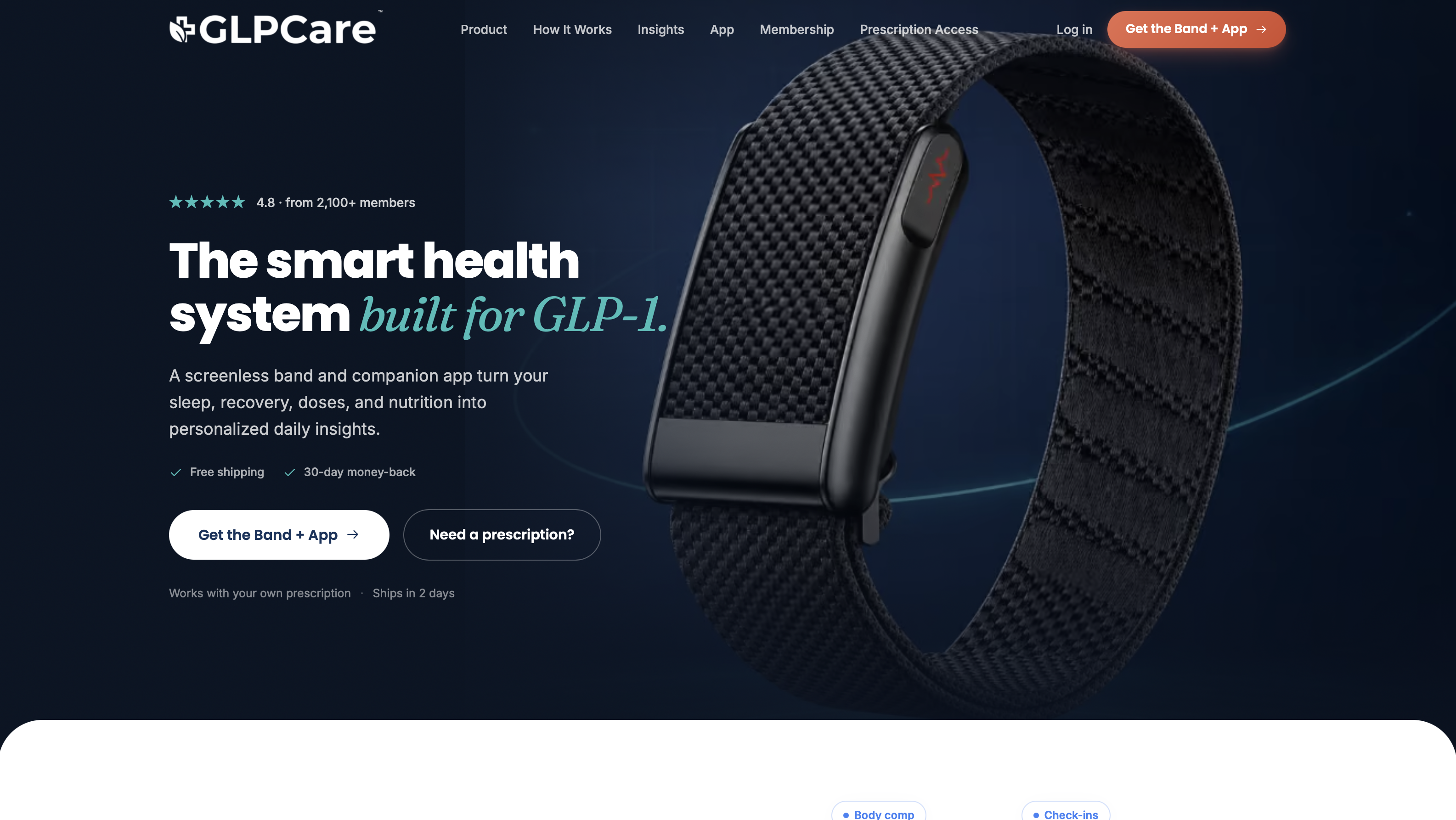
Every Glpcare member gets access to board-certified prescribers, medication shipped from a named, licensed pharmacy, an AI-powered tracking app for dose logging and health insights, and ongoing program support between visits. Plans are available whether you need a new prescription or already have one. Pricing is transparent across dose levels, with no hidden fees at maintenance dose. The wearable band, currently available at $89, tracks sleep, heart rate, and activity so your clinician has a clearer picture at every follow-up.
Starting is straightforward. Take the GLP-1 readiness quiz to see whether you qualify, then review the plans and pricing to find the right fit for your budget and goals.
Useful sources and links
- Medicare.gov — Medicare GLP‑1 Bridge program: Official program details, eligibility, and the $50/month pricing for Part D beneficiaries.
- FDA — Human drug compounding guidance: Regulatory framework for 503A and 503B pharmacies and what compounded drugs are and are not.
- FDA — Concerns about unapproved GLP-1 drugs: FDA’s specific guidance on unapproved GLP-1 products and what to watch for.
- FDA MedWatch: Safety reporting for adverse events and suspected counterfeit or unsafe medications.
- NovoCare — Novo Nordisk direct pharmacy: Cash-pay pricing, patient assistance program enrollment, and direct pharmacy access for Wegovy and Ozempic.
- Wegovy — What to pay for Wegovy: Manufacturer’s published cash-pay and savings card information.
- SingleCare — Cheapest semaglutide options: Retail discount card pricing and explanation of savings card eligibility for uninsured patients.
FAQ
Do you need a doctor to get semaglutide?
Yes. A licensed prescription is required for all semaglutide products, whether brand-name or compounded. Telehealth programs can connect you with a prescriber quickly, often the same day.
What diagnosis qualifies you for semaglutide coverage?
Semaglutide is typically prescribed for a BMI of 30 or higher, or a BMI of 27 or higher with at least one weight-related condition such as type 2 diabetes, hypertension, or high cholesterol. The Medicare GLP‑1 Bridge requires a covered medical indication under Part D.
What disqualifies you from taking semaglutide?
Contraindications include a personal or family history of medullary thyroid carcinoma, multiple endocrine neoplasia type 2, and pregnancy. A licensed clinician screens for these before prescribing.
How much does Wegovy cost without insurance?
Retail prices for Wegovy without a discount can exceed $1,000 per month. NovoCare has historically offered introductory cash-pay pricing for Wegovy (such as $199 for a first fill) with set standard cash prices for subsequent fills; confirm the latest pricing on the Wegovy website. Compounded semaglutide through telehealth programs starts around $119 per month at starter doses, with maintenance-dose pricing substantially higher.
Is semaglutide worth it without insurance?
For many patients, yes, particularly when the total program cost is weighed against the health outcomes of sustained weight loss. Glpcare’s integrated model, which bundles clinician oversight, coaching, and biometric monitoring with medication, is designed to make that value clearer and more sustainable over time.