Semaglutide Cost in 2026: What You'll Actually Pay
Semaglutide Cost in 2026: What You’ll Actually Pay
Brand-name semaglutide carries a list price between roughly $998 and $1,349 per month without insurance, but most people who use manufacturer savings programs or telehealth bundles pay far less. Commercially insured patients with prior authorization often land at $0–$25 per month with a copay card. Compounded options have been advertised as low as $88–$199 per month, though FDA enforcement has narrowed that market significantly.
Here is where prices typically fall right now:
- Brand injectable (Wegovy): ~$1,349/month list price; as low as $0–$25/month with commercial insurance and a manufacturer savings card
- Brand injectable (Ozempic): ~$998–$1,000/month list price; similar savings card eligibility for Type 2 diabetes indication
- Brand oral (Rybelsus): ~$998/month list price; daily tablet, same savings card programs apply
- Compounded semaglutide: $88–$199/month advertised, but availability has tightened with FDA enforcement actions
Three steps to lower your cost right now:
- Check your plan’s drug formulary at your insurer’s website or call the member services number on your insurance card.
- Apply for the Novo Nordisk manufacturer savings card (Wegovy or Ozempic) before your first fill.
- If you are uninsured or underinsured, compare a reputable telehealth bundle like Glpcare’s GLP-1 plans against the manufacturer’s self-pay direct program.
Key Takeaways
Brand semaglutide has list prices in the range of several hundred to over a thousand dollars per month, but manufacturer savings programs, insurance coverage, and integrated telehealth plans can reduce the cost significantly for most eligible patients.
| Point | Details |
|---|---|
| Brand list prices | Wegovy lists at ~$1,349/month; Ozempic and Rybelsus at ~$998–$1,000/month without any savings program. |
| Savings cards cut costs sharply | Commercially insured patients using a Novo Nordisk savings card often pay $0–$25/month. |
| Compounded options carry regulatory risk | FDA enforcement has narrowed the compliant compounding market; verify 503B status and batch testing before using. |
| Indication affects coverage odds | Ozempic for Type 2 diabetes has higher coverage rates than Wegovy for obesity; the cardiovascular indication opens new pathways. |
| Glpcare bundles care and medication | Glpcare’s integrated plans include medication, clinician support, and wearable monitoring, often at a lower combined cost than sourcing each separately. |
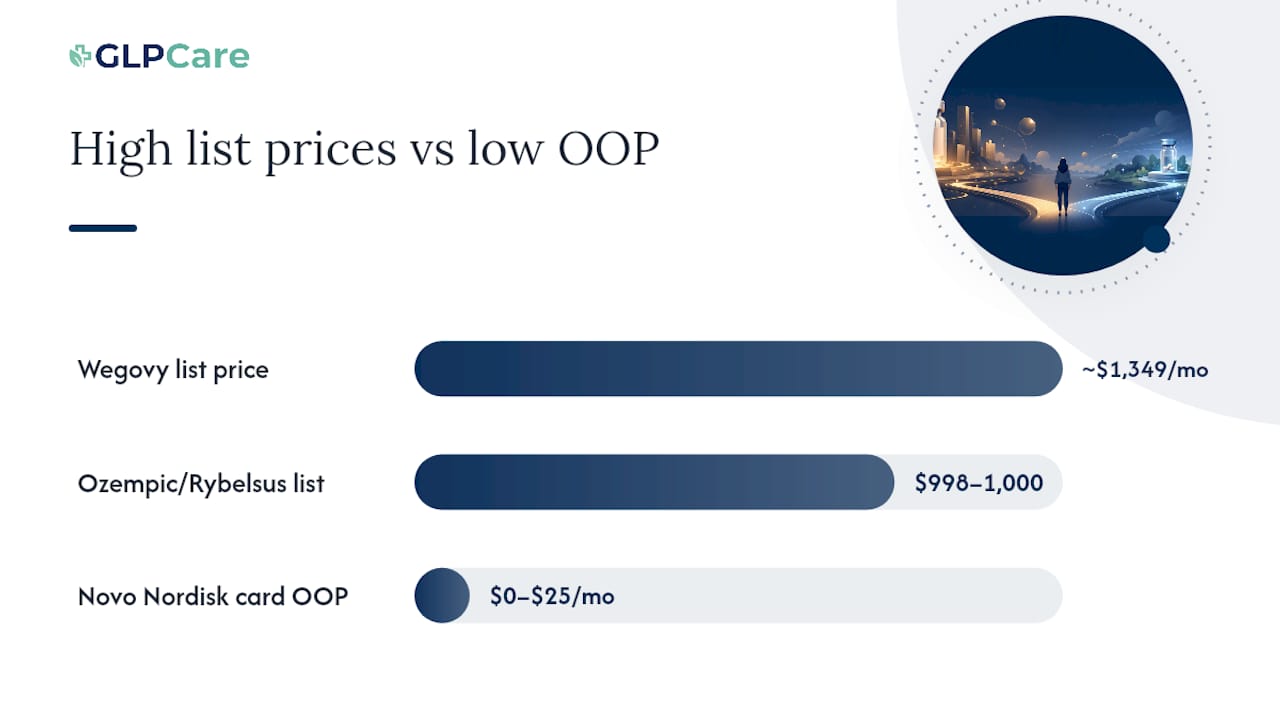
Table of Contents
- How much does semaglutide cost without insurance?
- How much does semaglutide cost with insurance?
- Which insurance plans sometimes cover semaglutide?
- Wegovy vs Ozempic vs Rybelsus: how cost, dosing, and approved uses compare
- Compounded semaglutide: lower cost, real trade-offs
- How to lower your out-of-pocket semaglutide cost, step by step
- Other costs to budget for beyond the medication itself
- What research says about semaglutide’s long-term cost-effectiveness
- Do you need a prescription, and how do you get semaglutide safely?
- How to weigh price signals when affordability is the goal
- Glpcare offers an integrated path to GLP-1 care
- Sources
- FAQ
How much does semaglutide cost without insurance?
Without insurance, semaglutide pricing splits into three tiers: brand injectable, brand oral, and compounded. Understanding each tier helps you set a realistic monthly budget before your first prescription.
Brand injectables carry the highest sticker prices. According to SingleCare, Wegovy’s list price runs approximately $1,349 per month for a maintenance-dose pack, while Ozempic sits closer to $998–$1,000 per month. These are list prices, not what most cash-pay patients actually spend. Novo Nordisk’s NovoCare self-pay program and direct-to-patient channels can reduce those figures substantially for people who qualify.
Brand oral (Rybelsus) lists at roughly $998 per month for a 30-tablet supply. Because it is a daily tablet rather than a weekly injection, the per-dose math looks different, but the monthly total is comparable to Ozempic.
Compounded semaglutide has been the lowest-advertised option, with telehealth providers listing prices between $88 and $199 per month. Those prices typically bundle the medication, a clinician consult, and shipping. However, FDA enforcement activity in 2025–2026 has reduced the number of compliant compounding suppliers, so availability at those prices is no longer guaranteed.
How the dose-to-month math works
The FDA label specifies that each Wegovy pen delivers a single weekly dose. The standard titration schedule starts at 0.25 mg weekly and steps up to a 2.4 mg maintenance dose over approximately 16–20 weeks. One pen equals one weekly dose, so a monthly supply requires four pens. At the 2.4 mg maintenance dose, you are paying the full list price per month. During titration at lower doses, the pen count stays the same but the mg per pen is lower, so the per-mg cost is actually higher at starter doses.
How much does semaglutide cost with insurance?
Insurance changes the math dramatically, but coverage is far from automatic. Your actual out-of-pocket cost depends on three variables: your plan’s formulary tier, the indication on your prescription, and whether you have completed prior authorization.
Typical insured out-of-pocket ranges:
- Commercial insurance with a manufacturer savings card: $0–$25/month for Wegovy or Ozempic
- Commercial insurance without a savings card: $50–$300/month depending on tier and coinsurance
- Medicare Part D: variable; historically limited coverage for weight-loss drugs, though CMS has selected semaglutide for Medicare drug price negotiations, which may shift costs over time
- Medicaid: highly variable by state; some states cover Wegovy for obesity, others do not
Indication matters more than most people realize. Ozempic prescribed for Type 2 diabetes has a much higher coverage rate than Wegovy prescribed for obesity. Many commercial plans and virtually all Medicare Part D plans have historically excluded weight-loss drugs from their formularies, even when the clinical case is strong. The FDA’s approval of Wegovy to reduce cardiovascular risk in adults with obesity-related conditions opened a new coverage pathway, because cardiovascular risk reduction is a covered indication for many plans that previously excluded obesity treatment.
How to check your coverage quickly
- Log in to your insurer’s member portal and search the drug formulary for “semaglutide,” “Wegovy,” or “Ozempic.”
- Note the tier (Tier 3 or 4 is common) and whether prior authorization is required.
- Call the member services number on your insurance card and ask specifically: “Is prior authorization required, and what clinical criteria does my plan use?”
- Ask your prescriber’s office to submit a prior authorization request using the cardiovascular risk or metabolic disease language from the FDA label, not just “weight loss.”
- If denied, request a peer-to-peer review between your prescriber and the plan’s medical director.
Pro Tip: When your prescriber submits a prior authorization for Wegovy, ask them to include your BMI, any obesity-related comorbidities (hypertension, sleep apnea, prediabetes), and the cardiovascular risk indication language. Plans that deny “weight loss” requests often approve the same drug under a cardiovascular or metabolic necessity framing.
Which insurance plans sometimes cover semaglutide?
Coverage is not uniform across plan types, and the gap between what is technically possible and what your specific plan actually does can be wide. Here is how the major plan categories break down.
Medicare Part D has historically excluded most weight-loss drugs under federal law, but that is changing. Wegovy’s cardiovascular indication created a new pathway, and Novo Nordisk has launched a Medicare GLP-1 Bridge program for eligible Medicare Part D beneficiaries during a specified period in 2026. Check the Wegovy savings page directly to confirm current eligibility dates and benefit amounts, since these programs have defined windows. CMS’s ongoing drug price negotiations also mean Medicare costs for semaglutide could shift in coming years.
State Medicaid programs vary widely. Some states have added Wegovy or Ozempic to their formularies with prior authorization for obesity or diabetes; others have not. Your fastest check is your state Medicaid agency’s preferred drug list, which is usually searchable online.
Large employer and self-funded plans make their own formulary decisions. Some have added Wegovy with utilization management requirements (BMI thresholds, documented lifestyle program participation). Others have excluded it entirely due to cost. The VA formulary guidance for Wegovy illustrates how institutional plans set clinical criteria and monitoring expectations, which gives you a useful template for what your own plan’s prior authorization criteria might look like.
How to check your specific plan:
- Visit your insurer’s website and use the formulary search tool
- Call member services and ask about prior authorization criteria and step therapy requirements
- Ask your HR benefits team if your employer plan has a GLP-1 coverage policy
- For Medicare, visit Medicare.gov’s plan finder and filter by drug coverage
For a deeper breakdown of how GLP-1 insurance coverage works across plan types, Glpcare’s insurance coverage guide walks through the most common scenarios.
Wegovy vs Ozempic vs Rybelsus: how cost, dosing, and approved uses compare
All three products contain semaglutide, but they are approved for different indications, come in different formulations, and carry meaningfully different coverage odds. That distinction directly affects what you pay.
Wegovy is FDA-approved for chronic weight management in adults with a BMI of 30 or higher, or 27 or higher with at least one weight-related condition. It is also approved to reduce cardiovascular risk in adults with obesity or overweight. The maintenance dose is 2.4 mg weekly, delivered via a pre-filled injection pen. Each monthly supply requires four pens. List price is approximately $1,349/month.
Ozempic is FDA-approved for Type 2 diabetes management and cardiovascular risk reduction in adults with Type 2 diabetes. It comes in 0.5 mg, 1 mg, and 2 mg weekly injection doses. The 1 mg and 2 mg pens each contain multiple doses per pen (four weekly doses per pen at standard fill). List price is approximately $998–$1,000/month. Because it is prescribed for diabetes, commercial insurance coverage rates are substantially higher than for Wegovy.
Rybelsus is the only oral semaglutide, approved for Type 2 diabetes. It comes in 3 mg, 7 mg, and 14 mg daily tablets, with a 30-tablet monthly supply. List price is approximately $998/month. The oral format eliminates injection supplies from your budget but requires daily dosing on an empty stomach with a small amount of water, which some patients find harder to maintain than a weekly injection.
For prescribers, the choice between Wegovy and Ozempic often comes down to the primary diagnosis. Patients whose primary goal is weight loss and who have an obesity diagnosis are typically prescribed Wegovy. Patients with Type 2 diabetes who also need weight management are often prescribed Ozempic, which carries better insurance coverage odds. Rybelsus suits patients who prefer oral medication and have a diabetes diagnosis. None of these products is interchangeable at the pharmacy without a new prescription.
Compounded semaglutide: lower cost, real trade-offs
Compounded semaglutide has attracted significant attention because advertised prices of $88–$199 per month are a fraction of brand list prices. Before you pursue that route, you need a clear picture of what you are actually buying.
What compounded telehealth bundles typically include: medication (compounded semaglutide in a vial with syringes), an initial clinician consult, and shipping. Some include follow-up messaging; others charge separately for ongoing visits.
The regulatory reality is direct. The FDA has issued explicit guidance warning about unapproved compounded GLP-1 products and has increased enforcement as the national GLP-1 supply stabilizes. As the FDA’s own communications state:
That enforcement posture means the pool of compliant compounding suppliers is shrinking. Providers who were operating under shortage-period exemptions are no longer permitted to compound copies of brand semaglutide now that the shortage has been resolved.
Safety and quality checklist if you evaluate a compounded provider:
- Confirm the pharmacy is a licensed 503A or 503B facility (503B outsourcing facilities have stricter quality standards)
- Ask for a certificate of analysis (CoA) showing third-party batch testing for potency and sterility
- Verify a licensed pharmacist and prescribing clinician are involved, not just an algorithm
- Confirm the active ingredient is semaglutide base, not a salt or derivative (some products use semaglutide sodium or acetate, which are not the same as the FDA-approved molecule)
- Check that the provider has a clear refund and adverse-event reporting policy
Lower-cost alternatives that avoid compounding risk:
- Novo Nordisk’s NovoCare self-pay program for Ozempic and Wegovy
- Manufacturer savings cards that reduce commercial copays to $0–$25
- Rybelsus oral tablets, which may be easier to cover under a diabetes indication
- Patient assistance programs (see the next section)
For guidance on how to get semaglutide without insurance through safe, documented channels, Glpcare’s resource covers the most current options.
How to lower your out-of-pocket semaglutide cost, step by step
Reducing what you pay is not a single move. It is a sequence. Work through these steps in order before concluding that semaglutide is unaffordable.
-
Check your formulary first. Log in to your insurer’s portal and confirm whether Wegovy, Ozempic, or Rybelsus is listed, at what tier, and whether prior authorization is required. This takes 10 minutes and tells you whether insurance is even a viable path.
-
Apply for the manufacturer savings card before your first fill. Novo Nordisk offers savings cards for both Ozempic and Wegovy that can reduce commercially insured copays to as little as $0–$25 per month. You apply online in minutes. These cards do not work with Medicare or Medicaid.
-
Explore manufacturer self-pay or direct programs. NovoCare offers direct-to-patient pricing for uninsured or underinsured patients. Pricing tiers vary by income and program availability, so check the NovoCare website for current rates.
-
Compare reputable telehealth bundles. Telehealth programs that include clinician oversight, refill management, and monitoring can cost less per month than piecing together a prescription, pharmacy fill, and follow-up visits separately. Compare total program cost, not just medication cost. Glpcare’s most affordable GLP-1 providers guide breaks down how bundled plans compare.
-
Apply for patient assistance if income qualifies. Novo Nordisk’s patient assistance program (NovoCare Patient Assistance) provides free medication to patients who meet income and insurance criteria. Applications are submitted through the NovoCare website or through your prescriber’s office.
-
File an appeal or request a peer-to-peer review if denied. Insurance denials are not final. A peer-to-peer review between your prescriber and the plan’s medical director reverses a meaningful share of prior authorization denials, particularly when the cardiovascular risk indication is documented.
Can you stack savings? Manufacturer savings cards cannot be combined with Medicare or Medicaid. You can use a savings card on top of commercial insurance. You generally cannot use a savings card and a patient assistance program simultaneously. GoodRx-style discount coupons apply at the pharmacy and replace insurance pricing; they do not stack with insurance copays.
Red flags for questionable bargains:
- No licensed prescriber involved in the process
- No batch testing documentation available
- Prices dramatically below the $88–$199 compounded range with no explanation
- No clear refund or adverse-event policy
- Pressure to pay in full upfront for several months
Pro Tip: GoodRx and similar discount platforms can sometimes beat your insurance copay on Ozempic or Rybelsus at certain pharmacies. Run the GoodRx price at your local pharmacy before filling with insurance, especially if you are in a high-deductible plan. You cannot use both on the same fill, so compare first.
Other costs to budget for beyond the medication itself
The medication price is only part of your monthly total. Several recurring add-on costs catch people off guard, especially in the first few months.
Common recurring extras:
- Telehealth or clinic visit fee: $0–$150/month depending on whether you use a subscription model or pay per visit
- Membership or program fee: Some telehealth platforms charge a separate monthly membership ($20–$50) on top of medication cost
- Pen needles or syringes: Wegovy and Ozempic pens require pen needles (not included). A box of 100 pen needles costs roughly $15–$30 at most pharmacies
- Shipping: Brand pharmacy fills are often free with manufacturer programs; compounded vials may carry a $10–$20 shipping fee per order
- Lab work: Baseline labs (HbA1c, metabolic panel, lipids) and periodic monitoring are typically required. Cost varies by insurance; uninsured labs can run $50–$200 per draw
- Nutrition or coaching program fees: Some programs include coaching; others charge separately ($30–$100/month)
Sample monthly budget (uninsured, brand Wegovy at self-pay program pricing)
| Cost item | Estimated monthly cost |
|---|---|
| Wegovy (NovoCare self-pay, estimated) | Varies by program tier |
| Pen needles (1 box/month) | $15–$30 |
| Telehealth visit or program fee | $0–$100 |
| Shipping | $0–$20 |
| Lab monitoring (amortized quarterly) | $15–$50 |
| Estimated total add-ons | $30–$200 |
Practical tips to reduce logistics costs:
- Use auto-refill where available; some programs discount auto-refill orders
- Ask whether your telehealth provider uses a specialty pharmacy with free shipping versus a local retail pharmacy that may charge more
- Request a 90-day supply if your plan allows it; per-unit cost is often lower and you reduce the number of prior authorization renewals per year
What research says about semaglutide’s long-term cost-effectiveness
The sticker price is one number. The value question is a different one, and the research gives a more nuanced answer than either advocates or critics typically present.
Cost-effectiveness in medicine is measured in cost per quality-adjusted life year (QALY). A QALY represents one year of life in perfect health. Regulators and payers use a threshold of roughly $50,000–$150,000 per QALY to judge whether a treatment is cost-effective for a given population.
Peer-reviewed analyses of GLP-1 receptor agonists document meaningful clinical outcomes: weight reduction, improved glycemic control, and cardiovascular risk reduction. These outcomes feed into QALY models. However, the cost-effectiveness result depends heavily on assumptions about how long patients stay on the drug, what happens when they stop, and what downstream health costs are avoided.
Harvard PolicyLab’s analysis of semaglutide’s cost-effectiveness found that at current U.S. list prices, semaglutide can increase lifetime healthcare costs in some models, even accounting for QALY gains. The cost-effectiveness picture improves substantially when the drug is priced lower (through negotiation, savings programs, or generic entry) or when it is targeted to patients with the highest cardiovascular or metabolic risk.
What this means for your personal decision:
- If you have significant cardiovascular risk, Type 2 diabetes, or obesity-related comorbidities, the long-term health benefit case is stronger
- If you are paying full list price out of pocket with no savings programs, the monthly cost is hard to justify on value grounds alone for lower-risk patients
- Sustainable access matters: a drug you can afford to take consistently produces better outcomes than one you start and stop due to cost
Do you need a prescription, and how do you get semaglutide safely?
Semaglutide is a prescription-only medication in the United States. No legitimate source sells it without a valid prescription from a licensed clinician. Any website offering semaglutide without a prescription is operating outside U.S. law and almost certainly selling an unverified product.
What a prescriber typically checks before prescribing:
- BMI and weight history
- Presence of Type 2 diabetes, prediabetes, or obesity-related conditions
- Baseline labs: HbA1c, kidney function, lipid panel
- Contraindications: personal or family history of medullary thyroid carcinoma or multiple endocrine neoplasia syndrome type 2
- Current medications and potential interactions
Routes to a safe, legal prescription:
- In-person prescriber: Your primary care physician, endocrinologist, or obesity medicine specialist. Prescription goes to your local or mail-order pharmacy.
- Telehealth prescription: A licensed clinician reviews your intake form and medical history via video or asynchronous consult. Prescription goes to a pharmacy or is fulfilled through the telehealth provider’s pharmacy partner.
- Manufacturer direct programs: NovoCare and similar programs connect patients with prescribers and pharmacies within a managed system.
Safety checklist for online providers:
- Licensed clinicians (MD, DO, NP, or PA) listed on the site with verifiable credentials
- Clear follow-up plan with scheduled check-ins, not just a one-time consult
- Lab monitoring required before and during treatment
- Transparent pricing with no hidden fees
- Clear adverse-event reporting and refund policy
- No claims that their product is “just as good as Ozempic” without FDA approval
For a detailed guide to buying semaglutide online safely, Glpcare’s resource covers the specific red flags to watch for when evaluating online providers.
Pro Tip: Before your telehealth consult, gather your most recent labs (HbA1c, metabolic panel) and a list of current medications. Clinicians can complete the assessment faster and more accurately, which means fewer follow-up requests and a faster prescription.
How to weigh price signals when affordability is the goal
The cheapest option is not always the safest, and the most expensive is not always the most effective. That tension is worth naming directly.
Brand semaglutide at list price is genuinely unaffordable for most uninsured Americans without savings programs. That is a real access problem, not a perception issue. But the response to that problem matters. Pursuing the lowest advertised price without verifying the source, the pharmacy’s credentials, and the product’s quality is a different kind of risk. Compounded products from non-compliant pharmacies have been associated with dosing errors and contamination concerns, and the FDA’s enforcement posture reflects that.
The practical hierarchy is this: if you can access brand semaglutide through a manufacturer savings program, a covered insurance plan, or a reputable telehealth bundle with licensed clinician oversight, that is the path worth pursuing first. Compounded semaglutide from a verified 503B outsourcing facility with batch testing documentation is a defensible second option for patients who cannot access brand products. Compounded products from unverified sources are not a cost-saving strategy; they are an unquantified risk.
Glpcare’s integrated model sits in a specific place in this picture. When you want clinician oversight, biometric monitoring through a wearable, and refill management in one subscription, piecing those services together separately often costs more than a bundled plan. The value is not just the medication; it is the continuous support structure around it. If cost is the only variable and you have strong insurance coverage, your insurer plus a manufacturer savings card may be all you need. If you are uninsured or underinsured and want more than a prescription, an integrated program is worth pricing out.
Glpcare offers an integrated path to GLP-1 care
Semaglutide’s list price is high, but your total monthly cost depends on how you access it. Glpcare’s GLP-1 plans include prescription medication shipped to your home, licensed clinician support, a proprietary wearable band with medical-grade sensors, and an AI-driven app for dose tracking and personalized health insights. That combination addresses the two things that drive long-term results: getting the medication and staying on it with the right support.

For patients who already have a GLP-1 prescription, Glpcare’s bring-your-own-medication tier lets you add the monitoring and coaching layer without changing your pharmacy. For those starting from scratch, the full-care plan handles the clinical assessment, prescription, and fulfillment in one place, which removes the friction of coordinating a prescriber, a pharmacy, and a monitoring program separately. Pricing is transparent on the plans page, and the first step is a short GLP-1 readiness quiz that tells you which plan fits your situation before you commit to anything.
Sources
These primary and peer-reviewed sources underpin the figures and policy details in this article. Each is worth bookmarking for your own research.
- FDA clarifies policies for compounders as national GLP-1 supply begins to stabilize | FDA
- HHS announces additional drugs selected for Medicare drug price negotiations | CMS
- CFU Semaglutide WEGOVY for weight management | VA Formulary Advisor
- GLP‑1 receptor agonists: clinical outcomes and economic implications | PMC
This article is general information, not a substitute for advice from a qualified doctor. Consult a qualified healthcare professional about your own circumstances before acting on anything here.
FAQ
Are semaglutide pills cheaper than injections?
Rybelsus (oral semaglutide) lists at approximately $998 per month, comparable to Ozempic and less than Wegovy’s ~$1,349 list price. With a manufacturer savings card and commercial insurance, out-of-pocket costs are similar across all three products.
How much semaglutide is in one Ozempic pen?
The FDA label specifies that Ozempic pens come in 0.5 mg, 1 mg, and 2 mg dose strengths, with each pen containing enough medication for four weekly doses. One pen typically covers one month of treatment at a given dose.
How can you afford semaglutide for weight loss?
The most reliable path is to check your insurer’s formulary, apply for the Novo Nordisk Wegovy savings card before your first fill, and ask your prescriber to document the cardiovascular risk indication if applicable. If you are uninsured, NovoCare’s patient assistance program and reputable telehealth bundles like Glpcare’s plans are the next options to evaluate.
What happens if you stop taking a GLP-1 drug?
Most patients regain a significant portion of lost weight after stopping semaglutide, because the drug’s appetite-suppressing effect is not permanent. Clinical trials show that weight regain typically begins within weeks of discontinuation, which is why sustainable access and ongoing monitoring matter as much as the initial prescription.
Does Medicare cover Wegovy?
Medicare Part D historically excluded weight-loss drugs, but Wegovy’s cardiovascular risk-reduction approval created a new coverage pathway for eligible beneficiaries. Novo Nordisk has also launched a temporary Medicare GLP-1 Bridge program in 2026 for eligible Part D patients. Check the Wegovy savings page for current program dates and eligibility requirements.