HSA for GLP-1 Medications: Your 2026 Eligibility Guide
HSA for GLP-1 Medications: Your 2026 Eligibility Guide
TL;DR:
- You can use your HSA or FSA to pay for GLP-1 medications if you have proper documentation linking the drug to a diagnosed condition. Filing requires a prescription with a qualifying diagnosis, an itemized receipt, an ICD-10 chart note, and often a Letter of Medical Necessity for weight management. Insurance denial does not prevent using pre-tax funds if documentation and IRS rules support the expense.
Yes, you can use your HSA or FSA to pay for GLP-1 medications — but eligibility depends on documentation, not just having a prescription. Under IRS Publication 502 and IRC §213(d), a medication qualifies as a medical expense when it treats a diagnosed disease. That means your clinician’s chart must show a qualifying diagnosis, and you need to keep the right paperwork to back it up.
Here is what you need to act on immediately:
- Get a valid prescription tied to a qualifying diagnosis (type 2 diabetes, obesity, or overweight with a comorbidity)
- Request a Letter of Medical Necessity (LMN) from your clinician if your GLP-1 is prescribed for weight management
- Keep an itemized pharmacy or provider receipt showing the medication name and amount paid
- Save your Explanation of Benefits (EOB) if insurance paid any portion
If your insurance denies coverage, that does not disqualify you from using HSA or FSA funds. The IRS standard and your insurer’s coverage decision are completely separate questions. As long as the expense meets Publication 502 rules, pre-tax funds are fair game.
Quick-start checklist:
- Confirm your diagnosis is documented in your chart with an ICD-10 code
- Request an LMN from your clinician (especially for Wegovy or Zepbound)
- Try your HSA/FSA debit card at checkout; if declined, pay out of pocket and keep the itemized receipt
- Submit a reimbursement claim to your HSA/FSA administrator with the receipt, prescription, and LMN
Table of Contents
- When do GLP-1 medications qualify for HSA/FSA?
- How HSA and FSA differ when paying for GLP-1 therapy
- What documents do you need to keep for GLP-1 HSA/FSA claims?
- How to request an LMN from your clinician
- When GLP-1 medications are not eligible and why claims get denied
- Insurance denied coverage — can you still use your HSA or FSA?
- What to do today: scripts for your clinician, pharmacy, and administrator
- Key Takeaways
- How Glpcare reduces the documentation friction most patients face
- Glpcare makes GLP-1 documentation straightforward from day one
- Useful sources
- FAQ
When do GLP-1 medications qualify for HSA/FSA?
The controlling standard comes from IRS Publication 502: an expense qualifies when it is for the diagnosis, cure, mitigation, treatment, or prevention of disease. General wellness or cosmetic weight loss does not meet that bar. A diagnosed medical condition does.
The diagnoses that routinely satisfy HSA/FSA administrators include:
- Type 2 diabetes (ICD-10: E11.x) — the clearest path; Ozempic (semaglutide) and Mounjaro (tirzepatide) both carry FDA diabetes indications
- Obesity (ICD-10: E66.x) — BMI ≥30, diagnosed by a physician
- Overweight with comorbidity (ICD-10: E66.09 or Z68.x) — BMI ≥27 plus hypertension, high cholesterol, or obstructive sleep apnea
- Cardiovascular risk reduction — Wegovy carries an FDA-approved CV indication that creates a particularly clean documentation path when the chart matches
The diagnosis on the chart is the controlling factor, not the FDA label. An FDA-approved indication reduces friction with administrators, but off-label use can still qualify if the clinician documents a diagnosable disease and links the prescription to it with an ICD-10 code.
Named GLP-1 drugs and their typical documentation expectations:
- Semaglutide as Ozempic — prescribed for type 2 diabetes; a prescription tied to an E11 diagnosis usually satisfies administrators with minimal friction
- Semaglutide as Wegovy — prescribed for chronic weight management; an LMN often eliminates friction for weight-only indications
- Tirzepatide as Mounjaro — diabetes indication; similar documentation path to Ozempic
- Tirzepatide as Zepbound — weight management indication; HSA-eligible at BMI ≥30, or BMI ≥27 with a qualifying comorbidity, with chart documentation required
The practical takeaway: HSA/FSA eligibility depends on IRS §213(d), not on whether your insurer approves the drug. A prescription alone may not be enough for weight-management indications — administrators look for documented clinical necessity.
How HSA and FSA differ when paying for GLP-1 therapy
The account type you use affects how you pay, how much you can set aside, and what happens to unspent funds at year-end.
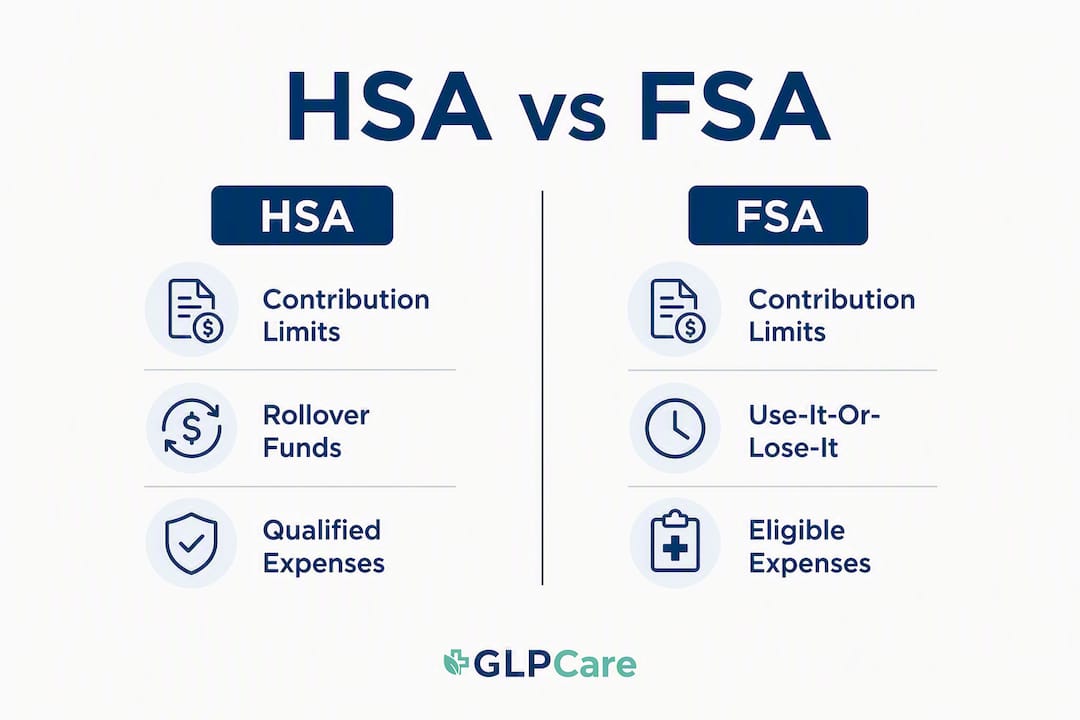
| Feature | HSA | FSA |
|---|---|---|
| Eligibility requirement | Must be enrolled in a qualifying High-Deductible Health Plan (HDHP) | Offered through employer; no HDHP required |
| Fund rollover | Rolls over indefinitely; account is individually owned | Use-it-or-lose-it (some plans allow limited carryover or grace period) |
| Contribution limits | — | Set by employer; IRS caps at — |
| Best for GLP-1 therapy | Ongoing, recurring monthly fills; larger annual spend | Single-year spend when you know the cost upfront |
| Payment at checkout | HSA debit card accepted at many pharmacies | FSA debit card accepted at many pharmacies |
| Reimbursement option | Yes — pay out of pocket, submit claim | Yes — pay out of pocket, submit claim |
A few practical points worth knowing:
- Some fulfillment channels accept HSA/FSA cards directly at checkout (manufacturer pharmacies, Amazon Pharmacy); others require a pay-and-reimburse workflow. A card decline at checkout does not mean the expense is ineligible.
- GLP-1 medications represent a significant recurring cost. Because HSA funds roll over, many patients build a balance over time and use it for monthly fills. With an FSA, timing matters more — plan your contribution to match your expected annual spend.
- If your GLP-1 therapy cost exceeds your individual HSA contribution limit, consider whether a family-tier contribution applies, or whether delaying reimbursement (banking the receipt) lets your balance grow before you claim.
What documents do you need to keep for GLP-1 HSA/FSA claims?
Audits happen. The documentation you collect at the time of purchase is far easier to produce than records you try to reconstruct months later. Here is the minimum set:
- Valid prescription — must be linked to a qualifying diagnosis; the prescribing clinician’s name and date should be visible
- Itemized pharmacy or provider receipt — must show medication name (not just “prescription”), date of service, and amount paid
- Clinician chart note with ICD-10 code — the diagnosis in the chart is what administrators check
- EOB (Explanation of Benefits) — required when insurance paid any portion; you may only use HSA/FSA funds for the out-of-pocket amount
- Letter of Medical Necessity (LMN) — strongly recommended for weight-management indications; required by many administrators
If your pharmacy receipt shows only a summary total, ask the pharmacist for an itemized receipt that includes:
| Field | What to request |
|---|---|
| Medication name | Generic or brand name (e.g., semaglutide / Wegovy) |
| NDC or description | National Drug Code or written drug description |
| Date of service | Fill date |
| Line-item price | Cost per unit or per fill |
| Payment method | How much you paid out of pocket |
Recordkeeping best practices:
- Scan and date-stamp every document at the time of purchase
- Store receipts, LMNs, EOBs, and chart notes in a dedicated folder (cloud or physical)
- Renew your LMN when treatment continues beyond the period it covers — administrators typically accept an LMN for a defined period, so check with your custodian on their specific requirement
- Keep records for at least three years after filing the tax return for the year the expense was incurred
Pro Tip: Set up a single digital folder labeled by tax year. Drop every receipt, EOB, and LMN into it the day you receive it. If an audit comes six months later, you will have everything in one place.

How to request an LMN from your clinician
An LMN converts a weight-management prescription into documented treatment for a diagnosed disease. That distinction matters to HSA/FSA administrators who need clinical necessity, not just a clinician’s signature.
A strong LMN states the patient’s diagnosis with ICD-10 code, the medication name and dosage, the clinical rationale linking the drug to treatment of that specific disease, and the expected treatment duration. Without those elements, administrators may still ask for more.
What a complete LMN should include:
- Patient name and date of birth
- Diagnosis with ICD-10 code (e.g., E66.01 for morbid obesity, E11.9 for type 2 diabetes)
- BMI value (where relevant to the diagnosis)
- Medication name, dose, and route of administration
- Clinical rationale: why this medication is medically necessary for this patient’s diagnosed condition
- Expected treatment duration
- Clinician’s name, credentials, signature, and date
Sample LMN language (clinician-ready):
| Field | Sample language |
|---|---|
| Diagnosis | “Patient presents with [diagnosis], ICD-10 [code], confirmed [date].” |
| BMI | “Current BMI: [value]. Patient meets clinical criteria for [indication].” |
| Medication | “[Drug name], [dose], administered [route], [frequency].” |
| Rationale | “This medication is medically necessary to treat [diagnosis] and is consistent with current clinical guidelines.” |
| Duration | “Treatment is expected to continue for [period] with ongoing monitoring.” |
How to ask your clinician:
- At your next visit, say: “I’m using my HSA to pay for this medication. Can you add an ICD-10 diagnosis code to my chart and provide a Letter of Medical Necessity for my HSA administrator?”
- Ask whether the clinic generates a separate LMN letter or adds the required information as a chart note — both formats are generally accepted.
- Confirm the date on the LMN and ask when it should be renewed if your treatment continues.
Most clinicians are familiar with LMN requests. If the front desk handles paperwork, ask them specifically for a letter that includes the ICD-10 code and clinical rationale — not just a note that says “medically necessary.”
When GLP-1 medications are not eligible and why claims get denied
The most common reason a GLP-1 claim fails is not the medication itself — it is missing or mismatched documentation.
Situations where GLP-1 medications do not qualify:
- Weight loss for cosmetic or general wellness purposes without a diagnosed condition
- No ICD-10 diagnosis code in the chart
- Prescription written without a linked diagnosis (clinician signature alone is not enough for weight-management uses)
Frequent denial triggers:
- LMN absent when the administrator requires one for weight-only indications
- Compounded semaglutide or compounded tirzepatide — administrators scrutinize compounded products more strictly because they often lack an FDA label that ties to a named disease; confirm your custodian’s policy before ordering
- Missing itemized receipt (a summary total is not sufficient)
- Double-dipping: using HSA/FSA funds for a portion already covered by insurance
If your claim is denied, do not assume the expense is ineligible. Gather your clinician chart note with ICD-10 code, LMN, itemized receipt, and EOB, then submit a formal appeal to your plan administrator. Most denials at this stage are documentation issues, not eligibility issues.
Red flags that increase audit risk:
- Off-label use with no matching chart diagnosis (e.g., Ozempic prescribed for weight when the chart shows no diabetes or obesity diagnosis)
- Medication name on the receipt does not match the drug name in the chart
- Bundled program receipts with no line-item breakdown of the medication cost
Insurance denied coverage — can you still use your HSA or FSA?
Yes. Insurance coverage and HSA/FSA eligibility are two separate questions. Your insurer decides whether it will pay; IRS Publication 502 decides whether the expense qualifies as a medical expense for pre-tax accounts. An insurance denial has no bearing on the IRS standard.
Reimbursement workflow after an insurance denial:
- Pay for the medication out of pocket and keep the itemized receipt
- Obtain the EOB from your insurer showing the denial (this documents that insurance did not pay)
- Gather your prescription, LMN, and clinician chart note with ICD-10 code
- Submit a reimbursement claim to your HSA/FSA administrator with all four documents
- If the administrator denies the claim, appeal with the same documentation package and reference IRS Publication 502 / IRC §213(d) in your appeal letter
Audit protection checklist:
- EOB showing insurance denial (or partial payment amount)
- Itemized pharmacy receipt with medication name, date, and out-of-pocket amount
- LMN with ICD-10 diagnosis and clinical rationale
- Clinician chart note confirming the diagnosis
A few practical notes: if your HSA/FSA debit card is declined at the pharmacy, pay with another method and submit for reimbursement — a card decline is often a merchant coding issue, not an eligibility ruling. If you are planning significant ongoing GLP-1 spend, call your HSA/FSA custodian in advance to confirm their documentation requirements for GLP-1 medications, including whether they accept compounded products. You cannot reimburse the portion covered by your insurer — retain the EOB and pharmacy receipt to prove the exact out-of-pocket amount.
What to do today: scripts for your clinician, pharmacy, and administrator
Getting the right documentation is mostly about asking the right questions at the right time. Here is a practical sequence.
Your action checklist:
- Confirm your diagnosis is documented in your chart with an ICD-10 code — call your clinic’s patient portal or front desk to verify
- Request an LMN at your next clinician visit (or via a portal message) if your GLP-1 is for weight management
- Ask your pharmacy for an itemized receipt at pickup — not a summary receipt
- Save your EOB from your insurer after each fill
- Scan and store all documents in a dedicated folder organized by tax year
Clinician script:
Pharmacy script:
Questions to ask your HSA/FSA administrator:
- Do you accept GLP-1 medications prescribed for weight management with an LMN?
- What documentation do you require for compounded semaglutide or tirzepatide?
- What receipt format do you accept for reimbursement submissions?
- How long do I have to submit a reimbursement claim after the date of service?
Calling your administrator before your first fill takes five minutes and can prevent a denial that takes weeks to appeal. Ask specifically about compounded products and LMN requirements — policies vary by custodian.
Key Takeaways
GLP-1 medications are HSA/FSA eligible when prescribed to treat a qualifying diagnosed condition under IRS Publication 502, provided you keep a prescription, itemized receipt, ICD-10 chart note, and an LMN for weight-management indications.
| Point | Details |
|---|---|
| Eligibility requires a diagnosis | A prescription alone is not enough; your chart must show an ICD-10 code for obesity, diabetes, or a qualifying comorbidity. |
| Insurance denial does not block HSA/FSA use | IRS Publication 502 governs eligibility; pay out of pocket and submit for reimbursement with your EOB and LMN. |
| LMN is your audit shield | For weight-management indications (Wegovy, Zepbound), an LMN with ICD-10 code and clinical rationale significantly reduces denial and audit risk. |
| Compounded products need extra documentation | Administrators scrutinize compounded GLP-1s more strictly; confirm custodian policy and keep LMN plus chart notes. |
| Glpcare provides documentation support | Glpcare’s clinician visits generate chart notes, LMNs, and itemized receipts designed to support HSA/FSA reimbursement submissions. |
How Glpcare reduces the documentation friction most patients face
The part of GLP-1 therapy that trips people up is rarely the medication itself. It is the paperwork. Getting an ICD-10 code into your chart, requesting an LMN, tracking down an itemized receipt, and coordinating with your HSA administrator while managing a new treatment protocol is a lot to handle at once.
Glpcare is built around that reality. Every Glpcare plan includes a licensed clinician visit where your diagnosis is documented, your ICD-10 code is recorded in your chart, and an LMN can be generated as part of the intake process. Medication fulfillment through Glpcare produces itemized receipts formatted for reimbursement submissions. The AI tracking app logs your dosing, biometric data, and adherence over time, giving your clinician a continuous record that supports ongoing medical necessity documentation. The proprietary wearable band tracks sleep, heart rate, and activity, adding clinical depth to your chart that a standalone prescription never provides.
For patients managing GLP-1 therapy through a telehealth channel that does not generate this documentation automatically, the gap between “I have a prescription” and “I have everything my HSA administrator needs” can be significant. Glpcare closes that gap by design, not as an afterthought.
Glpcare makes GLP-1 documentation straightforward from day one
Most patients spend more time chasing paperwork than they expect. Glpcare’s integrated care model gives you a clinician-generated LMN, a chart note with your ICD-10 diagnosis, and itemized medication receipts — the exact documents your HSA/FSA administrator will ask for — as a standard part of your care, not a special request.
Starting is straightforward. Take the GLP-1 readiness quiz to confirm clinical eligibility, then schedule your initial clinician visit. Your clinician documents your diagnosis, generates your LMN, and your medication ships directly to you with a receipt formatted for reimbursement. Ongoing clinician support and biometric tracking through the Glpcare band and app keep your documentation current for every fill. If you want to see how the plans are structured before starting, the GLP-1 plans and pricing page lays out exactly what each tier includes.
This article provides general information about HSA/FSA eligibility rules and is not tax or medical advice. Confirm your specific situation with your HSA/FSA custodian and a qualified tax professional.
Useful sources
The IRS publications below are the primary legal references for HSA/FSA eligibility. FDA approval pages and benefit-administrator guides are useful supporting evidence when preparing documentation.
- IRS Publication 502 — Medical and Dental Expenses: the primary federal guidance defining qualified medical expenses under IRC §213(d)
- IRS Publication 969 — HSAs and Other Tax-Favored Health Plans: covers contribution limits, rollover rules, and the double-dipping prohibition
- IRC §213 — Medical, Dental, etc., Expenses (Cornell Law): the statutory text underlying Publication 502
- Glpcare blog — GLP-1 therapy guides and documentation resources: clinician-facing templates and practical next steps for patients on GLP-1 therapy
| Source | What it covers | Best used for |
|---|---|---|
| IRS Publication 502 | Qualified medical expense definition | Eligibility determination and appeals |
| IRS Publication 969 | HSA/FSA contribution and reimbursement rules | Contribution planning and EOB retention |
| IRC §213(d) | Statutory definition of medical care | Legal basis for administrator appeals |
| FDA drug labeling | Approved indications per drug | Matching chart diagnosis to FDA indication |
| HSA/FSA custodian guidance | Plan-specific rules and receipt formats | Pre-fill confirmation and claim submission |
Always confirm current rules with your HSA/FSA custodian and a tax professional before making reimbursement decisions.
FAQ
Can I use my HSA to pay for semaglutide?
Yes. Semaglutide (Ozempic or Wegovy) is HSA-eligible when prescribed to treat a qualifying diagnosed condition such as type 2 diabetes or obesity. Keep your prescription, an itemized pharmacy receipt, and an LMN for weight-management indications.
Can I use my HSA for Wegovy specifically?
Yes, you can use your HSA for Wegovy when your chart documents a qualifying diagnosis — obesity (BMI ≥30) or overweight (BMI ≥27) with a comorbidity. An LMN from your clinician significantly reduces administrator friction for weight-management prescriptions.
Can I pay for Zepbound with my HSA?
Zepbound (tirzepatide) is HSA-eligible when prescribed for chronic weight management at BMI ≥30, or BMI ≥27 with a qualifying comorbidity, with the diagnosis documented in your chart. A clinician chart note with an ICD-10 code and an LMN are the key documents administrators look for.
Can I use my HSA for compounded tirzepatide?
Compounded tirzepatide can qualify under IRS Publication 502 if it is prescribed to treat a diagnosed condition, but administrators scrutinize compounded products more strictly than branded medications. Confirm your custodian’s specific policy and keep your LMN and chart notes ready before submitting a claim.
Who accepts HSA cards for GLP-1 medications?
Many retail and mail-order pharmacies accept HSA/FSA debit cards directly at checkout, including manufacturer pharmacies and Amazon Pharmacy. Some telehealth fulfillment channels require a pay-and-reimburse workflow instead. A card decline at checkout is usually a merchant coding issue, not an eligibility ruling — pay out of pocket and submit for reimbursement.