Mounjaro Cost: What U.S. Patients Pay and How to Lower It
Mounjaro Cost: What U.S. Patients Pay and How to Lower It
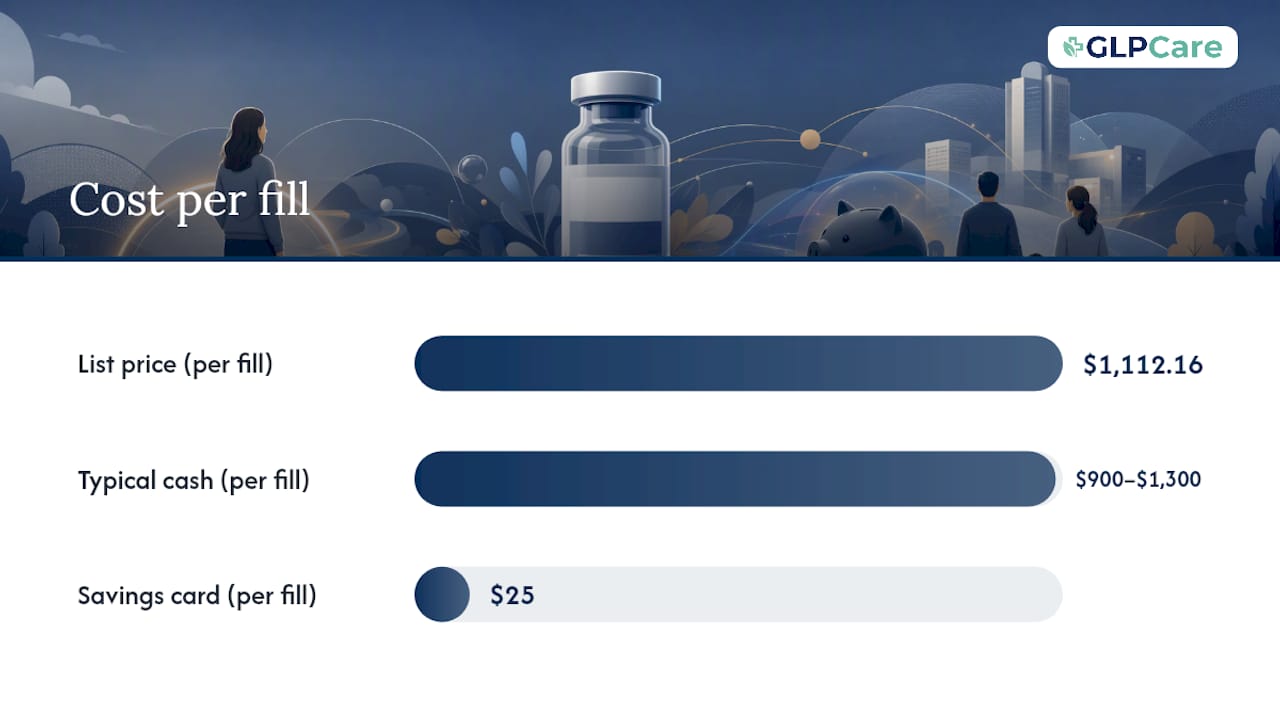
Most U.S. adults filling Mounjaro (tirzepatide) without insurance will see a retail price near Lilly’s published list price of $1,112.16 per fill, which works out to roughly $13,300 per year at list. With a commercial insurance plan and the Mounjaro Savings Card, that same fill can drop to as little as $25. The single fastest way to find your real number: call the member services line on your insurance card and ask whether tirzepatide is on your formulary and what tier it sits on.
What you pay depends on three things: your insurance type, your pharmacy, and whether you qualify for the manufacturer savings program. Government plan members (Medicare, Medicaid, TRICARE, VA) face a very different picture than commercial plan members, and the savings card that changes everything for one group is completely off-limits for the other.
- Retail/list price: ~$1,112 per 28-day fill (four pens)
- With commercial insurance + savings card: as low as $25 per fill
- Uninsured cash price: typically $900–$1,300 per month depending on pharmacy and region
- Government plan members: savings card excluded; cost depends on plan-specific drug coverage
Key Takeaways
Mounjaro’s list price is $1,112.16 per fill, but commercially insured patients with the savings card can pay as little as $25, while government plan members pay based on their specific plan with no access to the manufacturer card.
| Point | Details |
|---|---|
| List price per fill | Lilly’s published WAC is $1,112.16 for a 28-day, four-pen fill. |
| Savings card impact | Eligible commercial plan members may pay as little as $25 per fill; annual caps apply. |
| Government plan exclusion | Medicare, Medicaid, TRICARE, and VA members cannot use the manufacturer savings card. |
| Prior authorization | Most plans require PA before covering Mounjaro; your prescriber submits the documentation. |
| Glpcare next step | Glpcare bundles telehealth prescribing, PA support, and coaching; start with the GLP-1 readiness quiz. |
Table of Contents
- How much does Mounjaro cost per fill and per month?
- How insurance type and prior authorization change your out-of-pocket cost
- Practical savings options, who qualifies, and their limits
- How to find your exact out-of-pocket price
- How does Mounjaro’s cost compare to other GLP-1 medications?
- How integrated GLP-1 care affects adherence and total value
- Glpcare makes GLP-1 care more than a prescription
- Sources
- FAQ
How much does Mounjaro cost per fill and per month?
Understanding the price starts with knowing what “list price” actually means. Lilly’s published wholesale acquisition cost (WAC) for one Mounjaro fill is $1,112.16. That is a manufacturer-to-wholesaler benchmark, not what you hand over at the pharmacy counter. Your actual cost depends on what your insurer has negotiated, which tier Mounjaro sits on, and whether any savings programs apply.
One fill equals four pens and covers 28 days. The math from there is straightforward:
| Time Period | At List Price | Typical Cash Range | With Savings Card (eligible) |
|---|---|---|---|
| Per fill (28 days) | Approximately $1,112 | Varies, commonly reported between $900 and $1,300 | Potentially as low as $25 |
| Per month | Around $1,112 | Varies broadly by pharmacy and region | Potentially as low as $25 |
| — | Estimated based on monthly costs | Varies widely | Depends on program caps |
Two patients on the same dose can pay very different amounts. Dose matters because Mounjaro comes in six strengths (2.5 mg through 15 mg), and some pharmacies price by pen strength. A patient titrating up from 2.5 mg and a patient at their 10 mg maintenance dose are technically on the same drug, but their per-pen cost may differ. Consumer health sources report cash prices commonly ranging from $900 to $1,300 per month depending on pharmacy and region, which is why calling ahead to two or three pharmacies before filling is worth the five minutes.
Independent price analysis makes a useful point: the purchasing route you use matters more than any coupon. The four main routes are commercial insurance with a copay, the savings card layered over commercial insurance, manufacturer self-pay vials for uninsured patients, and standard uninsured retail. Each produces a materially different price floor.
Pro Tip: When comparing quotes from different pharmacies, always ask for the price on the same specific pen strength and quantity (e.g., four 10 mg pens). Prices quoted on different strengths are not comparable.
How insurance type and prior authorization change your out-of-pocket cost
Commercial insurance is where the widest variation lives. Plans handle specialty drugs like Mounjaro through tiers, and tirzepatide typically lands on a specialty or non-preferred tier, which means higher cost-sharing than a generic. Your actual copay or coinsurance depends on your plan’s benefit design:
- Copay plans: a flat dollar amount per fill (often $50–$150 for specialty drugs, before the savings card)
- Coinsurance plans: a percentage of the negotiated price (commonly 20–40% for specialty tiers)
- Deductible phase: before your deductible is met, you may pay the full negotiated rate, which can still be well below list price but is higher than your normal copay
- Out-of-pocket maximum: once you hit your plan’s annual cap, covered drugs cost you nothing for the rest of the benefit year
The Mounjaro Savings Card can reduce your cost-sharing to as little as $25 per fill when you have commercial insurance, but the program carries monthly and annual caps and excludes patients covered by any government-funded plan. Medicare, Medicaid, TRICARE, and VA beneficiaries cannot use the card. Those patients need to work directly with their plan or a patient-assistance program to understand their actual cost.
Statistic callout: The savings card exclusion for government plans affects many Americans, including Medicare beneficiaries, none of whom qualify for the manufacturer savings card.
Medicaid coverage for Mounjaro varies by state. State Medicaid programs set their own formularies and prior-authorization rules, so a Medicaid member in one state may have coverage while a member in another state does not.
Prior authorization (PA) is the other major cost variable. Most commercial plans and many government programs require PA before they will cover a specialty drug. Your prescriber submits clinical documentation confirming your diagnosis, that you meet the plan’s criteria, and that the FDA-approved indication applies. Until PA is approved, you are paying cash price. The PA process typically takes a few days to two weeks, and your prescriber’s office handles most of the paperwork.
Pro Tip: Ask your prescriber to confirm the exact ICD-10 diagnosis code on the PA submission. A mismatch between your diagnosis and the plan’s covered indication is one of the most common reasons for an initial PA denial.
Practical savings options, who qualifies, and their limits
The savings landscape for Mounjaro has a few distinct layers, and knowing which one applies to you is the difference between $25 and $1,100 per fill.
Mounjaro Savings Card (Lilly) The manufacturer savings card is the most impactful option for commercially insured patients. Eligible patients may pay as little as $25 for a 1- or 3-month fill. Monthly and annual caps apply, and the program terms include an expiration notice, so checking current eligibility at Lilly’s savings page before assuming the card still applies to your situation is worth doing. Government plan members (Medicare, Medicaid, TRICARE, VA) are excluded.
Manufacturer self-pay / direct channels For uninsured patients, Lilly’s direct pricing information can set a lower cash floor than standard retail. Checking manufacturer self-pay pricing before assuming compounding or other routes are cheaper is a step many patients skip. The self-pay route bypasses the insurance system entirely and can produce a more predictable monthly cost.
Pharmacy coupons and price-comparison tools GoodRx and similar pharmacy price services show cash-price estimates at local and mail-order pharmacies. These prices fluctuate and vary by zip code, but they give you a real-time market indicator before you fill. GoodRx is not insurance and does not layer over the savings card, but for patients ineligible for the card, it can meaningfully reduce the retail price.
Patient assistance programs NeedyMeds and the PAN Foundation list patient-assistance programs for patients who meet income-based eligibility criteria and are ineligible for manufacturer savings. These programs typically require income documentation and are designed for uninsured or underinsured patients who fall below a household income threshold.
| Savings Route | Who Qualifies | Potential Monthly Cost | Key Limit |
|---|---|---|---|
| Savings card + commercial insurance | Commercially insured, not on government plan | As low as $25 | Annual cap; card expiration |
| Manufacturer self-pay (uninsured) | Uninsured patients | Lower than retail; varies | No insurance can be billed |
| GoodRx / pharmacy coupons | Anyone paying cash | $900–$1,300 range | Cannot combine with savings card |
| Patient assistance (NeedyMeds, PAN) | Income-eligible, uninsured/underinsured | Varies depending on eligibility | Income and eligibility criteria |
How to find your exact out-of-pocket price
No published figure tells you what you will actually pay. Your real number comes from four steps:
-
Call your insurer. Ask member services whether tirzepatide (Mounjaro) is on your formulary, what tier it sits on, and what your copay or coinsurance is for specialty drugs. Also ask whether prior authorization is required and what the covered indication must be.
-
Check cash prices at two or three pharmacies. Ask each pharmacy for the price on a 28-day fill of your specific pen strength. Include at least one mail-order or specialty pharmacy, since prices can differ significantly from retail chains. Healthline’s cost breakdown notes that savings offers can reduce the counter price by several hundred dollars per fill, so the first quote you get is rarely the lowest.
-
Verify savings card eligibility. If you have commercial insurance, check whether you qualify for the Mounjaro Savings Card and whether your pharmacy accepts it. Confirm the current monthly and annual caps before counting on the $25 figure.
-
Ask your prescriber to start prior authorization. If your plan requires PA, your prescriber’s office submits the clinical documentation. Make sure the documented indication matches your plan’s covered criteria. The sooner PA is submitted, the sooner coverage can begin.
Pro Tip: Check your price after your annual deductible resets (typically January 1 for calendar-year plans). Your first fill of the year may cost significantly more than fills later in the year once your deductible is met.
How does Mounjaro’s cost compare to other GLP-1 medications?
The most important thing to understand about GLP-1 pricing is that insurers cover by indication, not by molecule. Tirzepatide is sold as Mounjaro for type 2 diabetes and as Zepbound for weight loss. Semaglutide is sold as Ozempic for diabetes and Wegovy for weight loss. A plan that covers Mounjaro for diabetes may not cover Zepbound for weight loss, even though the active ingredient is the same. Your diagnosis and the specific brand name on the prescription both matter for coverage decisions.
- Mounjaro (tirzepatide, diabetes): list price ~$1,112/fill; savings card available for commercial plans
- Zepbound (tirzepatide, weight loss): similar list price range; separate savings program; coverage depends on whether your plan includes obesity benefits
- Ozempic (semaglutide, diabetes): list price in a comparable range; manufacturer savings card available for eligible commercial patients
- Wegovy (semaglutide, weight loss): list price roughly comparable; coverage for weight loss indication varies widely by employer plan
Two patients on the same milligram dose of tirzepatide can still pay different totals if one receives a pen and the other receives a vial, or if their payer policies treat the two formats differently. Normalizing comparisons to cost per maintenance month at your specific dose gives the most accurate picture.
How integrated GLP-1 care affects adherence and total value
The clinical case for tirzepatide is strong. The drug’s FDA-approved label reflects evidence of meaningful improvements in glycemic control and body weight, and clinical trial data shows tirzepatide producing greater average weight reduction than earlier GLP-1 agents at comparable doses. But medication alone rarely captures the full benefit.
Nutrition support and activity monitoring matter because GLP-1 therapies reduce appetite significantly, and patients who do not maintain adequate protein intake risk losing lean muscle mass alongside fat. Protecting lean mass is not just a cosmetic concern; it affects metabolic rate and long-term weight maintenance. A protein intake calculator can help patients on tirzepatide set a daily target that supports muscle preservation throughout treatment.
Integrated care programs that combine GLP-1 medication with structured nutrition coaching and biometric monitoring tend to support better medication persistence. Patients who stay on therapy longer capture more of the drug’s clinical benefit, which is the real driver of long-term cost-effectiveness.
Employer and payer interest in GLP-1 drugs is growing, with more plan sponsors evaluating how to cover these medications while managing total cost of care. Integrated programs that document outcomes and support adherence are increasingly part of that conversation, because a patient who discontinues therapy after two months captures little of the drug’s benefit while still incurring most of the cost.
Pro Tip: Tracking your sleep, heart rate, and activity alongside your dose schedule gives your clinician a richer picture of how your body is responding, which can inform dose timing and nutrition adjustments that improve outcomes.
A note on how Glpcare approaches cost and access
At Glpcare, we built our program around the reality that medication access is only part of the challenge. Navigating prior authorization, understanding your formulary, and staying consistent with dosing and nutrition are where most patients lose ground. Glpcare’s integrated model pairs compounded tirzepatide options with clinician support, a proprietary wearable for biometric tracking, and an AI-driven app that helps you stay on track between visits. For patients who are unsure how to compare pricing routes or need help with the PA process, our clinical team is part of the program, not an add-on.
Glpcare makes GLP-1 care more than a prescription
If you have spent time comparing Mounjaro prices across pharmacies and insurance tiers, you already know the number alone does not tell the whole story. Glpcare offers a different path: a bundled GLP-1 program that includes telehealth prescribing, clinician support for prior authorization, personalized nutrition coaching, and a medical-grade wearable that tracks the biometrics that matter most during treatment.
The program is designed for U.S. adults who want more than a prescription shipped to their door. Whether you are starting GLP-1 therapy for the first time or looking for better support on an existing regimen, Glpcare’s clinical team works with you on access, adherence, and the nutrition habits that protect your results. Take the GLP-1 readiness quiz to see whether you qualify and to get a clear picture of your next step.
Sources
These are the primary sources and tools to verify pricing, coverage, and assistance eligibility:
- Mounjaro Cost Information | With or Without Insurance | Mounjaro® (tirzepatide) injection
- Savings & Coverage | Mounjaro® (tirzepatide)
- Medicaid
This article provides general information about Mounjaro pricing and coverage and is not a substitute for advice from your prescriber, pharmacist, or insurance plan. Confirm current prices, formulary status, and program eligibility directly with your insurer, pharmacy, and Lilly before making any treatment decisions.
FAQ
How much does Mounjaro cost without insurance?
Without insurance, Mounjaro typically costs $900–$1,300 per month at retail pharmacies, with Lilly’s list price set at about $1,112 per fill. Manufacturer self-pay channels may offer a lower cash floor for uninsured patients.
Who should not take tirzepatide?
Tirzepatide is not appropriate for patients with a personal or family history of medullary thyroid carcinoma or Multiple Endocrine Neoplasia syndrome type 2, among other contraindications listed in the FDA prescribing label. Your prescriber will screen for these before writing a prescription.
How much does Wegovy cost per month?
Wegovy (semaglutide for weight loss) carries a list price in the $1,300–$1,350 range per fill, making it broadly comparable to Mounjaro at list, though insurance coverage for weight-loss indications varies widely by plan.
How much does a two-month supply of Ozempic cost?
Ozempic’s per-fill list price is approximately $900–$1,000, and savings cards and commercial insurance copays can reduce that substantially for eligible patients.
How much does semaglutide injection cost in America?
Brand-name semaglutide (Ozempic or Wegovy) costs roughly $900–$1,350 per monthly fill at list price. Compounded semaglutide from telehealth programs like Glpcare can cost significantly less, though compounded versions are not FDA-approved finished drug products.