Three Channels to Find U.S. Alternatives Fast
Three Channels to Find U.S. Alternatives Fast
The fastest way to find real alternatives is to work three channels at once: alternative-discovery directories for products and software, community threads for the honest, unfiltered take, and domestic substitution lists for travel and retail. Once you know which category you’re replacing, non-U.S. brands, open-source or self-hosted tools, and homegrown substitutes cover almost every case. The examples and checklist below show you exactly how to run that search.
TL;DR:
- Domestic substitutes like Pella’s Tulip Time or Albany’s Tulip Festival offer cheaper, faster options but may not fully replicate international experiences.
- Open-source and self-hosted tools provide greater control and long-term savings but require technical maintenance and responsibility.
- When choosing alternatives, always verify U.S. availability, support policies, privacy terms, and check recent community reviews to avoid discontinued or unsupported products.
- For health and medical options, ensure providers disclose sourcing, licensed clinicians support, and ongoing follow-up rather than relying on simple product swaps.
- Managed GLP-1 programs combine medication with biometric tracking and clinician support, representing a significant improvement over basic prescription-only alternatives.
GlpcareExplore Integrated Weight ManagementGLPCare combines GLP-1 therapy, personalized nutrition coaching, wearable health insights, and ongoing clinician support.Visit GLPCare
Table of Contents
- Where to Look First for Found Alternatives
- How Do You Turn a Need Into a Replacement Strategy?
- Real Examples: Travel and Product Swaps That Actually Work
- How to Evaluate and Choose the Right Alternative
- Applying an Alternatives Mindset to Health and Service Choices
- A Different Kind of Alternative: Managed GLP-1 Care
- Sources
- FAQ
Where to Look First for Found Alternatives
Directories do the sorting work you’d otherwise do by hand across a dozen browser tabs. AlternativesAtlas organizes app and software substitutes side by side, showing pricing tiers and platform support in one view. That matters because a “found” alternative that only runs on Linux, when you need Windows, wastes your afternoon. Find Alternatives works on a bigger scale, cataloging thousands of options across categories with comparison filters, which is useful when you’re not sure what the replacement category even looks like yet.
Broad directories are your starting point. Niche discovery sites take over once you know what you’re optimizing for. Wezebo’s open-source alternative guide and platforms like BestAlternative map popular proprietary tools to credible open-source or self-hosted replacements, which matters most when privacy, licensing costs, or long-term control drive the decision. Choosing between the two types comes down to one question: do you want a ranked comparison, or do you want to know exactly who controls your data once you switch?
Community sources fill the gap directories can’t. Reddit threads, Quora answers, travel blogs, and Facebook groups reflect what actual users experienced after they switched, not just spec-sheet comparisons. The tradeoff is currency. A recommendation from 2021 may point you toward a product that’s been discontinued or a destination that’s changed hands. Vet any community tip against a recent post date and cross-check the claim against at least one other source before you act on it.
A few habits speed up the search itself:
- Search “[product] alternative” plus your state or “USA” to filter for domestic availability.
- Add “open source” or “self-hosted” to your query when control matters more than convenience.
- Check a product’s Wikipedia page for a “similar to” or “competitors” section — it’s often more current than paid directories.
- Use CB Insights-style competitive landscape pages, like this one for the fintech company Found, as a model for how thoroughly a category can be mapped once you know where to look.
Privacy and licensing questions deserve extra scrutiny before you commit. A self-hosted swap gives you more control but also more responsibility. If something breaks, there’s no support line waiting.
How Do You Turn a Need Into a Replacement Strategy?
Every substitution falls into one of four buckets, and picking the right one saves you from re-shopping twice.
Non-U.S. brand swap. This is the most literal replacement: a foreign-made product that does the same job. Check import fees, shipping timelines, and whether a U.S. retail partner already carries it, because ordering direct from overseas can add weeks and unexpected customs charges.
Open-source or self-hosted swap. You trade convenience for control. A self-hosted tool means no subscription fee and no company deciding to shut down the service, but you’re also the one troubleshooting it at 11 p.m.
Local artisans and specialty importers. Buying from a domestic maker or a small specialty importer often costs more upfront, but it shortens the supply chain and gives you a real person to call if something’s wrong. This route tends to fit best when craft quality or ethical sourcing is the actual priority, not just price.
Service or payment model swaps. Direct-pay arrangements, co-ops, and membership models replace the standard subscription or insurance-driven structure. This is common in healthcare, where a direct-pay clinic or a co-op buying group can replace a traditional insurance-gated service. Integrative care models are one example of a payment structure built around this idea.
- Brand swap: fastest, but check shipping and import rules first.
- Open-source swap: cheapest long-term, but you own the maintenance.
- Local/artisan swap: best for ethics and quality, weakest for speed.
- Payment-model swap: best for cost control, requires the most research upfront.
Pro Tip: Before switching a subscription-based service to a co-op or direct-pay model, ask what happens if you need to cancel mid-term. Exit terms vary more than the sales pitch ever mentions.
Real Examples: Travel and Product Swaps That Actually Work
Matching a specific need to a specific U.S. alternative is easier when you see the pattern in action. Here’s how it plays out across travel and everyday products.
- Keukenhof, Netherlands → Pella, Iowa’s Tulip Time. Keukenhof draws visitors with acres of tulip fields, while Pella’s Tulip Time offers the same Dutch heritage and floral displays at a fraction of the travel cost and time. The scale is smaller, and the season is shorter, so plan around early May.
- Amsterdam canal season → Albany, Oregon’s Tulip Festival. The Albany Tulip Festival is another domestic stand-in for a European flower-tourism trip, with easier logistics and no passport required.
- Denmark’s cultural towns → Solvang, California’s Danish Days. Solvang replicates Danish architecture, food, and festival culture in a weekend-trip package rather than a transatlantic one.
- Bavaria, Germany → Leavenworth, Washington. A Bavarian-themed town built around the same festival calendar and architecture, minus the overnight flight.
- A small German village experience → Frankenmuth, Michigan. Frankenmuth offers a similarly immersive, food-and-festival-driven version of German culture in the Midwest.
- A privacy-focused messaging app → an open-source alternative. Search an open-source directory for end-to-end encrypted apps that don’t rely on a single company’s servers.
- A global marketplace → a local boutique or maker’s site. Trade algorithm-driven recommendations for a curated, smaller inventory and often better customer service.
- A big-box online retailer → a specialty direct seller. Categories like coffee, cookware, and outdoor gear often have smaller U.S. sellers offering comparable quality with faster support response times.
A travel-focused breakdown of U.S. alternatives to international destinations makes a point worth repeating here: domestic swaps are usually cheaper and faster to reach, but they rarely replicate every feature of the original. A tulip festival in Iowa is not the Netherlands in April. Set that expectation before you book anything, and the substitute will feel like a win rather than a letdown.
How to Evaluate and Choose the Right Alternative
Once you’ve got two or three candidates, run them through the same five filters every time.
- Fit for the job. Does it actually solve the problem, or just resemble the original on the surface?
- Cost, including hidden fees. Factor in shipping, import duties, or subscription lock-in periods before comparing sticker prices.
- Support and return policy. A product with no return window is a bigger risk than one that costs slightly more.
- Legality and compatibility. Confirm the item or service is legal to import or use in your state, especially for regulated categories like supplements or medical devices.
- Privacy and security. For software swaps, check who owns your data after the switch and whether it’s stored domestically.
Before committing money, run these verification steps: request a trial period if one’s offered, read the return policy in full rather than skimming it, make a small test purchase before a bulk order, and confirm U.S. availability directly with the seller rather than assuming a listing means it ships domestically.
Watch for red flags: no stated return policy, a seller with no verifiable business history, or a product that’s import-only with no domestic parts or repair support.
| Check | Why it matters |
|---|---|
| Trial period available | Reduces risk before full commitment |
| Return policy in writing | Protects you if the fit is wrong |
| Seller verifiable (reviews, business registration) | Confirms legitimacy before payment |
| U.S. availability confirmed | Avoids customs delays or import bans |
| Privacy/data terms reviewed | Matters most for software and health-data swaps |
Applying an Alternatives Mindset to Health and Service Choices
The same discipline applies when the “product” is your health care. An integrated GLP-1 program pairs prescription medication with a wearable band, personalized nutrition coaching, and ongoing clinician support, rather than leaving patients with a prescription and no follow-up.
Health decisions carry more weight than a subscription swap, so the verification bar should be higher, not lower. Confirm any GLP-1 provider uses licensed clinicians, discloses medication sourcing, and offers real follow-up support, not a one-time consultation. Ask what happens between visits. That gap is often where an alternative quietly falls short.
— Dominique
A Different Kind of Alternative: Managed GLP-1 Care
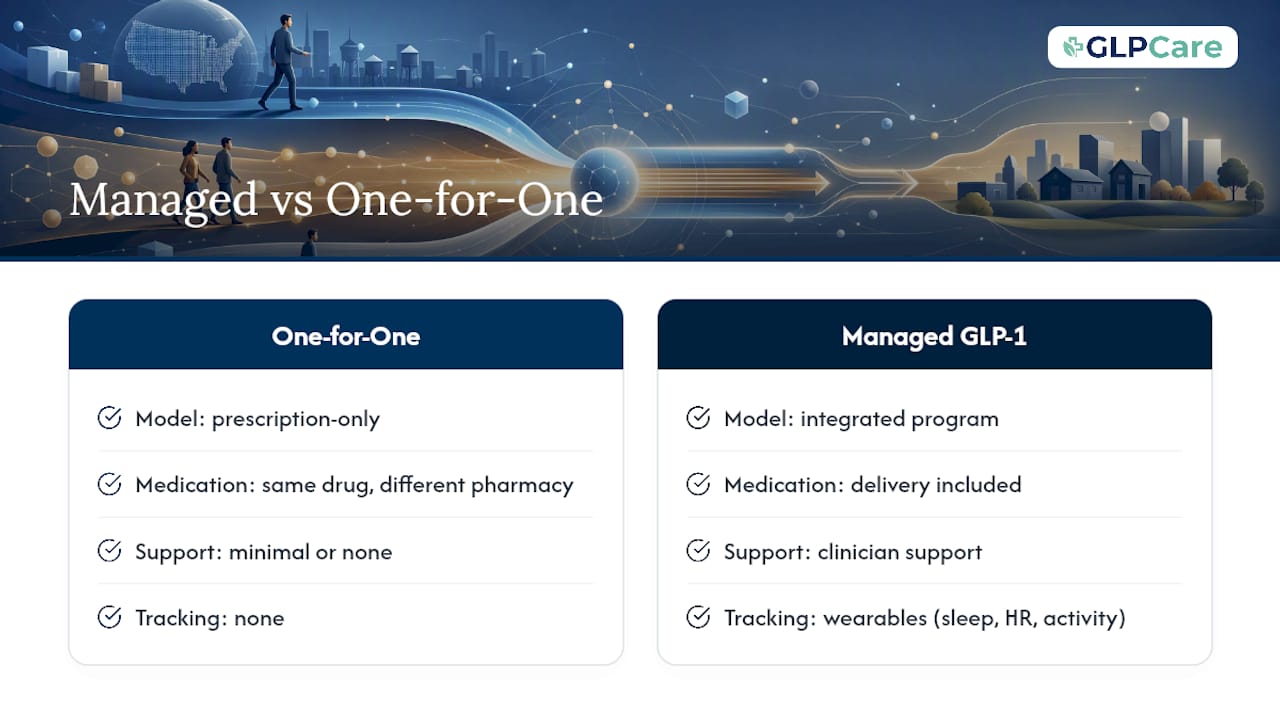
Most of the substitutions in this guide are one-for-one swaps: a different brand, a different app, a different weekend trip. Managed GLP-1 care is a different class of alternative entirely. Instead of replacing one product with another, an integrated system replaces the fragmented, prescription-only model by combining medication delivery, wearable tracking of sleep, heart rate, and activity, and an AI companion connecting daily habits to dosage and progress.
That distinction matters if you’ve been comparing GLP-1 options the way you’d compare two coffee brands. A simple swap gets you the same medication from a different pharmacy. An integrated program includes clinician support and biometric tracking that can flag problems before they show up on a scale. If you’re weighing whether a managed program fits your situation, GLPCare’s readiness quiz takes a few minutes and tells you where you stand. For general research along the way, the free weight-loss and GLP-1 tools page is worth bookmarking before you decide anything.
Sources
A short list of starting points covers most alternative-finding needs:
- Best App & Software Alternatives | AlternativesAtlas
- Discover Your Best Open Source Alternative - Wezebo
- Find AlternativesCompare. Decide. Switch.
Vet every source by date. A directory or forum post from three years ago may point you toward something discontinued.
FAQ
What are some good alternative options when a product gets discontinued?
Start with a directory search using the product name plus “alternative,” then cross-check community threads like Reddit or Quora for real user experiences before buying.
What are some alternatives to a specific destination when it’s too expensive or far away?
Domestic events and towns built around similar themes, such as Pella’s Tulip Time for Keukenhof or Solvang for a Danish cultural trip, usually cost less and require far less planning.
How do I know if an alternative is reliable before I buy it?
Check for a written return policy, verifiable seller history, and confirmed U.S. availability, and make a small test purchase before committing to a larger one.
What could cause someone to need an alternative in the first place?
Price increases, discontinued products, import restrictions, or a service simply not fitting personal needs anymore are the most common triggers for seeking a substitute.
Are there alternatives to standard prescription-only weight management?
Yes. Integrated programs like GLPCare combine prescription GLP-1 medication with wearable tracking and clinician support, which differs from a simple prescription-only model by adding ongoing guidance between visits.